'Alas, Poor Yorick': Who Says It, Which Act, and Whose Skull It Is
Two famous Hamlet scenes get fused into one image. The line, its act and scene, and who actually hands over the skull.


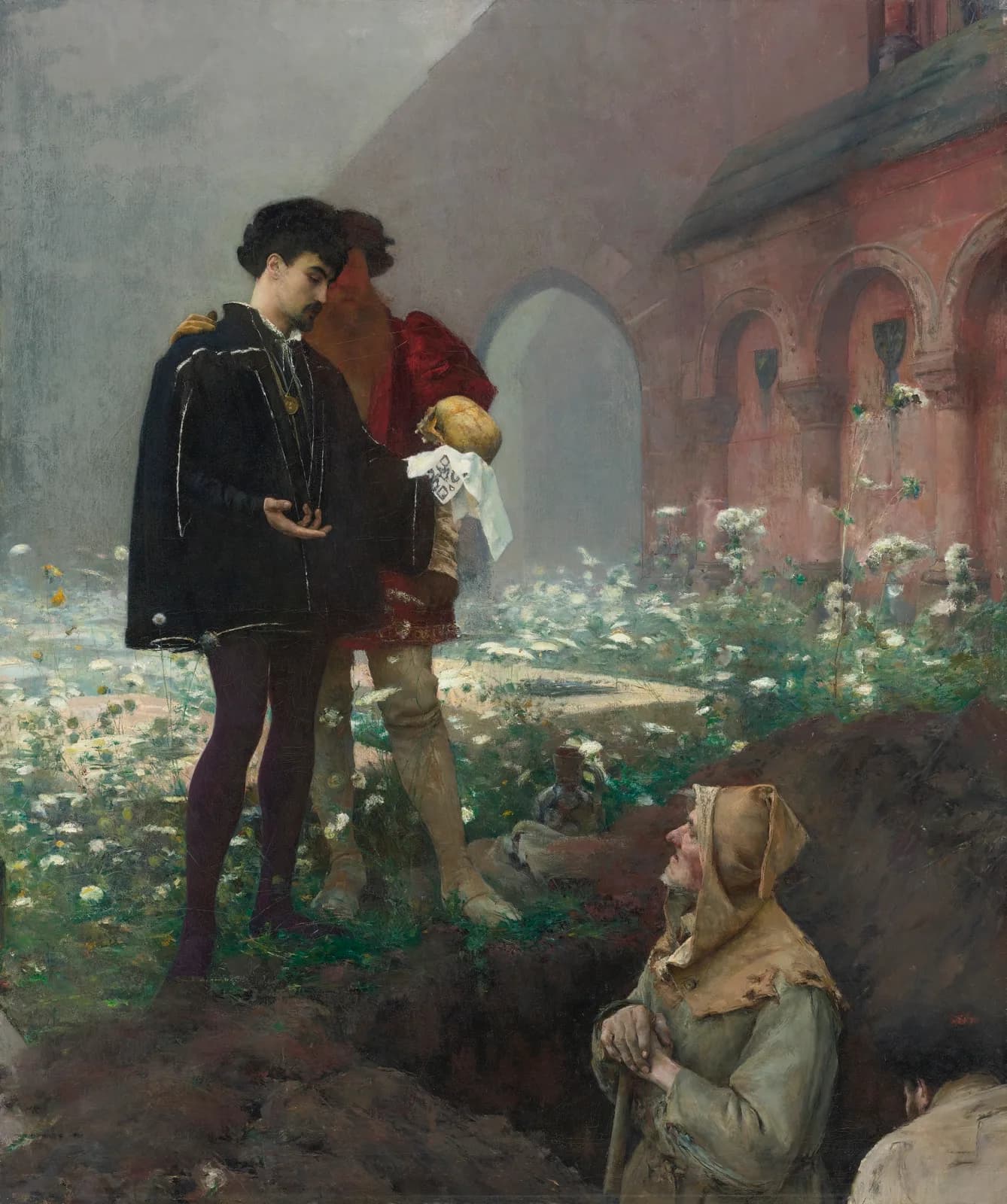
The poster image of Hamlet holding a skull while asking whether to be joins two scenes that sit two acts apart. The graveyard half of that image is a doorway in the playable Hamlet, where the gravediggers are already at work and still singing when you walk in.
💀 Who says “Alas, poor Yorick”, and in which act?
Prince Hamlet says it, to his friend Horatio, in the first scene of the fifth act. He has come back to Denmark and is walking through a churchyard where two gravediggers are digging a fresh grave, one of them tossing up old bones as he works. A search of the whole play for the word “skull” turns up nothing before this scene.
Hamlet first jokes about the anonymous skulls, wondering whether one belonged to a lawyer, before the gravedigger produces one that he says has lain in the earth for three-and-twenty years. Hamlet asks whose it was, and the answer changes the tone of the scene.
🃏 Whose skull it is, and who says so
The gravedigger names the skull, and he takes his time about it. He curses the dead man as a mad rogue, grumbles that the fellow once poured a flagon of Rhenish wine over his head, and only then says whose skull it is. Hamlet, asked to guess, has just admitted he has no idea.
“This same skull, sir, was Yorick’s skull, the King’s jester.”
The king meant here can only be Hamlet’s father, the dead king whose ghost opened the play, since Yorick carried the young prince on his back. He was the court fool of Hamlet’s childhood, and the twenty-three years in the ground place his death far back in the prince’s early boyhood, long before the events of the play.
🎭 The full speech, line by line
Hamlet takes the skull and speaks to it in prose, the register Shakespeare gives him for jokes and private talk, so the speech sounds like a man remembering a friend out loud, with the gravedigger and Horatio standing by.
“Alas, poor Yorick. I knew him, Horatio, a fellow of infinite jest, of most excellent fancy. He hath borne me on his back a thousand times; and now, how abhorred in my imagination it is!”
From there he moves through disgust to memory to a joke. He says his gorge rises at the sight, remembers kissing the lips that hung there, and asks where the jester’s gibes, gambols, songs and flashes of merriment have gone, the ones that used to set the table on a roar. He ends by telling the skull to go to a lady’s chamber and warn her that however thick she paints her face, she will come to this.
🔀 Why the skull ends up in Act 3
Both speeches are famous, both are Hamlet talking about death, and the skull is the easiest prop in the play to put on a poster. Nobody has traced the first production or poster that put the skull in Hamlet’s hand for “To be or not to be”, and any page that names one is guessing. What is easy to see is how the merge happens: posters and parodies need one picture of Hamlet, the skull is the only object anyone remembers, and the soliloquy is the only line anyone remembers, so the two get printed together.
In the text, the Act 3 speech is spoken by a Hamlet who believes he is alone, while Ophelia waits nearby and others listen in hiding. That scene, its staging and what the soliloquy actually asks are covered in the essay on “To be or not to be”, and the reference entry on Yorick places the skull in the graveyard scene as well.
⚱️ What the skull scene is doing in Act 5
The speech turns death from an idea into an object. In Act 3 Hamlet argues with himself about what might come after dying; in the graveyard he holds what actually remains of someone he loved. He goes on to ask Horatio whether Alexander the Great looked like this in the earth, then throws the skull down and imagines the conqueror’s dust stopping a bung-hole in a beer barrel.
The scene also sets up what comes next, because the grave being dug is for Ophelia, and her funeral procession enters a few lines later. The Project Gutenberg text gives the whole exchange in one continuous run, from the first skull to the arrival of the mourners.
- Act and scene: Act 5, Scene 1, a churchyard. The soliloquy is Act 3, Scene 1, with no skull in sight.
- Whose skull:Yorick, the old king’s jester, identified by the gravedigger after twenty-three years in the ground.
- Who is listening: Horatio, the friend Hamlet addresses the speech to, and the gravedigger at his feet.
Sources
- Hamlet (Project Gutenberg eBook #1524) — Project Gutenberg
- Yorick — Wikipedia
- Hamlet, Act 5, Scene 1 — The Complete Works of William Shakespeare (MIT)
- To be, or not to be — Wikipedia
Frequently asked questions
- What does "Alas, poor Yorick" mean?
- It means roughly "Oh, poor Yorick", a cry of pity for a dead friend. The line is also one of the most misquoted in English: people say "Alas, poor Yorick, I knew him well", but the text reads "I knew him, Horatio", because Hamlet is speaking to his friend, not describing how well he knew the jester.
- What does Yorick's skull symbolize in Hamlet?
- Death as the great leveller. After the jester, Hamlet runs the same thought up to emperors and turns it into a rhyme: "Imperious Caesar, dead and turn'd to clay, Might stop a hole to keep the wind away." A fool and a Caesar end as the same material, which is the point he takes from the skull.
- What is the quote from Hamlet about the skull?
- The famous one is "Alas, poor Yorick. I knew him, Horatio". Earlier in the same scene, before he knows whose bones they are, Hamlet watches the gravedigger toss up an unknown skull and says "That skull had a tongue in it, and could sing once", the first of several skull lines in Act 5.
- Who was Yorick in Hamlet?
- The court jester under Hamlet's father, dead for twenty-three years when the play takes place. The gravedigger remembers him without affection: "A pour'd a flagon of Rhenish on my head once", he says, meaning Yorick once emptied a jug of Rhine wine over him as a joke, which is why he calls him a mad rogue.
- Who gives Hamlet the skull?
- The First Gravedigger, who has been sexton "man and boy, thirty years" and began the job on the very day young Hamlet was born. Put together, those lines are the source of the common reading that Hamlet is thirty in Act 5, about seven years old when Yorick died.
Enjoyed this one?