Is Erik the Phantom a Villain or a Tragic Hero?
Leroux does not leave this to the reader. He asks the question out loud on the second-to-last page and answers it four sentences later, and the answer is the surprising half.


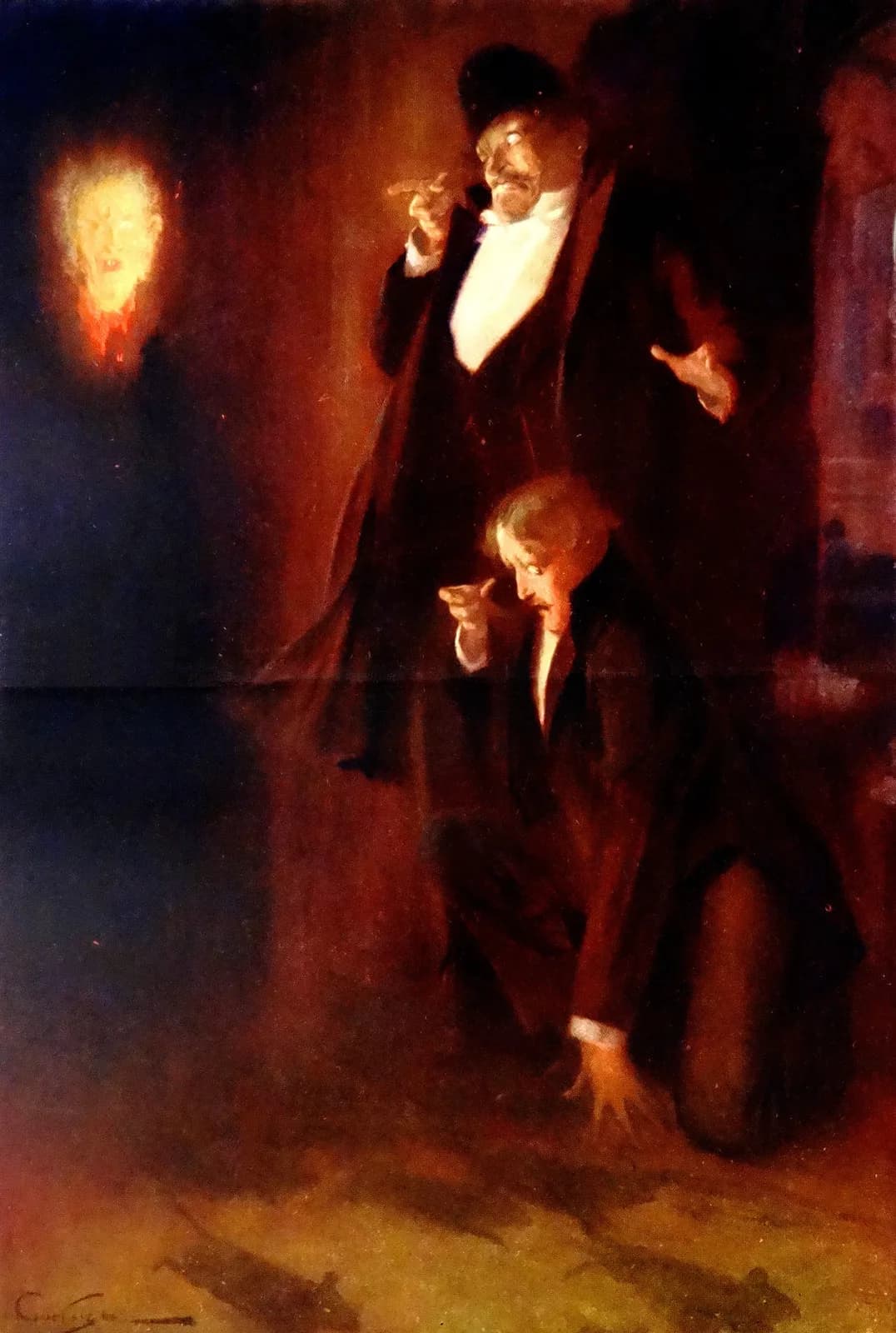
Leroux does not leave this to the reader. He asks the question out loud on the second-to-last page of his own novel, and then, four sentences later, he answers it. The answer is the more surprising half, because of how little the book has done to earn it.
Everything below is quoted from the free Project Gutenberg text, and every pull quote carries its line reference. The same judgement is a doorway in the playable Phantom of the Opera, where you meet him without a narrator standing between you.
Is Erik a villain or a tragic hero?
Erik is written as a murderer and tried as a victim. He extorts the management, abducts the woman he loves, keeps a strangling cord as a signature, and threatens to blow the Opera house up with an audience inside it. He also ran away as a child from parents who could not look at him, and spent years afterwards being exhibited at fairs as a living corpse.
The novel refuses to let either half cancel the other. It is not a book about a misunderstood man, and it is not a book about a monster; it keeps both readings live to the final page and then tells you which one it holds.
What Erik actually does in the book
Worth listing plainly, because the screen versions redistribute this. On the page, the charge sheet is long and almost none of it is proven.
- Joseph Buquet. A scene-shifter is found dead in the cellars early in the book, and the ghost is blamed. Leroux then closes the door on it in a single flat sentence that the rest of the novel never reopens.
- The chandelier. It comes down into the stalls during a performance. The papers of the day, as the novel reports them, record several wounded and one killed. Whether Erik did it is answered directly, and not in the way most readers expect. The real Paris accident the scene is built on has its own essay here.
- Count Philippe de Chagny.Raoul’s elder brother is found drowned on the bank of the underground lake. The Persian accuses Erik of murdering him to his face.
- Persia.This is the one place the book states the killing as fact rather than accusation. In the Shah’s service, the Persian’s account says, Erik took part calmly in a number of political assassinations.
“The truth is that no one ever knew how Joseph Buquet met his death.”
The deaths the text refuses to settle
Read the accusations next to the answers and a pattern shows up. Leroux writes the confrontation over Count Philippe as a courtroom scene with no verdict. The Persian states the charge in eight words. Erik gives an alibi in broken phrases, gasping between them, and calls the death an accident: the count fell very awkwardly into the lake, he says, simply and naturally.
“You lie!”
That is the whole rebuttal. Two words, no evidence, and the novel moves on to Erik’s death without ever returning to it. The reader is left holding an accusation from a man who loathes Erik and a denial from a man who is dying. Leroux could have resolved this in a paragraph, and he declines to do it three separate times, on three separate deaths, which is too consistent to be an oversight and reads instead like the design of the book.
Persia, and what it explains
The backstory arrives in the epilogue, told by the Persian, and it is the only sustained account of Erik’s life the book contains. He was born near Rouen, the son of a master mason. He ran away young because his face was a subject of horror and terror to his own parents. He was shown at fairs as the living corpse. He crossed Europe, learned conjuring from the Gipsies, and ended up at the palace at Mazenderan building rooms the Shah could vanish inside.
Then the part that decides how you read everything before it. Having commissioned the palace, the Shah ordered Erik’s yellow eyes to be put out, and afterwards ordered his death, along with the death of every labourer who had worked on it. Erik survived because the chief of police who had been told to kill him arranged a corpse instead.
None of that excuses the Punjab lasso. What it does is explain where a man learns that the world will use him and then destroy him for knowing too much, which is a fair description of how he behaves under the Opera for the rest of the book.
Leroux asks, then answers
The last page is the most quoted thing in the novel after the mask, and it is quoted in halves. People remember the question. The answer sits four sentences below it.
“Poor, unhappy Erik! Shall we pity him? Shall we curse him? He asked only to be ‘some one,’ like everybody else. But he was too ugly!”
Leroux then writes that Erik had a heart that could have held the empire of the world and had to content himself with a cellar, and finishes: ah, yes, we must needs pity the Opera ghost. That is the book’s verdict, delivered by the narrator who spent the prologue insisting the man was real.
It is worth being honest about where the modern version of this argument comes from. Most of the widely circulated tragic-hero readings of the Phantom are written about screen and stage performances rather than Leroux’s prose, and those versions soften him considerably. The book’s Erik is harder to love and easier to pity, which is a different thing. The essay here on how it ends shows what he does with his last piece of leverage. The full text is free at Project Gutenberg, and the epilogue takes about ten minutes to read.
Sources
Frequently asked questions
- Did Erik drop the chandelier in the book?
- He says not, and nobody ever contradicts him. Asked outright by the Persian, Erik sniggers and answers in capitals that it was not him, that the chandelier was very old and worn, and that it fell of itself. He taunts the Persian about everything else in the same conversation, telling him to go and dry himself and never to get into the boat again, which is what makes the flat denial land strangely.
- What did Erik do in Persia?
- He built the Shah a palace full of hidden passages and then taught the court to kill with it. The detail that fixes the atmosphere is the little sultana, the Shah's favourite, who was bored enough that she learned to wield the Punjab lasso herself and killed several of her own women with it for entertainment.
- Why does the novel call Erik's ugliness a compensation?
- Because the Persian frames his talents as a trade. Erik's extraordinary gifts of dexterity and imagination, he says, were received by way of compensation for his extraordinary ugliness, and Erik used them to prey on other people because he believed himself outside the human race entirely. It is the closest thing the book has to a diagnosis.
- Does Erik ever show remorse?
- Not for the deaths. He had already given his account of Count Philippe at the lake; by the time he reaches the Persian's flat, dying, he refuses to return to the subject at all, and what he wants to talk about instead is that Christine let him kiss her while she was alive. It was the first time, he says twice, breaking the sentence in half, that he had ever kissed a woman.
- Why does Erik live under the Opera house?
- Because he helped build it. After Persia and Constantinople he came back to France as an ordinary building contractor, tendered for part of the Opera's foundations, and had his estimate accepted. He was down in the cellars legitimately, on a contract, before he ever decided to stay.
Enjoyed this one?