Is The Phantom of the Opera Based on a True Story?
Leroux opens by saying the Opera ghost was a real man and that he has the documents to prove it. Two of the strangest details in the book turn out to be the true ones.


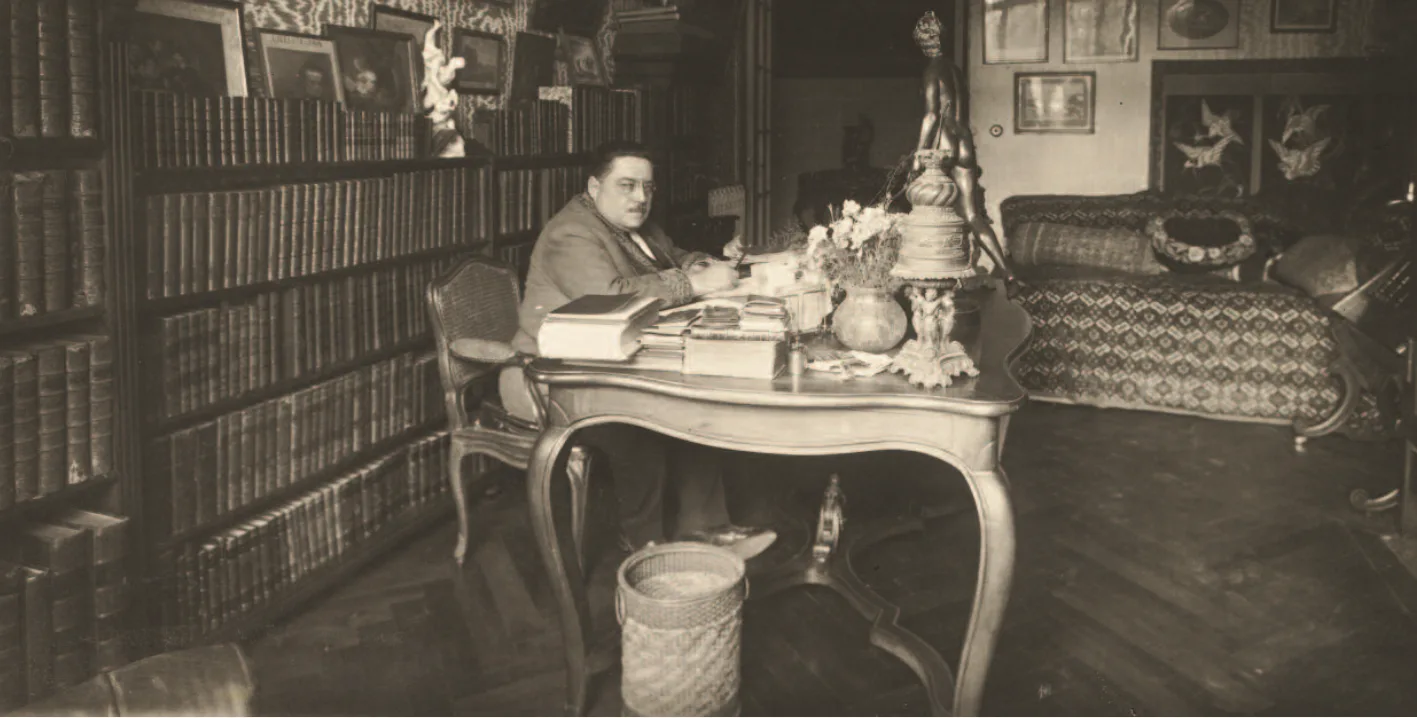
Leroux does not open his novel by saying once upon a time. He opens by saying the Opera ghost was a real man, that he has the documents, and that he intends to put them in the archives. Then he spends the rest of the novel making that claim untrue.
Quotations from the novel below come from the free Project Gutenberg text, and every pull quote carries its line reference; the Paris history is sourced to named outlets at the foot of the page. The building itself is playable here, cellars and all.
Is it based on a true story?
The Phantom is fiction wearing a documentary coat. Leroux was a working reporter before he was a novelist, and the book is built the way a piece of reporting is built: archives, named witnesses, a manuscript from a source, a body. None of which makes any of it true.
What is true is the setting, and the setting turns out to be stranger than the invention. Two of the elements readers assume are the most obviously made-up parts of the story are the two that were sitting in the building the whole time.
Leroux opens by swearing it happened
“The Opera ghost really existed.”
He keeps it up for the length of the book. In the prologue he calls what follows a dreadful and veracious story. In the epilogue he says he has now told the singular but veracious story of the Opera ghost. Veracious means truthful, and he uses the word as a hinge at both ends of the novel so the reader never quite settles.
This is a genre device and it was not unusual in 1910. A narrator who insists on his sources buys himself room for the parts that cannot be sourced. The interesting question is not whether Leroux was lying. It is which bits he did not have to invent.
The Night of the Chandelier is a doorway in the playable Phantom of the Opera: the house is full, the fixture above the stalls is two hundred kilos of bronze and crystal, and what you do in the seconds before it moves is up to you. Role-play The Phantom of the Opera →
What is actually real
- The accident.In 1896 a counterweight holding the Palais Garnier’s chandelier broke loose and came through the auditorium ceiling during a performance. One person was killed. Wikipedia’s own account of the building states outright that the incident inspired the corresponding scene in Leroux’s novel.
- The lake. There is water under the Paris Opera. Leroux calls it a lake and the engineers call it a cistern, and it is still there. French firefighters train in it, swimming in the dark.
- The year. The novel is pinned to real Paris history. It refers to the events of 1870 interrupting work on the Opera building, and its narrator claims to know where the people massacred under the Commune in the cellars were buried.
The accident is the detail worth sitting with. In the novel, the chandelier comes down into the stalls and kills the woman the management had just appointed to take over Mme. Giry’s job as the ghost’s box-keeper. Leroux then prints the morning paper’s headline, and it names her by her job rather than her name.
“TWO HUNDRED KILOS ON THE HEAD OF A CONCIERGE”
The person killed in the real 1896 accident was a concierge as well. Leroux borrowed the victim along with the event, gave her a role inside his plot, and wrote her an epitaph in newspaper capitals. That is the method of the whole book in one paragraph: take something the archive already contains, and put a ghost behind it.
What Leroux invented
Erik, entirely. The epilogue gives him a full biography told by the Persian, which is the closest the novel comes to a true-crime file: born near Rouen, son of a master mason, run out of his own home young because his parents could not stand his face, exhibited at fairs as a living corpse, then Persia, then Constantinople, then the Opera. It is detailed, it is dated, and there is no record of any of it.
The tidiest way to see the seam is to notice what the fictional half does with the factual half. The cistern becomes a lake with a boat on it. The falling counterweight becomes an act of will. A separate essay here deals with what Erik says about that, which is not what most readers expect.
The songs are not in the book
Worth stating plainly because it is the single most common assumption readers arrive with. Music of the Night, Think of Me, All I Ask of You, Masquerade: every one of them was written for Andrew Lloyd Webber’s stage musical and none of them exists in Leroux’s text in any form.
The novel’s equivalent is quieter and considerably worse for Christine. She hears a voice through the wall of her dressing room before she ever sees a person, and she is told it is an angel. The essay here on the three of them follows what that does to her. If you want the songs, the stage version has them and the book never will; the three-way comparison is here. The novel itself is free at Project Gutenberg.
Sources
- The Phantom of the Opera (Project Gutenberg text, Teixeira de Mattos translation) — Project Gutenberg
- Palais Garnier — Wikipedia
- Discover the real history behind The Phantom of the Opera — New York Theatre Guide
- The Phantom of the Opera (novel) — Wikipedia
- Gaston Leroux — Wikipedia
Frequently asked questions
- Did a real chandelier accident happen at the Paris Opera?
- On 20 May 1896, during a performance of the opera Helle, one of the counterweights holding the Palais Garnier's chandelier broke loose and came through the auditorium ceiling. The chandelier itself did not fall, which is the detail the stage version changes. A concierge was killed and several people were injured.
- Is there a real underground lake under the Paris Opera?
- There is a real water tank, and it was an engineering answer rather than a flourish. Groundwater kept flooding the site while the foundations were being laid, so the builders enclosed it instead of fighting it. The result is still down there, and French firefighters use it to practise swimming in the dark.
- What inspired Gaston Leroux to write The Phantom of the Opera?
- His day job, more than any single legend. Leroux worked as a court reporter and theatre critic for L'Echo de Paris from 1890 and then as an international correspondent for Le Matin from 1893, and only left journalism in 1907. The novel is built like a filed story.
- Is Music of the Night in the book?
- No. There is no song by that name or any other in Leroux's text. What the novel gives Erik instead is an organ whose keyboard fills one entire side of his underground room, and the music Christine hears him working on down there is a Mass for the dead rather than a love song.
- When was The Phantom of the Opera published?
- It ran as a newspaper serial in Le Gaulois from 23 September 1909 to 8 January 1910, then appeared as a book in late March 1910. The first English translation followed in 1911, which is the version nearly every English reader has met, and the one free at Project Gutenberg today.
Enjoyed this one?