Is Jia Baoyu a Bad Protagonist? The Case For and Against the Boy Who Smashes His Jade
The first thing the hero of this novel does when he meets the person he will love for the rest of the book is throw a screaming fit and try to destroy the object he was born holding.


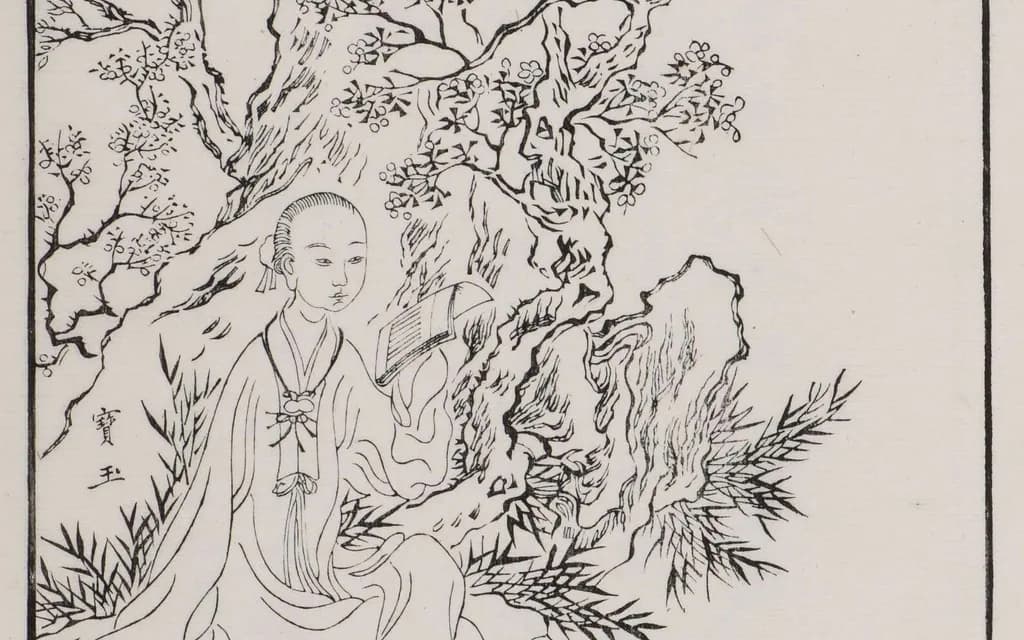
The first thing the hero of this novel does when he meets the person he will love for the rest of the book is throw a screaming fit and try to destroy the object he was born holding. He is about twelve. Two centuries of readers have been arguing about him ever since, and the argument is currently loud enough that search engines fill in the words "worst" and "hate" after his name.
The useful thing about that argument is that Cao Xueqin got there first. Chapter three plants two mocking verses about Baoyu, in the form of a pair of poems set to the tune Xijiang Yue, and they say everything his critics say. A novel that insults its own protagonist on the page where he walks in knows exactly what it is doing.
- He refuses every path his world offers a man: the examinations, official rank, the family business, the marriage market.
- He is not idle.He writes, he reads plays he is forbidden to read, and he takes the emotional lives of the household's women more seriously than anyone else in the book does.
- The jade is the frame story. He is a stone that asked to be born into the world, and the jade around his neck is that stone made portable.
- The novel argues with itself about him, in the text, from chapter three onward. Both sides of the modern argument are already in the book.
The rest of this is the evidence on both sides. If you would rather test him yourself, the playable Dream of the Red Chamber lets you walk into the great house as the cousin he is about to meet, and decide what you make of him in the room.
⚖️ The short answer: readers are split for a reason
Because the novel gives you the material for both verdicts and refuses to choose. The case against is that he is a pampered heir who will not study, will not take office, will not carry the family that feeds him, and cries a great deal.
The case for is that his world's idea of a successful man is precisely what the novel is watching collapse, and he is the only person in it who declines to participate. Here is how the book itself opens the prosecution, in a translation that has been out of copyright since before most of the current arguments started.
Addled his brain that nothing he could see; a dunce! to read essays so loth to be! Perverse in bearing, in temper wayward; for human censure he had no regard.
Those lines are not a critic's. They are inside the novel, presented as verses composed about Baoyu by a later poet, dropped in the moment he walks on stage. Every modern complaint about him is a paraphrase of a poem the book supplies for free, which is a strange thing for an author to do unless the complaint is the point.
💎 The scene that defines him, in chapter three
It takes about four lines of dialogue. Lin Daiyu has just arrived at the great house, orphaned and dependent. Baoyu, meeting her for the first time, asks whether she has a jade. She reasons that he asks because he has one himself, says she has not, and adds that his is a rare thing nobody could be expected to own. That is when he detonates.
"Rare object, indeed!" he shouted, as he heaped invective on it; "it has no idea how to discriminate the excellent from the mean, among human beings; and do tell me, has it any perception or not? I too can do without this rubbish!"
Read it as a tantrum and it is a tantrum. Read it as an argument and it is the argument the whole novel will make: an object that has been treated as proof of his worth turns out to have no judgement at all, since it cannot tell that the person who lacks one is the better of the two. He is twelve, and he has just worked out that his own distinction is arbitrary. His grandmother catches him and calls the jade the stem of his life, which is the household's view of the matter and the opposite of his.
The scene also sets the pattern for everything that follows. Baoyu's attachments are instant, total and physically expressed; his household's response is to manage him rather than answer him; and the thing he wants is never the thing he is offered. He and Daiyu spend the next fifty chapters reading forbidden plays together in chapter twenty-three, quarrelling, and understanding each other better than anyone else in the book manages to. How that resolves is the whole of the last quarter, and it is set out in a separate piece that discusses the ending openly, if you do not mind knowing.
🪨 What the jade actually is
It is the novel's frame story in portable form. The book opens before the family, with a stone left over when the goddess Nüwa repaired the sky, conscious, useless and aggrieved at being the one piece not chosen. It persuades a Buddhist monk and a Taoist priest to let it experience the mortal world.
It is then born into the Jia family as a boy with a piece of luminous jade in his mouth, and named Precious Jade. Two consequences follow, and both change how the smashing scene reads. The first is that the novel's alternative title, the one David Hawkes chose for his English version, is The Story of the Stone, because the stone is the protagonist and the surface of a family drama is what it came down here to look at. The second is that when Baoyu throws the jade on the floor, he is throwing himself, and the household's panic is not superstition.
The surname helps too. Jia is a homophone for the Chinese word meaning false, and the novel deliberately supplies a second family called Zhen, a homophone for real, complete with a boy of its own who mirrors Baoyu. A book that names its central family False and gives it a double called Real is telling you what kind of object it is before the plot starts.
🌊 The counter-case his own author builds
The defence is that Baoyu is the only person in the novel who values the people the novel is actually about. The household runs on the labour, marriages and reputations of its women, and treats almost all of them as instruments. Baoyu does not, and the book states his position long before anyone can accuse it of being modern about it.
Chapter two has a visitor reporting, as evidence that the boy is peculiar, what he goes around saying.
The bones and flesh of woman, he argues, are made of water, while those of man of mud.
Wikipedia summarises the same position in blunter modern English: that the essence of human nature is concentrated in women, while men are merely the dross. Either way, it is being reported by a man who thinks it proves the child will grow up dissolute. That framing is the joke. The novel hands its hero's central conviction to a hostile witness, and then spends eighty chapters demonstrating that the witness is wrong about what it means.
None of that makes him a comfortable protagonist. He is passive where a Western nineteenth- century hero would act, he is cruel to people who love him, and his refusal costs other people more than it costs him, which chapter thirty-three makes explicit when his father beats him almost to death and the household absorbs the damage. None of it reads as an authorial error. The strongest reading is that Cao Xueqin wrote a hero designed to fail his own society's test so that you would have to decide whether the test was worth passing.
Chapter twenty-three is the best evidence for the defence, and it is easy to miss because almost nothing happens in it. Baoyu's page brings him a stack of plays the household considers unsuitable, with strict instructions not to take them into the garden. He takes one into the garden. Sitting on a rock under the peach trees with a copy of the Western Wing romance, he reaches a line about fallen blossom lying in drifts, and the wind obliges.
Pao-yü was bent upon shaking them down; but as he feared lest they should be trodden under foot, he felt constrained to carry the petals in his coat and walk to the bank of the pond and throw them into the stream.
A boy accused of doing nothing with his life gathers fallen flowers into his coat so nobody will step on them. Daiyu finds him doing it, tells him the stream will only carry them somewhere filthier, and shows him the grave she has dug for hers. That is the whole case for Baoyu in one afternoon, and it is also the moment the novel quietly hands the argument over to her.
Joly's English of these chapters is free at Project Gutenberg, and the Chinese text is there too. If you have not started the novel yet, the case for it and the cast problem are here, and the person who actually runs the house Baoyu is failing to inherit is worth an essay of her own.
Sources
- 紅樓夢 (Chinese text, 120-chapter Cheng-Gao edition) — Project Gutenberg
- Hung Lou Meng, Book I (H. Bencraft Joly translation) — Project Gutenberg
- Dream of the Red Chamber — Wikipedia
Frequently asked questions
- Is Jia Baoyu a good protagonist?
- He is a deliberately annoying one. Chapter three plants two mocking verses about him, in the form of a pair of poems to the tune Xijiang Yue, calling him useless, unteachable and a disgrace to his family. The novel gets its objections in first and then spends a hundred and seventeen chapters arguing with them. Whether that lands depends on how much patience you have for a hero who never grows up.
- Why does Jia Baoyu smash his jade when he meets Daiyu?
- Because she does not have one. He was born with a piece of luminous jade in his mouth, and the household has treated it as proof he is special since the day he arrived. When the newly arrived cousin he has just decided he loves says she has no such thing, the object stops being a distinction and becomes a wall between them, so he tries to destroy it. It happens in chapter three.
- What does Baoyu's jade symbolise?
- It is the frame story made portable, and unlike most symbols it has terms written on it. In chapter eight the characters read the inscription aloud: never lose it, never forget it, and immortal life and lasting blessing will follow. What the household treats as a lucky charm is closer to a contract, and every scene in which the jade is mishandled is the novel reminding you of the wording.
- What does the name Jia Baoyu mean?
- Precious Jade, which is what he was born holding. The surname Jia is a homophone for the Chinese word meaning false or fictitious, and the novel uses that pun deliberately: a second family called Zhen, a homophone for real, turns up with a boy of its own. Roughly, the name is said jyah bao-yoo.
- Does Jia Baoyu love Lin Daiyu?
- Yes, and the novel is never coy about it: they are raised in the same house, read forbidden plays together in chapter twenty-three, and understand each other better than anyone else in the book does. How that resolves is the subject of a separate essay in this series, which discusses the ending openly. The playable version lets you walk eighteen scenes of the same story yourself.
Enjoyed this one?