Wang Xifeng: the Best-Written Character in Dream of the Red Chamber, and the Hardest to Like
Readers who find the rest of this cast slow-moving usually love her first. She is the funniest person in the book, the most competent, and the one doing the most harm.


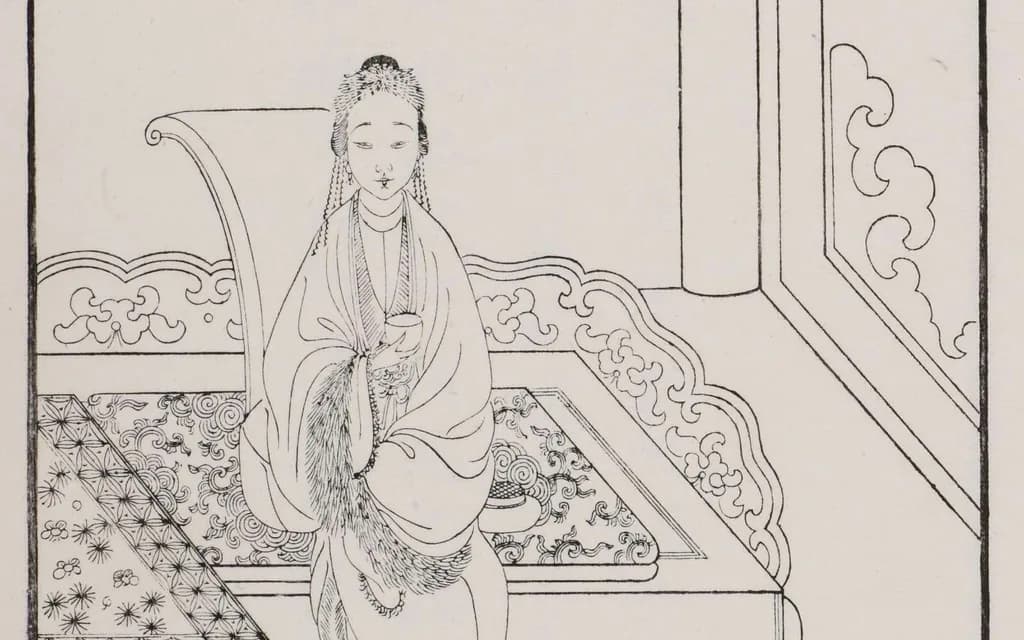
Readers who find the rest of this cast slow-moving almost always love Wang Xifeng first. She is the funniest person in the novel, the most competent, and the one doing the most damage, and the book presents all three facts without ever telling you how to weigh them. She is somewhere in her early twenties and she runs an aristocratic household of several hundred people.
Her formal name means something like splendid phoenix. What the household calls her, on her grandmother-in-law's own instruction in chapter three, is Feng the Pepper, for a tongue that burns going down. Joly's Victorian translation renders the word as vixen, which loses the heat and keeps the warning.
- She runs the money. Household accounts, wages, purchasing and, quietly, a private lending operation her own husband knows nothing about.
- Chapter thirteen is her set piece. A rival branch of the family borrows her to run a funeral it cannot manage itself.
- She is genuinely dangerous. Two chapters put her name in the title and a corpse at the end of the chapter.
- Modern China reads her as a manager.There is a small shelf of Chinese business books using her as a case study, which is not a joke at the novel's expense.
The rest of this is the evidence, mostly from two chapters. If you would rather run the household than read about it, the playable Dream of the Red Chamber hands you her hardest week directly.
🔥 The short answer: she is the engine of the household
Because she is the only person in the book who does work, and the novel is honest about what that costs everyone including her. Around her, the Jia family conducts poetry competitions, loses money it does not track, and treats its own decline as a rumour.
Xifeng keeps the accounts, pays the staff, settles the disputes and takes a cut, and she is the reason the house stays standing for as long as it does. The place in the family tree explains the power. She is married to Jia Lian of the Rongguo house, and her aunt is Lady Wang, Baoyu's mother, so she is related to the people she manages twice over. In a household run by seniority, being the niece of the woman above you and the wife of the man beside you is not a small thing. Chapter five counts her among the twelve women whose fates the novel writes down in advance.
👁️ The entrance, and the eyes
She is introduced by sound before she is introduced by sight, which is the single best character entrance in the novel. Daiyu has just arrived at a house where everyone is being careful and quiet, and a voice comes through the door laughing and apologising for being late. Only then does the narrator get round to describing her, and the description is a diagnosis.
She had a pair of eyes, triangular in shape like those of the red phoenix, two eyebrows, curved upwards at each temple, like willow leaves. Her stature was elegant; her figure graceful; her powdered face like dawning spring, majestic, yet not haughty. Her carnation lips, long before they parted, betrayed a smile.
Phoenix eyes, in the physiognomy the original readers carried around with them, mean intelligence and force of will rather than sweetness; upswept brows say the same. The face is being read out to you as a warning before she has spoken a line, and the last clause is the one that does the work, because a smile that arrives before the words is a smile that is deployed rather than felt.
Then she speaks, and the performance is flawless. She holds the newly orphaned Daiyu's hands, admires her, weeps for her dead mother, stops weeping the instant her grandmother-in-law signals that enough is enough, and moves straight to practical questions about the girl's luggage and medicine. Every emotion in that sequence is real and every one of them is timed.
📋 Chapter thirteen: the job nobody else can do
Qin Keqing of the senior Ningguo house dies, and her father-in-law Jia Zhen comes to the other mansion to borrow Xifeng for a month, because his own household cannot bury its daughter-in-law without embarrassing itself. Lady Wang objects on the sensible grounds that Xifeng is young and has never handled a funeral, and that if she makes a mess of it people will laugh.
Jia Zhen answers that she had decisiveness in her games as a child, that she has been running a house since her marriage, and that apart from her there is nobody. The narrator then tells you what she is actually feeling, and it is not modesty. She has always loved taking things on and showing off what she can do; she has never yet been given a wedding or a funeral to run and has been quietly afraid that people would not submit to her; and she has been waiting for exactly this. She accepts before Lady Wang has finished objecting.
What she does next is why the business books exist. She sits down alone in the receiving room of a house she has no authority over and writes out what is wrong with it, in five points: too many people mixed together, so things go missing; no one responsible for anything, so when the moment comes they all pass it along; expenses uncontrolled, with funds drawn and claimed at will; duties handed out without regard to their size, so the hardship and the ease fall unevenly; and servants who cannot be governed, the ones with standing refusing to be checked and the ones without unable to rise.
That is an operational audit of a failing organisation, written in the 1750s, by a woman in her early twenties who has been in the building for an hour. She then fixes all five by assigning named individuals to named tasks with named consequences, and the funeral goes off perfectly. Cao Xueqin closes the chapter on a couplet that is close to a thesis statement.
Thousands in gold and purple, and which of them governs the realm? One or two in skirt and hairpin can put a household in order.
The sinologist Annie Ren, writing in China Heritage, has noted how thoroughly modern China has taken that reading up: recent Chinese publications include titles along the lines of Wang Xi-feng is the Best CEO and Learn Management from Wang Xi-feng: how to become a female leader. It sounds like a gag until you read chapter thirteen and realise the material is genuinely there.
🗡️ The part the praise usually skips
The same chapter that shows her competence shows her appetite, and the novel spends the rest of its length making you pay for having enjoyed her. Chapter sixteen is the small, exact scene that gives the game away: her maid Ping'er intercepts a delivery of interest silver and hides it, because if Jia Lian sees it he will ask what interest, and Xifeng will not be able to lie to her own husband about the fact that she has been lending the household's money out.
The novel does not editorialise. It just shows you the maid deciding. The rest is worse. Two chapters put her name in the title and a corpse at the end. Chapter twelve is called, in the Chinese, a vicious love-trap laid by Wang Xifeng, and the cousin who propositioned her is dead before it closes. Chapter sixty-nine is blunter still, titling itself with the phrase for borrowing a sword to kill; the woman on the other end of that arrangement swallows gold rather than continue. She is not a bad-tempered manager. She is a person who removes obstacles.
And the largest thing she does is the plan that runs the novel's last quarter, which she proposes, argues for and executes on the family's behalf. It is the most consequential decision anyone in the book makes, and it is hers. The essay on the ending sets it out in full, if you do not mind knowing what happens.
What keeps her from being a villain is that the novel never lets you separate the two halves. The talent that runs the funeral is the talent that runs the trap. The energy that saves the household is the energy that spends it. A lesser book would give her a moment of remorse and square the account. This one gives her a fate in chapter five, a great deal of laughter, and no verdict at all.
Chapter three and chapter thirteen are both inside the free English translation at Project Gutenberg, and the Chinese text every chapter number here was checked against is there as well. If you are still deciding whether to start, the case for the novel and its cast problem is here, and the person she spends the book managing is the argument nobody settles.
Sources
- 紅樓夢 (Chinese text, 120-chapter Cheng-Gao edition) — Project Gutenberg
- Hung Lou Meng, Book I (H. Bencraft Joly translation) — Project Gutenberg
- Wang Xi-feng's Guide to Success in Modern China — China Heritage
- Dream of the Red Chamber — Wikipedia
Frequently asked questions
- Who is Wang Xifeng in Dream of the Red Chamber?
- She is the wife of Jia Lian and the effective manager of the Rongguo house, and she is related to the family twice over: her aunt is Lady Wang, Baoyu's mother, which is how a woman in her early twenties comes to be running an aristocratic household of hundreds. Chapter five counts her among the twelve women whose fates the novel sets out in advance.
- Why is Wang Xifeng considered the best-written character?
- Because she is the only person in the book who is consistently funny, consistently competent and consistently dangerous, and the novel never resolves that into a verdict. The household nicknames her Feng the Pepper, La Zi, for a tongue that burns; her formal name, Xifeng, means something like splendid phoenix. She talks more than anyone and reveals less.
- What does phoenix eyes mean?
- Eyes shaped like the red phoenix, dan feng san jiao yan, which in Chinese face-reading signal force of will rather than sweetness. The bird follows her around. Chapter five's verse about her opens with a character riddle, stacking the words for ordinary and bird to make the phoenix in her own name, and places her deliberately in what it calls the last age, meaning a family already on its way down.
- Is Wang Xifeng a villain?
- Not simply, and the novel gives her one chance to prove it. In chapter thirteen the dying Qin Keqing comes to her and says that when the tree falls the monkeys scatter, then advises her to buy farmland near the ancestral graves now, while the family is rich, so the rites and the family school stay funded when the fall comes and a confiscation cannot reach them. Xifeng hears her clearly. She never does it.
- Why do Chinese business books use Wang Xifeng as an example?
- Because her chapter-thirteen assignment reads like a management case study. The sinologist Annie Ren, writing in China Heritage, notes that recent Chinese publications include titles along the lines of Wang Xi-feng is the Best CEO and Learn Management from Wang Xi-feng, reading her as a model of operational competence inside a failing institution.
Enjoyed this one?