Daiyu vs Baochai: the Debate Every Reader of Dream of the Red Chamber Ends Up In
Two centuries of readers have picked a side. The novel refuses to, and the way it refuses is the reason the last twenty-five chapters hurt.


Spoilers for the whole of Dream of the Red Chamber, including chapters 96 to 98 and how the novel ends for all three of the people in it.
Every reader of this novel ends up on a side, and the sides have names. Team Daiyu is for the cousin who arrives orphaned in chapter three, writes the best poetry in the book and cries at everything. Team Baochai is for the cousin who arrives with money, good sense and perfect manners, and never once says the wrong thing. The argument has been running for two hundred years and it is currently being had, in enormous volume, in Chinese.
What makes it worth having is that it is not a preference. The choice is built into the architecture of the book: chapter five, which is certainly Cao Xueqin's work, writes the outcome down in advance, and the chapters that deliver it were finished by somebody else after his death. Whichever side you pick, you lose.
- Daiyu is the soulmate. The frame story gives her and Baoyu a debt contracted before either was born, and the novel never lets you doubt they belong together.
- Baochai is the correct choice. Not the villain, and not stupid: the person any functioning family in that world would pick, for reasons the book takes seriously.
- The family chooses Baochai, by deception. Chapter ninety-six calls the plan, in its own title, a scheme to conceal the news.
- Nobody wins. Daiyu dies in chapter ninety-eight, the marriage fails, and Baoyu walks out of the world in chapter one hundred and nineteen.
Everything below is how the book gets there. If you would rather stand inside the scene than read about it, the playable Dream of the Red Chamber puts the wedding in your hands, on either side of the veil.
💔 The short answer: it is the book's argument, not a fandom
Because the two women are not rivals for one man's affection so much as two answers to the question the novel is actually asking, which is what a person owes the family that made them. Daiyu is what Baoyu wants. Baochai is what the Jia household needs. The book agrees with him and sides with them, and that contradiction is the plot.
The chapter-five songs put it in fourteen characters, in a line that occurs exactly once in the whole novel.
Everyone speaks of the match of gold and jade; I think only of the old vow between the wood and the stone.
Gold and jade is Baochai. She wears a gold locket whose inscription is said to pair with the one on Baoyu's jade, and the household repeats the pairing until it becomes a fact about the world. Wood and stone is Daiyu, and it is older than either of them. Chapter one has a Crimson Pearl Plant growing beside a sacred river, kept alive by a Stone-in-Waiting who watered it daily with sweet dew, and when the stone decides to be born into the world she decides to follow.
He gave me the grace of sweet dew and I have no such water to return. Since he goes down into the world as a man, I will go down as a woman, and repay him with all the tears of one lifetime.
That is the contract Daiyu is fulfilling every time she weeps, which is often. Readers who find her exhausting are reading her as a temperament. The novel means her as a debt being paid off, and the debt runs out when the tears do.
🌸 The scene that makes people Team Daiyu
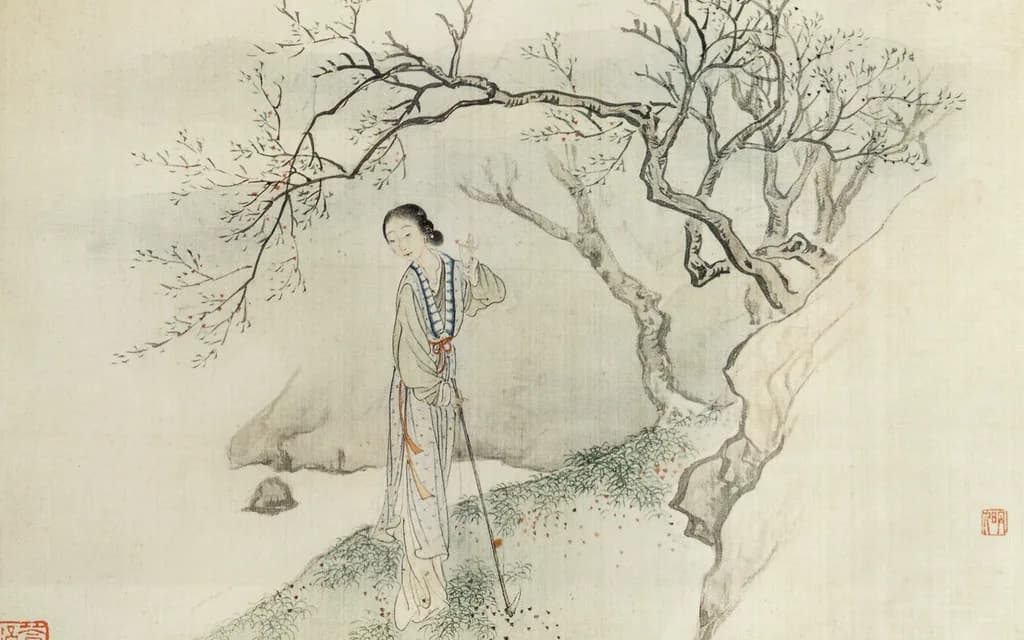
Chapter twenty-seven, and it converts more readers than any argument does. Daiyu goes out with a hoe and a silk bag to bury fallen blossom, because sweeping it into the water would let it be carried off and fouled somewhere downstream. Then she sings over the grave.
The song is the most famous set of verses in Chinese fiction and it is a young woman working out, in public, that she is the flower.
Yet peach and pear will, when next year returns, burst out again in bloom, but can it e'er be told who will next year dwell in the inner room?
The case for Daiyu is entirely in that stanza. She is the only person in the household who has understood her own position, which is that she is a dependent orphan with no money, no living parents and no leverage, in a house that will dispose of her when it is convenient. Everyone else in the book is managing the family's decline. She is the one saying out loud that it is going to eat them.
She is also, by some distance, the best writer in the novel. The poetry club chapters are a competition and she keeps winning it, and Baoyu's attachment to her is at least partly an attachment to somebody who thinks in the same register he does. What they have is not romance as the household understands the word. It is recognition.
🪙 The case for Baochai, which readers skip
She is the better person, and the novel knows it. Baochai is generous to servants nobody else notices, tactful with a mother-in-law who is impossible, and honest with Baoyu about the fact that she thinks he should sit the examinations. She is also, alone among the young women in the garden, competent with money in a house that is quietly running out of it.
| Daiyu | Baochai |
|---|---|
| Orphaned, dependent, no property. Her position in the house rests entirely on her grandmother's affection. | A wealthy merchant family behind her, and a mother in the house arguing her case. She arrives with leverage. |
| Says what she thinks, immediately, to everyone. Makes enemies among the servants without meaning to. | Says the correct thing every time. The staff like her, which in this novel is a political fact rather than a personality note. |
| Agrees with Baoyu that the examination track is a waste of a life, and never once presses him about it. | Tells him to study. Readers hold this against her; the household regards it as the only responsible thing anyone says to him. |
| Wood and stone: a debt from a previous existence, being repaid in tears. | Gold and jade: a match the family repeats until it sounds like destiny, which is how arranged marriages are made to feel inevitable. |
The reason readers skip her is that the novel gives Daiyu the poetry and gives Baochai the good sense, and poetry wins arguments. But if you read the book as an account of how a family destroys itself, Baochai is the tragedy that gets least sympathy: a capable woman married off to a man who does not want her, by a household that then breaks under her.
🕯️ How the novel resolves it
With a deception, in three chapters, and it is worse than a simple substitution. By chapter ninety-six Baoyu has lost his jade and most of his mind with it. The household decides a wedding will restore him, and that the bride must be Baochai. They also decide that telling him so would kill him.
The chapter title states the plan in the family's own language: Xifeng conceals the news and devises an ingenious scheme. What they arrange is that Baoyu is told he is marrying Daiyu, and marries Baochai. The news leaks to Daiyu anyway, in the same chapter, and she stops eating. Chapter ninety-seven puts both halves of the night in its own two-line title: Lin Daiyu burns her manuscripts and severs her passion, Xue Baochai leaves her chamber for the great ceremony. She burns the poems she has been keeping since she was a child, in the other courtyard of the same house, while the wedding music plays.
She dies at the start of chapter ninety-eight, whose title returns her soul to the Realm of Separation and Sorrow. Baoyu, meanwhile, has lifted the veil and found the wrong cousin, and is by now too ill to be told anything. His grandmother knows perfectly well that his collapse is about Daiyu and cannot risk saying so. His maid, asked directly how Cousin Lin is taking the wedding, answers that Miss Lin is unwell.
The person who finally tells him is Baochai, and the way she does it is the most interesting decision in the last quarter of the novel. He asks her how she came to be there, since he remembers being married to Daiyu. She waits, and then says plainly that while he was out of his senses, Cousin Lin died. He sits bolt upright and asks whether that is really true. She answers that it is really true, and that nobody would say such a thing of a living person.
That is Baochai's character in four sentences. Everyone else in the household has lied to him for three chapters to protect him. His new wife, who has the most to lose from his grief, tells him the truth on the grounds that he has asked for it. It does not save the marriage. Wikipedia's summary of the ending is exact about why: the marriage ultimately fails because Baoyu's love for Daiyu persists after her death.
The last movement follows from there. Baoyu recovers enough to sit the imperial examination in chapter one hundred and nineteen, passes it in high rank, and then walks away from the family, the marriage and the world, leaving Baochai pregnant and the debt to the Crimson Pearl Plant paid in full.
🎭 So which side is right?
Neither, and the novel is unusually explicit that this is the point. Chapter five does not offer the reader a choice between two women; it hands over a register in which the pair share a single verse, one riddle for both of them, because they are two halves of one question. A book that wanted you to root for somebody would not do that.
The honest reading is that Team Daiyu is right about what Baoyu wants and Team Baochai is right about what the world is like, and the novel's subject is the gap. Insisting on a side turns a tragedy into a competition, which is a very human thing to do with a book that hurts. Two hundred years later, the competition is still where most of the energy goes.
If you want to know who orchestrated the substitution and how she lives with it, that is a separate person with a separate essay: the woman who runs the household is the best-written character in the book and by some distance the hardest to like.
Chapters 96 to 98 sit past the end of the free English translation, so the account above is translated from the Chinese textwith our own gloss; the flower-burial song is Joly's 1892 English, free at Project Gutenberg. If you want the chapters this post skipped over, the argument about Baoyu himself starts in chapter three, and which English version gets you to the ending at all is worth settling before you buy.
Sources
- 紅樓夢 (Chinese text, 120-chapter Cheng-Gao edition) — Project Gutenberg
- Hung Lou Meng, Book II (H. Bencraft Joly translation) — Project Gutenberg
- Dream of the Red Chamber — Wikipedia
Frequently asked questions
- How does Dream of the Red Chamber end?
- Badly for everyone, and then the frame closes. Baoyu is married to Xue Baochai under a deception, Lin Daiyu dies the same night, and in chapter one hundred and nineteen he passes the imperial examination in high rank and walks out of the world. Chapter one hundred and twenty hands the story back to the two men who found the stone in chapter one, and leaves the family reading a son born after his departure as a sign it will rise again.
- Who does Jia Baoyu end up with?
- Xue Baochai, and the marriage occupies twenty-two chapters. The wedding is chapter ninety-seven and he leaves the world in chapter one hundred and nineteen, and for most of the interval he is ill, grieving or studying. The novel gives the match under a fifth of its length and never once describes it as a settlement.
- Why does the family trick Baoyu into marrying Baochai?
- Because he is ill and they believe a wedding will cure him. The jade goes missing in chapter ninety-four, whose title calls the loss an omen of calamity, and in chapter ninety-five a substitute is passed off on him and he loses his wits altogether. By the time the marriage is arranged the household has convinced itself that telling him the truth would kill him outright, so it lets him believe he is marrying his cousin Daiyu.
- Does Lin Daiyu die in Dream of the Red Chamber?
- Yes, at the start of chapter ninety-eight, in the same house and on the same night as the wedding. Her maids Zijuan and Xueyan are the only people with her. In chapter ninety-seven she can no longer sit up, and what she asks Xueyan to fetch is her book of poems, which is what she spends the last of her strength burning.
- Does Baoyu ever find out?
- Within a chapter of the wedding, and the rest of the novel is the consequence. His grandmother knows exactly why he has collapsed and will not risk saying so; his maid, asked directly, answers only that Miss Lin is unwell. It is his new wife who tells him plainly, and his grief at hearing it is one of the things that eventually drives him out of the family for good.
- Are Daiyu and Baochai fated to end up this way?
- The novel says so from chapter five, and it ranks them while it does it. Baoyu is shown three cabinets in the Land of Illusion: a main register of twelve, a secondary register, and a further one below that. Daiyu and Baochai share the first page of the main register in a single riddling verse, which is the book saying they are one question rather than two women.
- What do the names Daiyu and Baochai mean?
- Daiyu means something like dark-green jade, tying her to Baoyu's own jade and to the frame story's stone. Baochai means precious hairpin, a piece of gold, which is the other half of the pairing the household keeps repeating: gold and jade are said to match. The book builds its central conflict out of two nouns.
Enjoyed this one?