Hawkes or the Yangs? Which Dream of the Red Chamber Translation to Read, and Whose Last Forty Chapters You Get
One translator resigned an Oxford chair to finish the job. The other two finished theirs after four years in prison. And nobody agrees on who wrote the third of the book they were all translating.


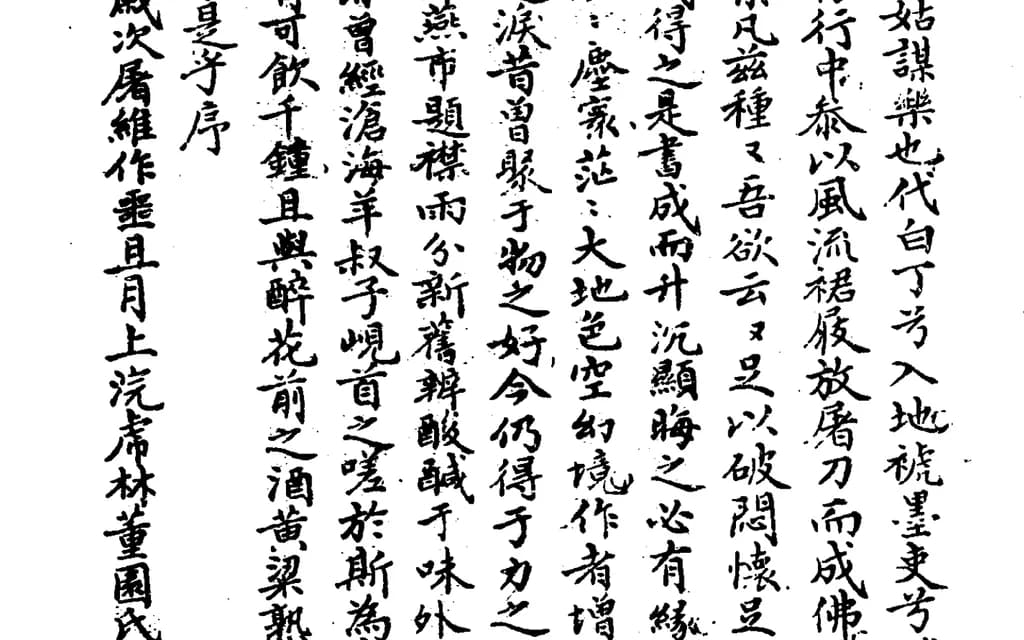
Two English versions of this novel are in general circulation, and the story of how each one got made is nearly as dramatic as the book. One translator gave up an Oxford chair to finish his. The other two were in prison for four years in the middle of theirs. Both sets were working on a text whose last third nobody can confidently attribute to its author, and both had to decide what to do about that.
- Hawkes and Minford, The Story of the Stone (Penguin, 1973 to 1986). Five volumes, complete, and the one most readers should buy.
- The Yangs, A Dream of Red Mansions (Foreign Languages Press, Beijing, 1978). Three volumes, complete, more literal, harder to find outside a library.
- Joly, 1892. Free, out of copyright, and it stops at chapter fifty-six of a hundred and twenty.
- The authorship problem is real. Cao Xueqin left eighty chapters. The other forty first appear in print in 1791, and a 2014 stylometric study found evidence of a second hand.
The rest of this piece is the reasoning, plus the argument about who wrote the ending. If you would rather play the story than choose an edition of it, the playable Dream of the Red Chamber runs the whole arc in eighteen scenes, in English, with no volume two to hunt down.
📚 The short answer: Hawkes, unless you want the literal one
Take Hawkes and Minford. It is the only complete English version you can reliably buy new, it runs to five volumes and about 2,339 pages of core text, and it was made over roughly a decade by a man who arranged his professional life around finishing it.
The Yangs' three-volume version is the alternative, and the honest reason to choose it is that you want a translator who stays closer to the Chinese sentence.
| Translation | What you are getting |
|---|---|
| David Hawkes and John Minford, The Story of the Stone(1973–1986) | Penguin Classics and Indiana University Press, five volumes. Hawkes did the first eighty chapters across three volumes in 1973, 1977 and 1980; his son-in-law John Minford did the last forty as The Debt of Tears (1982) and The Dreamer Wakes(1986). Titled from one of the novel's own names for itself. This is the default recommendation. |
| Yang Hsien-yi and Gladys Yang, A Dream of Red Mansions (1978) | Foreign Languages Press, Beijing, three volumes, made by a husband-and-wife team at a Chinese state publisher. Wikipedia describes it as faithful and readable, which is a fair summary: it keeps closer to the Chinese and does less to smooth the reading experience. Widely available secondhand and in libraries. |
| H. Bencraft Joly, Hung Lou Meng (1892) | Free and public domain, in two books on Project Gutenberg, covering chapters one to fifty-six. Victorian English, Wade-Giles spellings, and it stops less than half way through the novel. Good for sampling, not for finishing. |
| Florence and Isabel McHugh, The Dream of the Red Chamber (1958) | An abridgement, and a translation of a translation: it comes from Franz Kuhn's 1932 German version rather than from the Chinese. Historically important, since it is how a lot of mid-century English readers met the book. Not the one to start with now. |
One practical point that the comparison tables never make. Neither version is a single book you can put in a bag. Hawkes and Minford is five paperbacks and the Yangs is three hardbacks, and in both cases the volume breaks fall inside the story rather than at natural rests, because a hundred and twenty chapters do not divide neatly by anything. Readers who stall usually stall at a volume boundary rather than at a difficult chapter, so it is worth buying at least the first two at once.
The other thing worth knowing before you commit is that the Chinese text is free and easy to find, which is unusual for a book of this standing and useful even if you do not read Chinese. Every chapter number in this series was checked against the Project Gutenberg edition, and a chapter-heading list in the original is the fastest way to confirm that an English volume actually contains the scene you are looking for.
🕯️ What each translation cost the people who made it
One of them cost a career and the other cost four years of liberty, and both facts are on the public record. In 1971 David Hawkes resigned the chair of Chinese at Oxford to work on this book full time, a decision that startled his own field; he took a research fellowship at All Souls in 1973, and the translation occupied him for close to ten years.
He got through eighty chapters and handed the rest to John Minford. Yang Xianyi and Gladys Yang were translating the same novel for the Foreign Languages Press in Beijing when the Cultural Revolution reached them. They were imprisoned as class enemies from 1968 to 1972. The work on this book was interrupted by that imprisonment and the three-volume translation appeared in 1978, six years after their release.
This is worth knowing before you choose, because the two versions were produced under opposite pressures. Hawkes had a decade, a fellowship and an English readership he could design for. The Yangs had a state publisher, a mandate to render the text accurately for export, and an interruption of the kind that ends most long projects. The books read like their circumstances.
🧾 Did Cao Xueqin write the ending?
Nobody can prove it either way, and the field's own answer has moved twice in a century. Cao Xueqin died in 1763 or 1764 leaving the novel at an advanced stage but not finished. What circulated in his lifetime were hand-copied manuscripts of eighty chapters, several of them carrying commentary by an annotator who signed himself Zhiyanzhai, Rouge Inkstone.
The hundred and twenty chapter text everybody now reads first appears when Cheng Weiyuan and Gao E printed it in 1791.
| When | What was argued |
|---|---|
| 1921 | Hu Shih, in Studies on A Dream of the Red Chamber, argues that Gao E wrote the last forty chapters. This becomes the standard account and is still the version most readers are told. |
| 2014 | Three researchers apply stylometric analysis to the Cheng–Gao text and report "convincing if not irrefutable evidence that the first 80 chapters and the last 40 chapters of the book were written by two different authors." |
| 2020 | Zhang Qingshan, who presides over the Beijing academic society devoted to this novel, states that although the authorship of the last forty chapters remains uncertain, it is unlikely that Gao E was the one who wrote them. |
Read those three rows together and the position they leave you in is oddly precise. Two different hands is the best-supported claim. Gao E as the second hand is the weakest part of the old story, because he may have been an editor working from material rather than an author inventing one. What no manuscript supports is the romantic version in which a complete original ending exists and was lost.
The interesting part is that you can run the test yourself, in English, without any Chinese at all. Chapter five is where the novel writes down its own intentions: Baoyu falls asleep in the Land of Illusion, reads registers of the household's women and hears twelve songs about them, and the riddles are specific enough to be checkable. Anything after chapter eighty either keeps those promises or quietly fails to. Readers who feel the last third change gear are usually noticing exactly that, and it is a better argument than any impression of style.
For a reader this matters less than it sounds. Both complete translations give you the same hundred and twenty chapters, because that is the text that survived. The practical consequence is that the last quarter feels different, and now you know why rather than assuming the translator changed gear.
🆓 How far the free English text gets you
Chapter fifty-six of a hundred and twenty, which is further than most people expect and not far enough. H. Bencraft Joly was a British vice-consul at Macao who translated the novel for the same reason a lot of people start it, which is that he found it hard.
Wikipedia dates his translation of the first fifty-six chapters to 1892; his own preface is signed at the vice-consulate on 1 September 1891.
This translation was suggested not by any pretensions to range myself among the ranks of the body of sinologues, but by the perplexities and difficulties experienced by me as a student in Peking.
What his fifty-six chapters cover is the whole first movement: the stone, the arrival of the orphaned cousin, the building of the garden, the poetry club, the beating in chapter thirty-three. What they do not cover is the last quarter, where the family's decline stops being financial and starts happening to people. For that you need one of the two complete versions.
Know what you are getting into with the prose. Joly wrote before pinyin, so every name is spelled the old way: Pao-yü, Tai-yü, Hsi-feng, lady Feng, dowager lady Chia. His sentences are late-Victorian and his parentheses are generous. He is also unexpectedly good on the physical detail of the household, and because his text is out of copyright he is the only translator any English-language essay, this one included, can quote at length. Every block quotation in this series comes from a chapter at or below fifty-six for exactly that reason.
Two other free-looking options are worth knowing about and not using. Edward Charles Bowra published the first eight chapters in 1868, which is a curiosity rather than a reading text. And Bramwell Seaton Bonsall finished what is probably the first complete hundred and twenty chapter English translation in the 1950s, only for publication to be abandoned when Penguin announced the Hawkes project; a typescript survives online. From Bowra's eight chapters in 1868 to Minford's last volume in 1986 is a hundred and eighteen years, and for all but the last of them there was no complete English text you could buy.
Joly is at Project Gutenberg in two books, and the Chinese text this series checked its chapter numbers against is there too. If you are still deciding whether to start at all, the case for reading it is here, and the reason so few English readers ever did is a longer story than the translation history.
Sources
- Dream of the Red Chamber — Wikipedia
- David Hawkes (sinologist) — Wikipedia
- John Minford — Wikipedia
- Gladys Yang — Wikipedia
- Hung Lou Meng, Book I (H. Bencraft Joly translation) — Project Gutenberg
- Hung Lou Meng, Book II (H. Bencraft Joly translation) — Project Gutenberg
Frequently asked questions
- What is the best English translation of Dream of the Red Chamber?
- David Hawkes and John Minford's The Story of the Stone, for most readers: complete, in print, and written to be read rather than checked. Order the whole set at once rather than volume by volume. Minford's two closing volumes alone run to 400 and 385 pages, and the five together took from 1973 to 1986 to appear, so a shop holding volume one is no guarantee of volume four.
- Did Cao Xueqin finish Dream of the Red Chamber?
- Probably not, and certainly not in a form anyone has found. He died in 1763 or 1764 leaving the novel at an advanced stage, and what circulated in his lifetime were hand-copied manuscripts of eighty chapters carrying commentary by an annotator who signed himself Zhiyanzhai, Rouge Inkstone. The last forty chapters appear only with the printed edition of 1791.
- Did Gao E write the last 40 chapters of Dream of the Red Chamber?
- It is genuinely unresolved. Hu Shih argued in 1921 that Gao E wrote them, and that remains the popular version of the story. But in 2020 Zhang Qingshan, who presides over the Beijing academic society devoted to this novel, said that while the authorship is uncertain, it is unlikely Gao E was the author. The safest statement is that someone other than Cao Xueqin finished the book.
- Is there a free English translation of Dream of the Red Chamber?
- Yes, but only about half the book. H. Bencraft Joly, a British vice-consul at Macao, translated the first fifty-six chapters; his preface is dated 1 September 1891 and Wikipedia dates the translation to 1892. It is on Project Gutenberg as ebooks 9603 and 9604. It stops long before the last quarter of the novel, so the free text cannot take you to the end.
- What is the difference between The Story of the Stone and Dream of the Red Chamber?
- Nothing. They are two of the book's own titles, and Hawkes chose the first for his version. Older English readers often met it under a third route entirely: Franz Kuhn's 1932 German abridgement, which Florence and Isabel McHugh translated into English in 1958. That English text is a translation of a translation.
- When was Dream of the Red Chamber first translated into English?
- In pieces, from the middle of the nineteenth century. Edward Charles Bowra published a translation of the first eight chapters in 1868, Joly reached chapter fifty-six by 1892, and no complete English version was published for another eighty years. Bramwell Seaton Bonsall finished a complete one in the 1950s, but publication was abandoned when Penguin announced the Hawkes project.
Enjoyed this one?