Why Doesn't the West Read Dream of the Red Chamber? Genre, Timing, and the 1987 Series to Watch Instead
In 1873 an English reviewer decided that no amount of scholarly effort would ever get this novel into Western letters. He has been right for a hundred and fifty years, and not for the reason he thought.


In April 1873 an English reviewer in Hong Kong sat down with this novel, admired it, and concluded that the West was never going to read it. He has been right for a hundred and fifty years. He was wrong about the reason, and the gap between his reason and the real one is the most interesting thing about this book's life outside China.
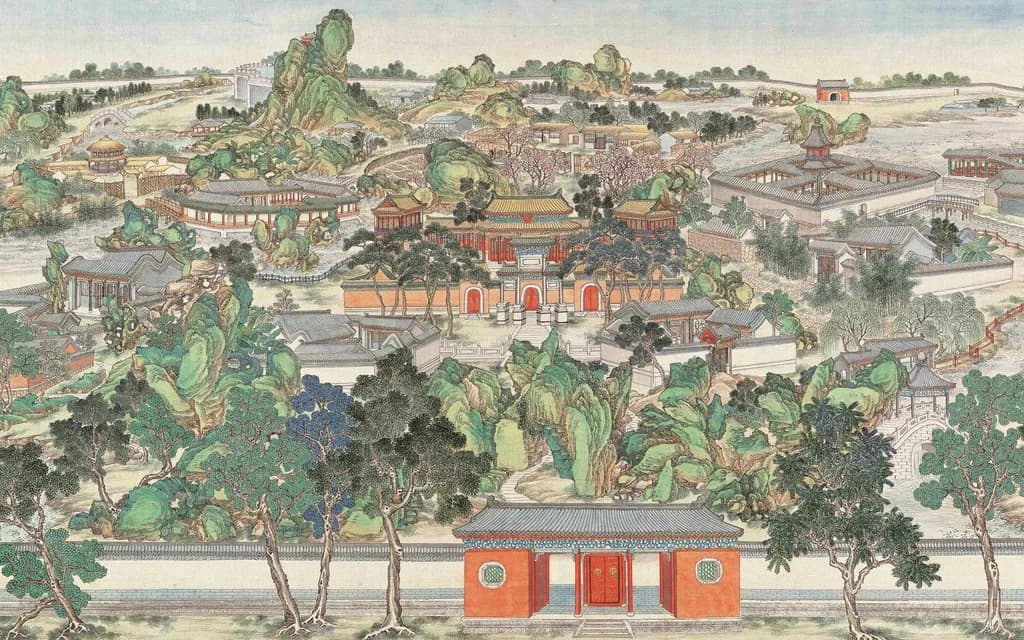
The shorthand English readers meet most often is that it is China's War and Peace. That comparison is useful for scale and misleading about method. There is no war in it, no campaign, no history in the Tolstoyan sense. There is a walled garden, a household of about four hundred named people, and money running out.
- Genre, not quality. Its three famous neighbours are adventure stories that travel and adapt easily. This one is a domestic interior.
- Timing. Eight chapters in English in 1868, fifty-six by 1892, and no complete translation in a shop until 1986.
- China went the other way. An entire academic discipline, with its own learned society and university research centres, studies this one novel.
- The 1987 television series is the way in. Thirty-six episodes, a four-year score, and a cast of unknowns.
The rest of this is the long version, plus what to watch. If you would rather be inside the house than reading about its reception, the playable Dream of the Red Chamber runs eighteen scenes from the frame story to the end of the family.
🧭 The short answer: genre and timing
Because a novel about a household is much harder to carry across a language than a novel about a journey. Journey to the West is a road movie with a monkey in it. Romance of the Three Kingdoms gives you a war. Water Margin is a hundred and eight outlaws with nicknames.
All three have been adapted into films, games and comics for a century, and each adaptation carries the original a little further. This book is a description of an interior, and its plot is a balance sheet. The second reason is arithmetic. English readers got the first eight chapters in 1868 and the first fifty-six in 1892, and then nothing complete for eighty years; the Penguin translation was finished in 1986. The translation history is its own story, but the effect is simple. For most of the period when the Western canon was being assembled, there was no complete English text of this novel for anyone to put in it.
It is not that the novel lacks scenes that travel. Chapters thirty-nine to forty-one are as portable as anything in world fiction: a poor countrywoman with a distant claim on the family is invited to tour the great garden, and the household spends two days being entertained by her, feeding her and laughing at her table manners. The text is explicit that the joke is arranged: Xifeng and the head maid agree in advance to get a laugh out of her, and the old woman tells them afterwards that she knew, that they were all coaxing a laugh out of the grandmother together, and that if she had minded she would have said so. She goes home in the following chapter with rather more than she arrived with. It is funny, cruel and legible in any language, and in China it is the most staged sequence in the book. Almost no English reader has heard of it.
The third reason is the one nobody says out loud, which is that the book is genuinely demanding at the start and offers no incentive for the first eighty pages beyond the prose. A reader who bounces off Proust has bounced off one difficult book. A reader who bounces off this one has, in most English-speaking countries, no second chance at Chinese fiction lined up behind it.
📜 An English critic called it in 1873
Alfred Lister reviewed it in The China Review in April 1873, and his verdict is worth reading in full because it is both admiring and completely defeated. He can see the book is a work of art. He simply cannot imagine the machinery that would get it to an English reader.
A work of art ... yet at a great disadvantage on account of its bulk. Its tremendous length, no less than twenty volumes; the vast number of persons involved in the story; and the complicatedly mysterious character of the introductory chapters, make it a book which perhaps the most heroic efforts of enthusiastic scholars will never succeed in introducing to the world of Western letters.
Three objections, and the striking thing is how well they have held up as a description of what actually deters readers: it is long, there are too many people, and the opening is strange. What Lister got wrong is the conclusion. Heroic efforts by enthusiastic scholars did eventually produce a complete English translation, and it is very good. The book still did not arrive.
Which suggests the obstacle was never scholarly. Translation was the necessary condition and not the sufficient one. What a novel needs in order to enter a foreign readership is a continuous supply of secondary versions, and for a century this book had almost none in English while its three neighbours had films, comics and games.
🎓 Meanwhile, China built an academic field around it
There is an academic discipline devoted to this single novel, called hongxue in Chinese and Redology in English, and it is not a hobbyist affair. It has a national learned society in Beijing, 中国红楼梦学会. It has university research centres, including the Cao Xueqin Center for Aesthetics and Art and the Weiming Society at Peking University, an International Research Center at National Dong Hwa University in Taiwan, and a research centre at the University of Malaya.
Its questions are textual, and they are the questions this novel forces on anyone who looks closely. Which of the surviving eighty-chapter manuscripts is nearest to what Cao Xueqin wrote. What the annotator who signed himself Zhiyanzhai, Rouge Inkstone, knew about the author and his intentions. Who wrote the last forty chapters. Hu Shih's New Redology, dated by the field to the decades from 1922 to 1953, put those questions on a documentary footing and the discipline has been arguing about them ever since.
The political history is inseparable from that, and Mao Zedong is the reason. He claimed to have read the novel five times and praised it as one of China's greatest works of literature. He also, in 1954, personally criticised the Redologist Yu Pingbo for bourgeois idealism, on the grounds that Yu had failed to stress that the novel exposed the decadence of feudal society and the theme of class struggle. Loving the book and turning it into a political instrument were, for him, the same gesture.
Set that against the English-language situation of the same decade and the asymmetry is almost comic. In the 1950s the book was important enough in China to be worth a leader's public intervention in a scholarly dispute. In English it existed as a Victorian half-translation and an abridgement made from a German version.
📺 The 1987 series, and every other screen version
Watch the 1987 CCTV series, which runs to thirty-six episodes and is regarded by many in China as close to definitive. It was controversial before it aired, because few Redologists believed television could do the novel justice, and the way it answered them was to take everything slowly. The composer Wang Liping set the novel's own verses to music and spent about four years doing it.
The director Wang Fulin cast non-professional young people and trained them, and the decision is now the standard example of why that choice can work. The most striking evidence of its standing is what happens around it. When a children's restaging went viral in China, as The World of Chinese reported in October 2017, the scenes, plots, costumes and make-up were all taken from the 1987 production, and Ouyang Fenqiang, who had played Baoyu in it, was brought in to coach the child actors. An adaptation that supplies the visual grammar for its own parodies thirty years later has won.
| Version | What you are getting |
|---|---|
| 1987, CCTV television series | Thirty-six episodes, directed by Wang Fulin, scored by Wang Liping over roughly four years, cast with unknowns. The one to watch, and the one everything else is measured against. |
| 1977, Shaw Brothers film | Directed by Li Han-Hsiang, 108 minutes. A Hong Kong studio compression of a hundred-and-twenty-chapter novel into under two hours, which tells you what had to go. |
| 1988–89, Beijing Film Studio | Directed by Xie Tieli and Zhao Yuan, released in six parts, and at 735 minutes it remains the longest film ever made in the People's Republic of China. The completist option. |
| 2010, television series | Fifty episodes, directed by Li Shaohong, first broadcast on 6 July 2010. Handsomely produced and permanently in the shadow of 1987, which is most of what Chinese viewers have to say about it. |
| 2016, San Francisco Opera | An English-language opera by Bright Sheng, with a libretto by Sheng and the playwright David Henry Hwang, premiered on 10 September 2016. The clearest sign to date of a Western institution treating the book as repertoire rather than as a curiosity. |
There is no Western screen adaptation on that list, and there is no sign of one coming. That is the whole argument of this piece in one row of a table. The book's afterlife has been enormous, continuous and almost entirely conducted in Chinese, which is why an English reader can finish a literature degree without ever hearing the names in it.
If that is your situation, the honest recommendation is to watch the 1987 series and read the novel in parallel, one against the other. Chinese readers have never had to hold this book on the page alone, and there is no reason you should.
Lister's 1873 verdict and Mao's 1954 intervention are both recorded in the novel's Wikipedia article, and the field itself has its own. If you have not started yet, the case for reading it is here, and the argument every reader eventually joins is about the two cousins, and gives the ending away.
Sources
- Dream of the Red Chamber — Wikipedia
- Redology — Wikipedia
- Dream of the Red Chamber (1987 TV series) — Wikipedia
- Children's version of TV classic goes viral — The World of Chinese
- A Dream of Red Mansions (1988 film) — Wikipedia
- Dream of the Red Chamber (opera) — Wikipedia
Frequently asked questions
- Why isn't Dream of the Red Chamber as well known in the West as other Chinese novels?
- Its three famous neighbours are adventure stories that travelled early and adapt easily to screen; this one is a domestic novel about a household's finances and a garden full of cousins. It also arrived late in English. The first eight chapters appeared in 1868, the first fifty-six in 1892, and a complete translation only between 1973 and 1986.
- What is Redology?
- Hongxue, the academic study of this one novel. It has its own national learned society in Beijing, and research centres at institutions including Peking University, National Dong Hwa University and the University of Malaya. Its central questions are textual: which manuscript is closest to Cao Xueqin, and who wrote the last forty chapters.
- Did Mao Zedong like Dream of the Red Chamber?
- He said he had read it five times and called it one of China's greatest works of literature. He also used it. In 1954 he personally criticised the scholar Yu Pingbo for bourgeois idealism, on the grounds that Yu had failed to read the novel as an exposure of feudal decadence and class struggle. Admiring the book and weaponising it were the same gesture.
- What is the best screen adaptation of Dream of the Red Chamber?
- The 1987 CCTV series, which runs to thirty-six episodes and is widely regarded in China as close to definitive. The most extreme adaptation is the six-part film Beijing Film Studio released between 1988 and 1989: at 735 minutes it remains the longest film ever made in the People's Republic. The San Francisco Opera premiered an English-language opera of it on 10 September 2016.
- Is Dream of the Red Chamber China's War and Peace?
- It is the comparison English readers meet most often, and it is right about scale and wrong about everything else. Both books are very long, both describe a whole aristocratic society through one extended family, and both were written to be lived in. But there is no war in this one, no history, and no battlefield. The subject is a household budget and a walled garden.
- What does Hong Lou Meng mean?
- Red Chamber Dream, said roughly hong low mung. The red chamber is not a room in the plot but a conventional term for the sheltered inner quarters where the daughters of a wealthy family lived, and the dream is the one Baoyu has in chapter five. The title names a place and a warning at the same time.
Enjoyed this one?