Journey to the West Ending Explained: Blank Scrolls, an 81st Ordeal, a Buddha
The great pilgrimage ends with a demand for a gift, a bundle of empty paper and a missing disaster. The Sun Wukong everyone loves loses his headband by being promoted out of it.


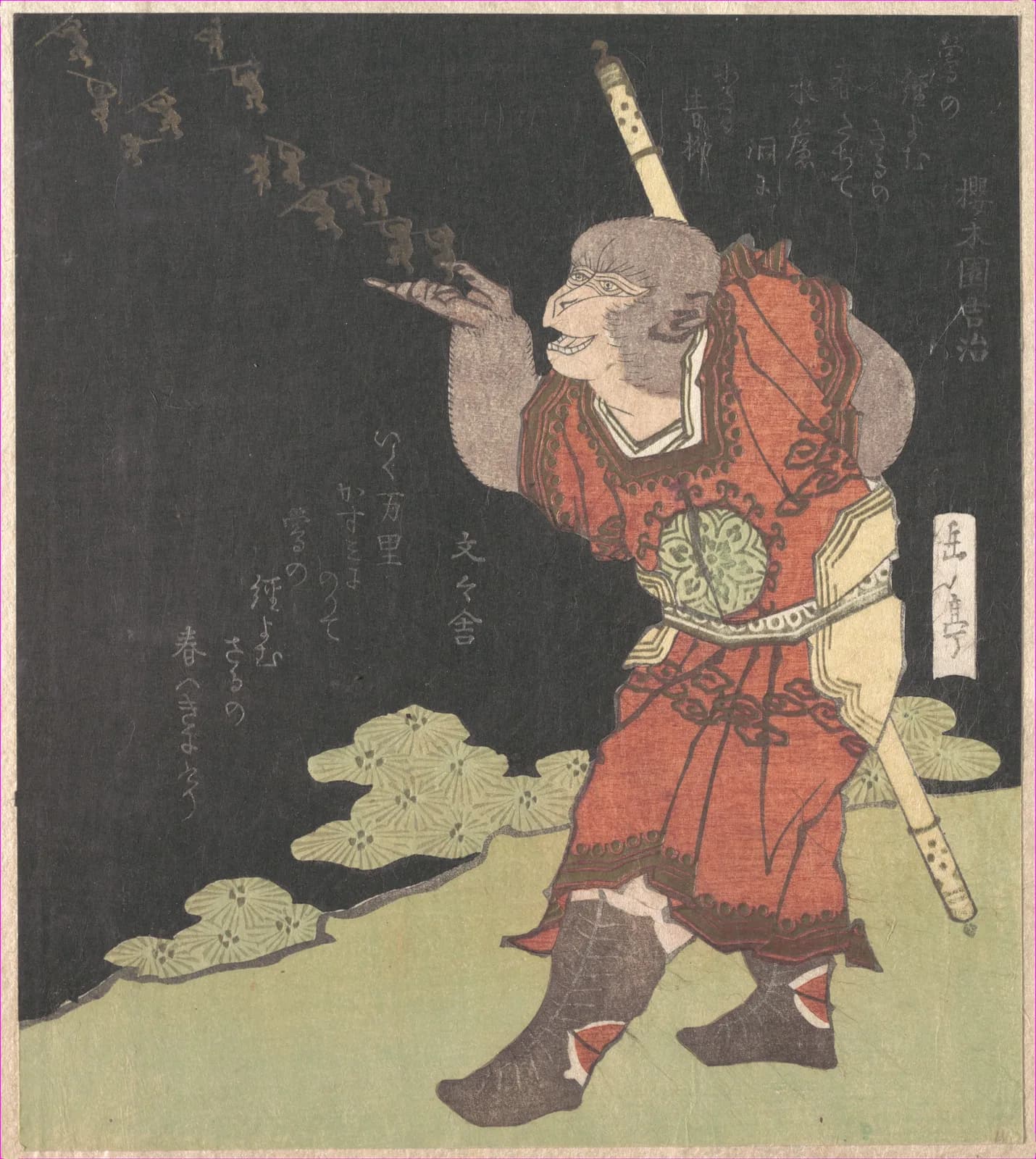
Spoilers for the whole of Journey to the West, including the last chapter and what becomes of each of the five travellers.
The famous journey ends with a bribe, a stack of empty paper and an ordeal that has to be added because the count came up short. The last two stages of the road are both doorways in the playable Journey to the West, the ferry where the monk leaves his body behind and the river where the scriptures get soaked. The quotations below come from the Chinese text the game uses, and the English renderings are our own.
⛵ What happens at the Lingyun ferry?
Tang Sanzang leaves his mortal body in the river. The crossing in Chapter 98 is a single log over fast water, and when he refuses it a ferryman poles up in a boat with no bottom. Wukong pushes his master in, the ferryman hauls him aboard, and as they push off a corpse comes floating down the current.
那個原來是你。 That one, it turns out, is you.
Wukong says it first, and Pigsy, Sandy and the ferryman all join in. On the far bank the boat is gone, and Wukong explains that the ferryman was the Buddha who receives pilgrims, so Tang realises what has happened and turns to thank his three disciples.
📜 Why are the first scriptures blank?
Because Tang paid nothing. Ananda and Kasyapa, the Buddha’s two senior disciples, whom he sends to hand out the texts, ask him what gift he has brought them. He says the road was long and he brought none, so they give him scrolls with no writing on them. The pilgrims only find out when a gust of wind, sent on purpose, rips the bundle open on the road and every page turns out to be white.
They march back and complain. The Buddha laughs and defends the disciples. Scriptures, he says, may not be handed out lightly, nor taken away empty-handed. Some monks once recited them for a wealthy household in Śrāvastī and came back with three dou and three sheng of gold grains, measured out like rice, and even then he told them the price was too low.
白本者,乃無字真經,倒也是好的。 The blank ones are the true scriptures without words, and good ones too.
The people of the East, he adds, are too deluded to use them, so they will get the written kind. Tang pays with the purple-gold alms bowl the Tang emperor gave him for the road. The two disciples take it, to the open mockery of the temple staff, and hand over 5,048 scrolls, each one checked for writing this time.
🐢 What is the eighty-first ordeal?
A ducking in the Tongtian River, added because the ledger came up one short. Guanyin reads the list of everything the pilgrims have suffered and counts eighty. The Buddhist number of completion is nine times nine, so she orders one more to be added before they reach home.
佛門中九九歸真。聖僧受過八十難,還少一難。 In the Buddhist gate, nine nines return to truth. The holy monk has suffered eighty ordeals; one is still missing.
The guardians flying the pilgrims home drop them by the river. The old turtle who once ferried them across offers to do it again, and halfway over asks whether Tang remembered to ask the Buddha how long the turtle would live. Tang forgot, and the turtle dives, so monks, horse and scriptures all go into the water.
They dry the scrolls on a rock, which the narrator says is still there. When they pack up, a few pages of one sutra stick to the stone and tear, and Wukong tells his anxious master that this is fitting, because heaven and earth are not complete either. How the game Black Myth: Wukong borrows the eighty-one ordeals is a separate question, covered in the essay on the game and the novel.
🏯 What happens back in Chang’an?
Tang delivers the scriptures and is called away before he can read them aloud. He tells Emperor Taizong the journey took fourteen summers and winters. The emperor checks the travel pass and points out that it was issued in the thirteenth year of his reign, and it is now the twenty-seventh.
At the Wild Goose Pagoda temple Tang climbs a platform to recite. Before he begins, the guardians appear in the air and tell him to put the scrolls down and come back to the West. He drops them and rises into the sky with his disciples, while the emperor and his court bow to the empty air.
🙏 Who becomes what?
All five travellers are promoted at once, in Chapter 100, by the Buddha himself, and each title is fitted to the traveller’s record on the road.
- Tang Sanzang becomes 旃檀功德佛, the Buddha of Sandalwood Merit. The Buddha reminds him he was once a disciple demoted for not listening to the teaching.
- Sun Wukong becomes 鬥戰勝佛, the Victorious Fighting Buddha.
- Zhu Bajie (Pigsy) becomes 淨壇使者, the Altar Cleanser, and protests on the spot that the others all became Buddhas.
- Sha Wujing (Sandy) becomes 金身羅漢, a Golden-Bodied Arhat.
- The white horse, a dragon prince all along, becomes the Heavenly Dragon Horse and is turned back into a dragon coiled round a pillar at the monastery gate.
Pigsy’s complaint is the comic beat of the ending, and the case for Pigsy explains why so many readers side with him. The standard summary of the novel renders Wukong’s title the same way, Victorious Fighting Buddha.
⭕ What happens to the headband?
It disappears by itself. Wukong points out that he is now a Buddha like his master and asks Tang to say the loosening spell, so he can smash the band and stop anyone using it on someone else. Tang answers that it was only ever a way to control him, and that it must have gone now he is a Buddha. Wukong reaches up, and it is not there.
The vanished band is the last thing that happens to him in the story. Where the band came from, and why it was put on him so early, is in the Sun Wukong explainer. The whole Chinese text is free at Project Gutenberg, traditional script, one hundred chapters.
Sources
- Xiyouji, the Chinese text of Journey to the West (Project Gutenberg #23962) — Project Gutenberg
- Journey to the West — Wikipedia
- Sun Wukong — Wikipedia
- Tang Sanzang — Wikipedia
Frequently asked questions
- What happens at the end of the journey to the west?
- The pilgrims bring the scriptures to Chang'an and are flown straight back to Vulture Peak to receive their rewards. The text times the whole return trip, out and back, at under eight days, after a westward journey that took fourteen years.
- What does the true ending of Wukong mean?
- In the novel it means a title with a reason attached. The Buddha reminds Wukong that he was pinned under Five Elements Mountain for wrecking Heaven, then credits him with hiding evil, spreading good and subduing demons on the road, finishing what he started. The fighting that once got him imprisoned is now the reason he is promoted.
- What is the main message of Journey to the West?
- Many readers take it to be that the road mattered as much as the prize, though the Buddha never says so. The text adds one small, firm detail: the sutra whose pages tear on the drying stone is named as the Fo Benxing Jing (佛本行經), and the narrator says it has been incomplete ever since. Even the prize arrives slightly damaged by the road.
- Why does Zhu Bajie get a lower title?
- Because his appetite never changed, and the Buddha says so. Pigsy is told he still has a lazy body, a loud mouth and a stomach of great capacity, so his job is to clear the offerings from Buddhist altars across the Four Continents. The Buddha presents it as a post with excellent perks, which is the joke.
- How many chapters does Journey to the West have?
- 100 chapters in the Chinese text that Project Gutenberg publishes and the game is built on. The last chapter's heading reads 徑回東土 五聖成真, which we render as Straight Back to the Eastern Land, the Five Sages Made Whole. The ending proper takes only the final three chapters.
Enjoyed this one?