Sun Wukong Explained: His Powers, His Personality, and Why He Wears the Headband
He fights an army sent by Heaven to a standstill before anyone works out how to govern him. The answer, five hundred years later, turns out to be a hat.


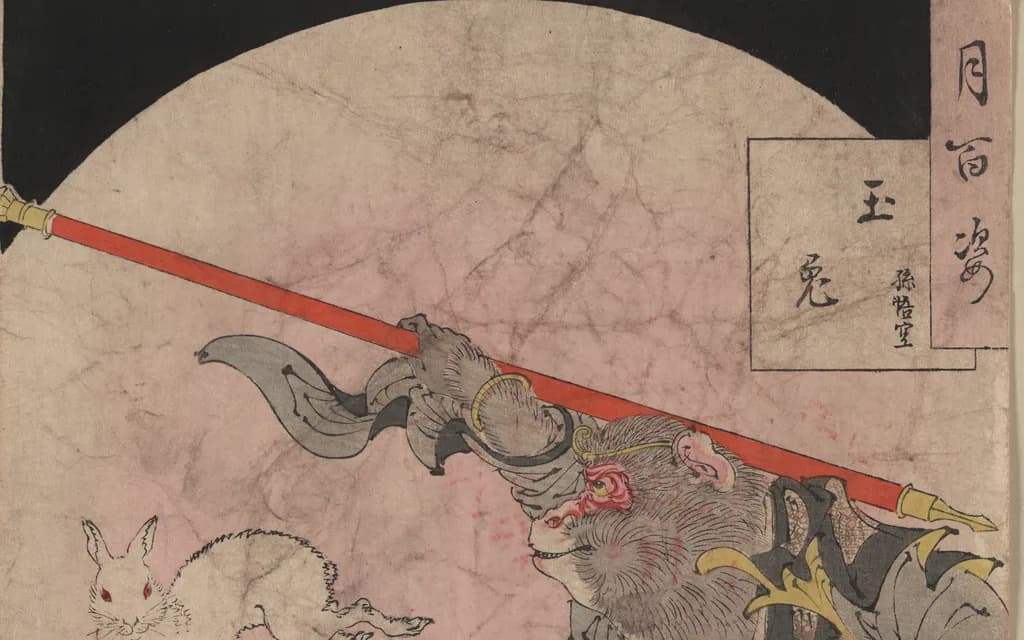
Sun Wukong is introduced as a rock. Within seven chapters he has learned immortality, robbed a dragon king, defaced the register of the dead, been given a job in Heaven, quit it in a rage, been given a better-sounding job, eaten everything at a party he was not invited to, fought the entire celestial army to a standstill, and lost a bet with the Buddha. The rest of the novel, ninety-three chapters of it, is about teaching him to walk somewhere without causing an incident.
- Seventy-two transformations, which is a Daoist star-count rather than a list of seventy-two things he can turn into.
- Eighty-four thousand hairs, each one able to become a copy of him or anything else he needs.
- One somersault covers a hundred and eight thousand li, which happens to be the exact length of the road the pilgrims spend the book walking.
- The headband is not his. It arrives in chapter fourteen, from a monk he has known for one afternoon, and he is tricked into putting it on.
What follows is the book's own account, chapter by chapter, of what he can do and why he wears the thing on his head. If you would rather meet him than read about him, the playable Journey to the West includes the afternoon the monk finds him pinned under a mountain and offers him a job.
💨 What can Sun Wukong actually do?
His power set is four things, and three of them are more interesting than their reputation. He can transform, he can multiply himself, he carries a weapon that resizes on command, and he can cross the world in a single jump. The novel is precise about all four, and the precision is where the fun is.
The famous seventy-two is the most misquoted number in the book. In chapter two his teacher offers him a choice between two sets of skills, named for two Daoist star-counts: the Heavenly-Ganglia number, which is thirty-six transformations, and the Earthly-Fiend number, which is seventy-two. Wukong picks the second one on the explicit grounds that it is the bigger number, and learns the lot. So seventy-two is not a menu of shapes. It is the size of a school of magic, chosen by a monkey doing exactly what you would expect a monkey to do when offered a large option and a small one.
The hairs are the ability that actually decides fights. The same chapter says he has eighty-four thousand of them and that every single one can transform at will, which is why his standard response to being outnumbered is to pull out a fistful, chew them up, spit them into the air and produce a small army of himself. Nothing in the book ever counts the copies down again.
The staff is his one piece of equipment and it comes with a receipt. He takes it from the dragon king's treasury in chapter three, and the inscription on the shaft gives both its name and its weight: thirteen thousand five hundred catties. He immediately asks it to get smaller, twice, which is the first time in the novel a cosmic artefact is treated as an inconvenience.
And then the somersault cloud, which produces the best structural joke in the book. In chapter seven, boasting to the Buddha about why he should be given Heaven, he says his cloud-somersault covers a hundred and eight thousand li in one leap. Two hundred pages later, when the pilgrimage is being planned, the distance from Chang'an to the Buddha's mountain is given as exactly the same figure: a hundred and eight thousand li. The register that closes the pilgrimage in chapter ninety-nine repeats it a third time. The strongest member of the party could have done the entire journey in one hop on the first morning, and the book knows it, and that is the point of the journey.
👑 Is Sun Wukong technically a god?
He is, on paper, and the paperwork is the joke. The title everyone knows him by, Great Sage Equal to Heaven, is one he invents for himself and flies as a banner outside his own cave. Heaven then formally grants it to him. What the novel is careful to show is why.
In chapter four, after the celestial army has failed to bring him in, an official proposes the solution that gives the sequence its comedy: give him the name and nothing else. His exact recommendation is to add an empty rank, an office with no salary. No duties to manage, he explains, and no stipend either, just keep him fed somewhere between Heaven and earth until the wildness wears off. The Jade Emperor agrees, issues the edict, and has a Great Sage residence built for him containing two administrative bureaus, one called the Bureau of Peace and Quiet and the other the Bureau of Calmed Spirits.
So the answer to whether he is a god is yes, in the way a difficult employee is promoted sideways into an office with a nice door. The immortality is a different question and the book stacks it deliberately: he strikes his own name out of the register of the dead in chapter three, then eats the peaches, then the elixir, then the wine, until no single method of killing him is left that another method has not already covered. Heaven cannot execute him. That is why the ending of his rebellion is a mountain rather than a sentence, and why he tells Guanyin, when she finds him under it, that the Buddha tricked him and has held him there five hundred years and more.
💍 Why does he wear the headband, and who gave it to him?
The circlet is a control device, it comes from the Buddha by way of Guanyin, and he does not get it until chapter fourteen, several hundred years after the rebellion that made it necessary. Anything that shows him wearing it during the raid on Heaven has the order wrong.
The supply chain is set out in chapter eight, before the monk has even been chosen. The Buddha hands Guanyin the equipment for the journey he is planning: a brocade kasaya, a nine-ringed staff, and three circlets. They look identical, he tells her, but their uses differ, and he gives her three separate spells to go with them, named gold, tight and ban. The instruction is specific. If she meets a demon on the road with real power, she is to talk him into joining the pilgrim, and if he will not take orders, the circlet goes on his head, roots into the flesh, and the spell does the rest.
“This treasure is called the tightening circlet. They are one kind, but three, and each is used differently.”
Six chapters later the monk pulls him out from under the mountain, and the circlet arrives disguised as a gift of clothing. Wukong, who has spent five centuries with a rock on his chest and is delighted by a hat, puts it on himself. Nobody forces it. That detail is the cruellest and best-observed thing in the sequence, and every adaptation that stages it as a fight is making him more dignified than the book does.
The other two circlets are the part almost nobody knows, and the novel does eventually account for them. In chapter forty-two Guanyin lists the set out loud: the tight one went on the monkey, the ban one took the bear demon she recruited as the guardian of her own mountain, and the gold one she had never been able to bring herself to give away until a fire-breathing child annoyed her enough to earn it. Both of those characters turn up as doorways in the playable version, which is a pleasant thing to notice on a second read.
🔥 Why is he loved, rather than just admired?
Because he is never once dignified about it. The most powerful character in a hundred-chapter novel spends that novel sulking, showing off, storming out, coming back, pretending he was not worried, and being outmanoeuvred by people with a fraction of his strength. Readers do not attach to the power.
They attach to a creature who cannot leave a provocation alone and has to live with the consequences in front of witnesses. The book builds him that way from the first chapter. He gets his name by jumping through a waterfall on a dare. He gets his immortality by pestering a teacher who did not want students. He loses his first job in Heaven because somebody tells him what the job title actually means. Every escalation in the first seven chapters starts with him being unable to accept a small slight, and the pattern does not stop when the pilgrimage does: he is still walking off in a temper in chapter fifty-seven.
What makes it a character rather than a running gag is that the novel gives him something to lose. Once the circlet is on, the monk can drop him to his knees with four lines of verse for the crime of being right too aggressively, and the monkey stays anyway. He complains. He threatens to go home. He goes home twice. Then he comes back, because the thing that turns out to be stronger than a will that beat the celestial army is being needed by somebody weaker than him.
It is also the part the 2024 video game is most careful with. Black Myth: Wukong does not let you be him: it is set after the novel, and the monkey you play is a separate character assembled to go and recover six relics of the original, which keeps the temperament intact by keeping the original off the board. The powers are all reproduced, the transformations included. The prickliness could not be, because the game needs a protagonist who takes orders from the player.
That is the general rule with him. Every adaptation that borrows the character borrows the temperament first and the power set second, which is exactly the right order, and it is why a Japanese cartoon and a Chinese video game can be relatives without being copies.
Every chapter number above was checked against the Chinese text at Project Gutenberg. If you are deciding which English version to read him in, the four translations are compared here, and the monk he ends up working for turns out to have been a real person who really walked to India.
Sources
- Journey to the West (Chinese text, 100 chapters) — Project Gutenberg
- The Purpose and Possible Origin of Sun Wukong's Golden Fillet — Journey to the West Research (Jim R. McClanahan)
- Who is Sun Wukong, China's Monkey King? — National Geographic
- Black Myth: Wukong — Wikipedia
Frequently asked questions
- Is Sun Wukong technically a god?
- He holds a celestial title, and by the last page he outranks it. The novel closes by promoting him past every office he stole: in chapter one hundred he is given a Buddhahood title, Buddha Victorious in Strife, which is the only rank in the book he is awarded for what he actually did rather than to keep him quiet.
- What do Sun Wukong's 72 transformations actually mean?
- They are a school of magic named after a Daoist star-count, not a list of seventy-two things he can become. He learns them in chapter two from a reclusive master named Subhodhi, who does not teach them in a lesson: the text says he leans close and whispers the formula into the monkey's ear, and Wukong then works out the whole set by himself.
- Why does Sun Wukong wear a headband, and who gave it to him?
- The Buddha gave three circlets to Guanyin to control powerful recruits, and the monk fitted one to him in chapter fourteen. The third one is the strangest: rather than a single band, it splits into five rings that go on Red Boy's head, both wrists and both ankles at once, which is the only time in the novel the device is used on a child.
- How long was Sun Wukong supposed to live?
- Three hundred and forty-two years, and a natural death. The novel is exact about it: in chapter three he forces his way into the underworld, finds his own entry standing at soul number 1,350 in the register, and reads that a heaven-born stone monkey is allotted three hundred and forty-two years. He then crosses the line out with a brush.
- What is Sun Wukong's real weakness?
- Smoke, and the novel makes it permanent. In chapter seven he is sealed in an alchemical furnace for forty-nine days and survives by sheltering in the trigram position that governs wind, where there is no flame. The wind stirs up smoke instead, and it ruins his eyes for good. His famous fiery golden eyes are a chronic injury he never recovers from.
Enjoyed this one?