The Real Xuanzang vs the Novel's Tang Sanzang: the Monk Who Actually Walked to India
Take away the monkey, the pig and the eighty demon ambushes, and a real monk still walked to India against direct orders and came back with the scriptures.


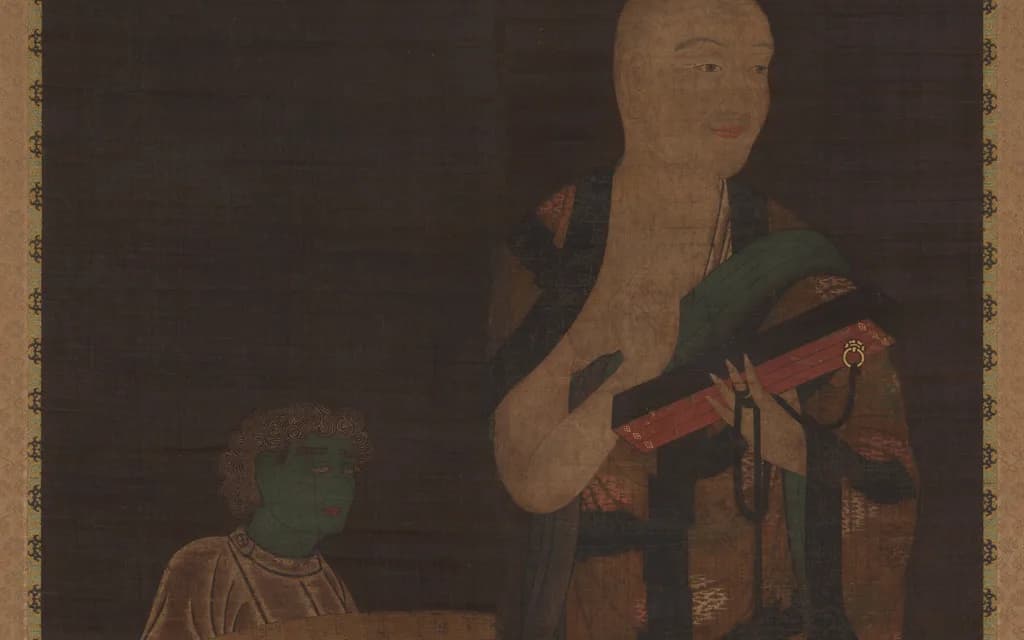
Take the monkey out of Journey to the West, and the pig, and the eighty-odd demon ambushes, and something is still left standing. A young Chinese monk really did leave Chang'an for India, on foot, against a direct imperial order, and really did come back sixteen years later with several hundred manuscripts nobody in China had read. The novel is a fantasy. The trip was not.
- Xuanzang, 602 to 664. A real monk with a real name, which the novel then borrowed unchanged.
- He left illegally. Travel abroad was banned, so he went in secret and never applied for permission.
- He came back with 657 texts and gave the remaining nineteen years to translating a fraction of them.
- He travelled without a monkey. Also without a pig, a river demon or a dragon horse.
What follows is the real journey, the fictional one, and why the second needed to be so different from the first. If you would rather stand in the scene where the novel sends him off, the playable Journey to the West includes the great assembly in Chang'an where the commission is handed over.
🧭 Who was the real Xuanzang?
A scholar-monk born in 602, dead in 664, who concluded early that the Buddhist texts available in Chinese were unreliable. Translations disagreed with each other; doctrines depended on which version of a sutra you happened to have. His response was to go and get better copies from the place they came from, which meant India, which meant several thousand miles of desert and mountain in a period when the Tang state had closed the western frontier.
He applied for permission and was refused. He went anyway, leaving Chang'an quietly in 629 in open defiance of an imperial order not to travel, so the journey the novel turns into a mission from Heaven began as a piece of deliberate law-breaking by a man who had been told no. That detail almost never survives into the retellings, which tend to open with an emperor blessing the departure rather than with a monk avoiding the border guards.
The name is worth pausing on too. The novel does not invent a character and attach a real monk's reputation to him. It uses his actual name. When the book calls its holy fool Xuanzang, it is naming a specific historical person who had been dead for roughly nine hundred years when the novel was printed, in the way a modern novel might make a supernatural adventure out of a named explorer.
🐫 What did the real journey involve?
Sixteen years, roughly ten thousand miles, and no demons. He crossed the Gobi, went north around the Taklamakan through the oasis kingdoms of Central Asia, came down through Afghanistan and into the Indian subcontinent, and stayed for years rather than passing through.
The centre of it was Nalanda, then the largest Buddhist monastic university in the world, where he studied under an elderly master named Silabhadra. He learned Sanskrit well enough to argue in it. At the court of King Harsha he took part in a formal debate tournament, defending Mahayana doctrine in a public contest of the kind that decided reputations. This is the part of his life that the fantasy has no room for, because a man winning a philosophical argument in a second language is not a scene you can stage with a golden cudgel.
It is worth being blunt about how the two versions handle danger, because the fiction is in some ways the tamer of the pair. The novel's threats are monsters, and monsters can be beaten by a stronger monster. The real hazards were a closed frontier, a desert crossing with no guarantee of water, mountain passes at altitude, and years of dependence on the goodwill of kings who had no particular reason to help a foreign monk. There is no version of that story in which somebody arrives on a cloud.
He came home in 645 with at least 657 texts, and the Tang court, which had banned his departure, received him as a celebrity. The rest of his life was translation work: he managed 75 distinct sections out of 1,335 chapters before he died, which is the honest measure of what he had brought back. He also wrote the journey up. The Great Tang Records on the Western Regions is a geographic and ethnographic account of the places he passed through, and it is still used as a source for the history of seventh-century Central Asia and India. It is also the book the novel grew out of.
🎭 Why did the novel turn one monk into five pilgrims?
Because the real story has no antagonist. A determined scholar walks a very long way and reads a great deal, and the obstacles are weather, distance, bandits and time. That is admirable and almost impossible to serialise, and the novel arrived after centuries of storytellers had already had a go at fixing it.
Their fix was to give the monk companions who could carry the plot, and to make him the one thing he historically was not: helpless. The novel's Tang Sanzang is devout, kind, constantly weeping, and captured again and again by things that want to eat him for the immortality his flesh confers. He gives orders badly, misjudges every disguise, and punishes the one companion who can actually tell a demon from a peasant.
The novel also keeps a running joke about how badly he estimated the trip. In chapter eighty-eight a prince asks how long he has been travelling and the monk answers that he has passed fourteen rounds of cold and heat, which the prince converts out loud to fourteen years. Eight chapters later the monk admits the rest of it: when the emperor asked, at the gate, when he would be back, he said three years. He is still apologising for that answer in chapter ninety-six.
| The historical Xuanzang | The novel's Tang Sanzang |
|---|---|
| Left in 629 in secret, defying a travel ban | Sent west with an imperial commission and a farewell ceremony |
| Travelled alone, with guides and caravans hired en route | Four supernatural companions and a dragon in the shape of a horse |
| Sixteen years, most of them spent studying in one place | Fourteen years on the road, after promising the emperor three |
| Argued doctrine in Sanskrit at a royal debate | Recites the same sutra, faints, and is tied up |
| Came back with 657 texts and translated 75 sections | Comes back with scriptures and is made a Buddha |
This is not a failure of research on the novel's part. The demotion is the design. Once the monk is the weakest person present, every episode has the same engine: he walks into danger because he cannot see it, and somebody who can see it has to decide whether to save him. The book gets eighty chapters out of that arrangement, and it could not have got eight out of a competent traveller with good maps.
☯️ Is Journey to the West a Buddhist book or a Daoist one?
Both, structurally, and the tension is deliberate rather than confused. The goal, the moral frame and the accounting are Buddhist. Most of the machinery, most of the bureaucracy and the entire power system are Daoist. The novel runs them side by side and lets them irritate each other.
Look at where the monkey gets his abilities. His teacher is a Daoist patriarch. His immortality comes from an elixir, peaches and a furnace. The two sets of transformations he is offered are named for two groups of stars in Daoist cosmology, one governing the heavens and one governing the earth, and he picks whichever group is bigger. Heaven, when he storms it, is a Daoist celestial civil service with ranks, stipends and paperwork, and the novel finds it very funny.
There is a third reading underneath both, and the novel plants it in its first chapter. When the monkey goes looking for a teacher, he is told the immortal lives on Spirit Terrace Square Inch Mountain, in Slanting Moon and Three Stars Cave. Neither is a place. A square inch is an old Chinese term for the heart, and a slanting moon with three stars beside it describes the shape of the written character for the heart-mind. The monkey's entire education, in other words, happens inside his own head, and readers who take that seriously find the whole pilgrimage rearranging itself around them: five travellers who are five parts of one person, walking west to fetch something they were carrying.
Then look at who cleans up after him. The Buddha ends the rebellion, Guanyin runs the entire recruitment operation for the pilgrimage, the goal is a set of Buddhist scriptures, and the final audit of the journey is done in Buddhist arithmetic. Even the punishment device on the monkey's head is issued by the Buddha, and it comes with three spells and two spare circlets.
So the honest answer to the question is that the book is a Buddhist pilgrimage conducted almost entirely by Daoist immortals who keep getting in the way, written in a culture where both traditions plus Confucian officialdom were part of the same furniture. Readers looking for a single doctrinal message tend to leave frustrated. Readers who treat the mixture as the joke tend to enjoy themselves.
The Chinese text of the novel is free at Project Gutenberg, and every chapter reference above was checked against it. If you want the companion the novel invented to protect him, Sun Wukong is explained here, and if you want to see how faithfully the screen versions have handled the monk, they are ranked here.
Sources
- Journey to the West (Chinese text, 100 chapters) — Project Gutenberg
- Xuanzang — Wikipedia
- Xuanzang's journey to the West - and back to Chang'an — The China Project
- Who is Sun Wukong, China's Monkey King? — National Geographic
Frequently asked questions
- Is Journey to the West based on a true story?
- The skeleton of it is. A monk really did travel from Chang'an to India for Buddhist texts, and he was young when he started: twenty-seven at departure, which is worth holding beside the novel's version of him as a fragile older cleric who cannot cross a river without help. Everything supernatural in the book is invention laid over that trip.
- How many texts did the real Xuanzang bring back?
- At least 657 by the most-cited figure, and accounts vary upward from there: one recent history puts it at nearly 700 books and manuscripts. Translating them took the remaining nineteen years of his life, and he died on 5 February 664 with most of the collection still in Sanskrit, which is the quietly sad ending the novel replaces with an apotheosis.
- What is the difference between Xuanzang and Tang Sanzang?
- They are the same person, one historical and one fictional, and the novel is unusually direct about it: it calls its monk Chen Xuanzang, giving the real man's name a surname. Tang Sanzang is a description rather than a name, meaning the Tang-dynasty monk of the Three Baskets. In chapter nine he also has a childhood name, River Float.
- Were Hiuen Tsang and Xuanzang the same person?
- Yes. Hiuen Tsang is an older romanisation of the same Chinese name, which is why nineteenth-century books on Indian archaeology cite him under that spelling while modern ones use Xuanzang. You will also meet him as Hsuan-tsang in older scholarship and as Genjo in Japanese sources, including the museum labels on Japanese paintings of him.
- Did the real Xuanzang travel with official permission?
- No, and the novel inverts that completely. The historical monk left in secret because his application was refused, whereas the fictional one carries an imperial travel document that has to be presented and re-stamped at the court of every kingdom he passes through. The paperwork the real journey lacked becomes a running plot device in the fictional one.
- Is Journey to the West a Buddhist book or a Taoist one?
- Both at once, and the book enjoys the collision. The neatest evidence is the monkey's teacher: he is written as a Daoist immortal running a mountain school of alchemy and transformation, and the name he is given, Subhodhi, belongs to one of the Buddha's own chief disciples in Indian tradition. A single character carries both traditions and the novel never comments on it.
Enjoyed this one?