Is Journey to the West Worth Reading? Yes, and Here Is Which Translation to Pick
A hundred chapters, and the monkey has the first seven of them to himself. The honest case for the novel, and the translation that decides whether you finish it.


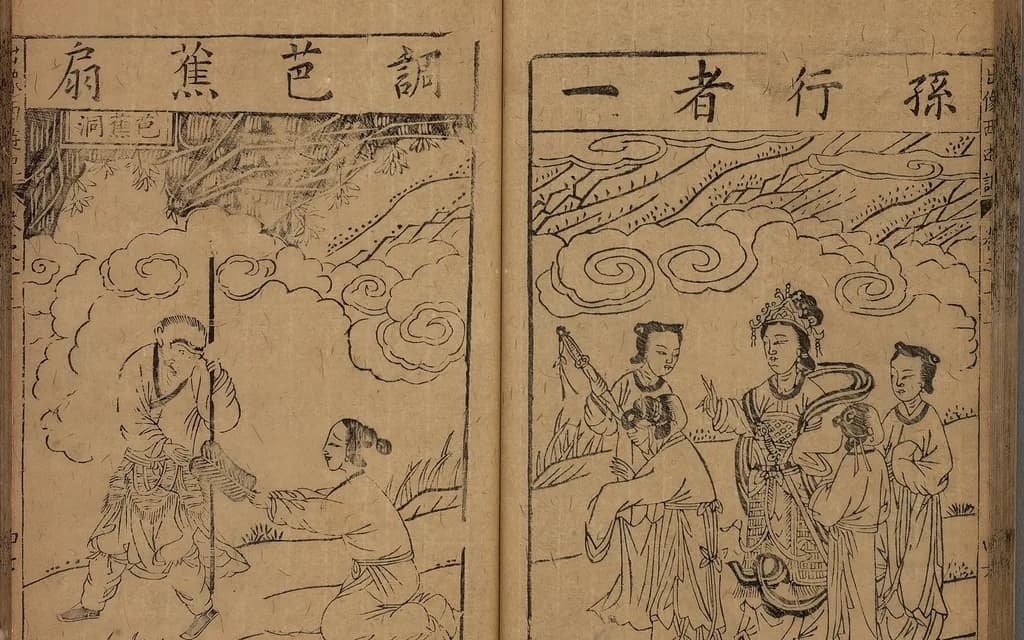
Most English-speaking readers meet this book sideways. A game, a cartoon, a monkey on a cloud in somebody else's anime, a half-remembered fact that Goku came from somewhere. Then they go looking for the source and find a hundred-chapter Chinese novel from the 1590s, four English translations that disagree about how much of it you need, and a wall of forum threads arguing about whether it is worth the time. This piece is the short version of that argument, with the parts that actually decide it.
- It is a hundred chapters, and the monkey has the first seven of them entirely to himself before the journey is even proposed.
- The middle is modular. Demon, capture, rescue, road again. You can put it down for a week and lose nothing.
- It is funny on purpose. Heaven is a bureaucracy, the pig complains about the catering, and the holy monk is the least competent person present.
- The translation decides your experiencemore than any other book on a beginner's list. Pick wrong and you will blame the novel.
Everything below is about that choice and what it buys you. If you would rather step into the story than read about it, the playable Journey to the West opens where the novel opens, on a stone egg on a mountain in the eastern sea, with nothing yet decided about what hatches.
🐒 Is it worth reading, or is the reputation bigger than the book?
It is worth reading, and the reason is structural rather than reverent: the book front-loads its best material. Sun Wukong's rise, his raid on Heaven and his imprisonment all happen in chapters one to seven, before the pilgrimage is even proposed. A reader who gives the novel a single evening still gets a complete story with a beginning and an ending.
That shape is unusual enough to be worth stating plainly. The monk the whole quest is named for is not born until chapter nine, does not take the commission until chapter twelve, and does not collect the monkey until chapter fourteen. If you have been told the book is a slow religious allegory that takes two hundred pages to warm up, whoever told you that had a translation with a long introduction and stopped reading it.
It helps to have the map before you start, because the book is really three books stacked. Chapters one to seven are the monkey's biography, from the stone egg to the mountain that finally holds him. Chapters eight to twelve are the setup, and they belong to other people entirely: a bodhisattva is issued equipment in chapter eight and sent east to find a scripture-seeker, a monk is born and orphaned in chapter nine, an emperor tours the underworld in chapter eleven and comes back owing the dead a favour, and in chapter twelve that monk volunteers at the ceremony held to pay it. From chapter thirteen the road starts, and it does not stop until chapter one hundred. Readers who stall usually stall in the second block, which is the only stretch of the novel with no monkey in it.
The online argument about whether it holds up is mostly not an argument about the novel. It is an argument about editions. Readers who describe the book as dry are usually describing an unabridged scholarly text with several hundred pages of apparatus, read as a first encounter rather than a second. Readers who describe it as one of the funniest things they have read are usually describing an abridgement that keeps the jokes and cuts the poems. Both are reading the same book.
📚 Which English translation should you pick?
For a first read, take Waley or Lovell. Both are abridgements and both are honest about it, and both were built to be read rather than consulted. For a second read, or for anyone who wants the whole thing including the verse, Anthony C. Yu's complete translation is the standard. W. J. F.
Jenner's complete version is the other unabridged option and the easier of the two to read straight through.
| Version | What you are getting |
|---|---|
| Arthur Waley, Monkey (1942) | Thirty of the hundred chapters, roughly a third of the book, chosen for narrative drive. The version most Western readers over forty have met, and still the fastest door in. |
| Anthony C. Yu (1977–83, revised 2012) | Complete, in four volumes, with the poetry translated rather than summarised. The scholarly standard. Revised throughout for the 2012 edition. |
| W. J. F. Jenner (1982–84) | Also complete, from Foreign Languages Press in Beijing. Plainer English than Yu and lighter on apparatus, which makes it the readable unabridged choice. |
| Julia Lovell, Monkey King (2021) | Thirty-six chapters for Penguin, in modern English with a deliberately irreverent register. The newest door, and the one built for readers arriving from the game. |
The second difference is what they do with the names, and it catches more readers out than the poetry does. Every character in this book has several: a birth name, a religious name given at ordination, a nickname, and often a title. The abridgements simplify aggressively, which is where the English nursery names come from, so the pig is Pigsy, the river demon is Sandy and the monk is Tripitaka. The complete translations keep Zhu Bajie, Sha Wujing and Tang Sanzang, and expect you to hold three names for the same character at once. Neither approach is wrong, but a reader who learns the party as Monkey, Pigsy and Sandy and then picks up a complete translation will spend fifty pages wondering who has joined.
The practical difference is what each one does with the poems. The Chinese text stops constantly to describe a mountain or a fight in verse, and those passages are where the novel is at its most beautiful and at its most skippable. Yu translates them. Waley mostly removes them. Lovell keeps a working sample. There is no correct answer, but there is a correct order: read one that keeps you moving, then go back for the one that keeps everything.
⏳ How long is it, and is an abridgement a compromise?
The complete novel runs a hundred chapters and lands somewhere around two thousand pages in English. An abridgement of it is less of a compromise than it would be for almost any other long novel, because of how the middle is built: once the party is assembled, the book becomes a sequence of largely self-contained episodes, each with its own demon, its own trap, and its own resolution.
Cutting one of those episodes removes an adventure. It does not remove a plot thread, because the next episode does not depend on it. This is why a thirty-chapter version can still feel like the whole book, and why the thing readers most often say about the unabridged text is that it is wonderful and repetitive at the same time. Both halves of that sentence are true and neither is a flaw; the novel was assembled out of centuries of separate storytelling before anyone wrote it down as one work.
There is one thing worth knowing before you commit to the long version. The novel is very interested in numbers, and it keeps its own accounts: distances are given in exact figures and repeated hundreds of pages apart, the ordeals the monk suffers are counted, and the counting is eventually read out loud and audited by a bodhisattva with a list. A reader in a hurry sees repetition. A reader who slows down sees a book quietly keeping score on itself, which is one of the pleasures the complete translations preserve and the short ones cannot. How that audit comes out, with one more ordeal added to make the count right, is traced in the Journey to the West ending explained.
What an abridgement genuinely costs you is texture. The full text is where the bureaucracy jokes live, where minor gods get whole scenes of terrified paperwork, and where the four pilgrims bicker at a length no summary preserves. If you finish a short version and find yourself missing the company rather than the plot, that is the signal to go and get Yu.
🎮 Why so many readers are arriving here from a video game
Because the game assumes the book. Black Myth: Wukong, released by Game Science in August 2024, is set long after the novel ends rather than retelling it, so it reaches for characters and grudges it never explains. Players outside East Asia who describe feeling that they walked in on a conversation are correct, and the missing piece is not a plot summary.
It is four hundred years of a story everyone around them grew up inside. That is a good reason to read the novel and a bad reason to feel behind. Nobody in China learned this book by reading it either. They got it from a grandmother, from a television serial that has been rerunning since the 1980s, from a schoolyard argument about which pilgrim you were. Arriving through a game is the same route with a different door, and the book is unusually welcoming to it, because the game's opening hours draw on episodes the novel tells in full.
The one thing worth setting straight before you start is that the game is a continuation rather than an adaptation, so its differences from the book are deliberate design rather than mistakes. We take that comparison apart properly in the piece on what the game changed, which also handles the other question everyone brings to this book, the one about a certain spiky-haired Japanese cartoon character.
The Chinese text is free at Project Gutenberg, which is where every chapter number in this series was checked. If you want to know who the monkey actually is before you commit two thousand pages to him, his powers and his headband are explained here, and the case for the character everyone underestimates is made in defence of the pig.
Sources
- Journey to the West (Chinese text, 100 chapters) — Project Gutenberg
- Journey to the West — Wikipedia
- What's the best translation of Journey to the West? — We Love Translations
- Yes, You Should Read Journey To The West Before Playing Black Myth: Wukong — GameLuster
Frequently asked questions
- Is Journey to the West worth reading?
- Yes, and the commitment is smaller than the reputation suggests if you start with an abridgement. The unabridged option is genuinely large: Anthony C. Yu's complete translation runs to about 1,873 pages across its four volumes, poetry included. Most first-time readers get more out of a shorter version and then go back for that one.
- What is the best English translation of Journey to the West?
- For a first read, Arthur Waley's Monkey or Julia Lovell's Monkey King. For everything, Anthony C. Yu's complete four volumes. There is also a middle option most readers miss: Yu made his own one-volume abridgement, The Monkey and the Monk, published in 2006, which keeps his translation and cuts the length.
- How long is Journey to the West, and should I read an abridged version?
- A hundred chapters, roughly two thousand pages complete. An abridgement is a normal way to read this book rather than a shortcut. The earliest surviving printing, made at Nanjing in 1592 by the Shidetang hall, already came with cross-page illustrations to carry readers through, and cut-down versions have been circulating ever since.
- Do I need to read the book before playing Black Myth: Wukong?
- No, but it was built for players who have. The game never introduces its cast, and it reached an enormous number of people who had no introduction to them: ten million copies sold within three days of its 20 August 2024 release. Reading even an abridgement first turns most of its unexplained references into jokes you are in on.
- Who actually wrote Journey to the West?
- Traditionally Wu Cheng'en, and the attribution is far shakier than most editions admit. Much of the material came out of centuries of folk storytelling before anyone assembled it, and the earliest surviving edition carries no author's name. Anthony C. Yu wrote that the dispute had see-sawed back and forth for nearly a century without resolution.
- Is Journey to the West hard to read for a first-timer?
- Less than expected, because you probably already know the opening. The novel's first seven chapters are the ones screen versions keep choosing, from the 1961 Shanghai animated film to Netflix's 2023 one, so a new reader usually arrives at chapter one already knowing the monkey's rise and his war with Heaven, and only meets unfamiliar material from chapter eight.
Enjoyed this one?