Miss Havisham Is a Victim, Not Just a Villain — What the Text Actually Shows
Readers keep choosing a side on this and the book keeps refusing to, which is why the question is still being typed into search boxes.


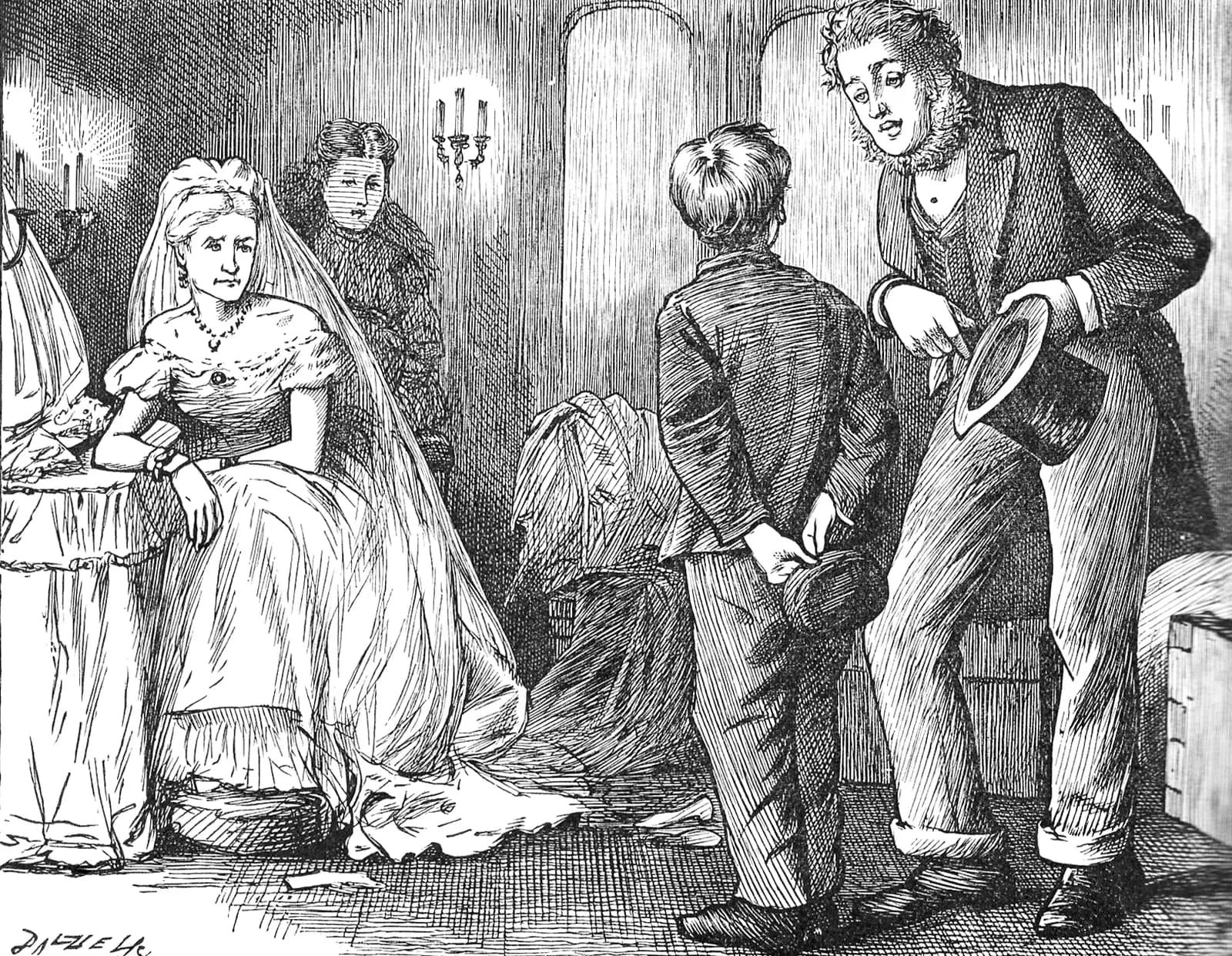
The question is the most-searched thing about her, and most answers pick a side and then argue it. The novel will not do that, and neither will the playable Great Expectations, which lets you meet her as a patron, a monster and a penitent inside a single run. Here is what the text actually shows, on both sides of the ledger, with chapter and line.
🖤 The cruelty, stated plainly
Nobody has to soften this half. Miss Havisham adopts a small girl and trains her, deliberately and over years, into an instrument. Herbert gives Pip the plan in one sentence in Chapter XXII, describing a child adopted and brought up “by Miss Havisham to wreak revenge on all the male sex” (l.7379), and Pip has already watched the training happen without understanding it.
“Break their hearts my pride and hope, break their hearts and have no mercy!”
Pip overhears that whispered into a child’s ear while the two of them play cards, and the detail that makes it worse is the greed Dickens gives the older woman: she watches Estella’s moods with a miserly relish, feeding on them. Pip himself is brought in as practice material, invited to fall in love on schedule so that the girl can learn her trade on a boy who cannot possibly defend himself.
💍 What was done to her first
The novel is equally specific about the origin, and it is not a broken heart in the ordinary sense. It is a confidence trick with a marriage wrapped round it, run by a fiancé who wanted her money and a half-brother who wanted his share. Chapter XLII names the man without ceremony: “Young Havisham’s name was Arthur. Compeyson is the man who professed to be Miss Havisham’s lover” (l.14789).
- The letter arrived while she was dressing.Herbert tells Pip the wedding dresses were bought, the tour planned, the guests invited, and “the day came, but not the bridegroom” (Chapter XXII, l.7599-7601).
- Twenty minutes to nine. Pip sees the stopped clock and the single shoe on her first visit, years before he is told what they mean (Chapter VIII, l.2363, l.2398-2399); Herbert confirms that is the hour and minute the letter reached her (l.7604-7607).
- It was money, not love. A modern reading of the same facts calls it romance fraud, and one academic account in The Conversation makes exactly that case: a fraudster courting a wealthy woman to strip her of her fortune, with a relative inside the plan.
The Bridal Chamber Burns is a doorway in the playable Great Expectations: she has just written you an order for nine hundred pounds for a friend's secret partnership, asked you to write 'I forgive her' under her name, and gone down on her knees at your feet, and the fire she has kept in that grate for decades is about to reach the dress. You can go back for her, or not. Role-play Great Expectations →
🕊️ The remorse is on the page, not implied
Chapter XLIX is the chapter people forget when they argue she is simply a villain. Pip comes back to ask her for money on somebody else’s behalf, gets it, and then tells her what she has done to him, and she drops to her knees in front of him with her hands folded.
“O!” she cried, despairingly. “What have I done! What have I done!”
She repeats the sentence for pages. The novel does not let her off with it either, because Pip notices that her grief is at least partly for herself, and the scene keeps the reader suspended between pity and the knowledge that the damage is already thirty years old and cannot be withdrawn by anybody saying anything.
🔥 A death written without triumph
Then Dickens burns her, in the same chapter, and writes it as an accident rather than as a judgement. Pip has turned to leave when the fire in the grate reaches the dress she has worn since the morning the letter came.
“In the same moment I saw her running at me, shrieking, with a whirl of fire blazing all about her, and soaring at least as many feet above her head as she was high.”
What follows is not a punishment scene. Pip throws his coat over her, drags the rotten wedding feast off the table to smother the flames, and holds her down while she fights him, burning his own arm badly enough that it is dressed three times before morning. Her last words on the page are an instruction to write “I forgive her” under her name (l.16965), and her death is reported off-stage eight chapters later, by Joe, in the gentlest way he can manage (Chapter LVII, l.19527-19538).
⚖️ Why readers keep splitting on her
Ordinary readers argue this out constantly, and the sharpest version of the argument barely concerns her. What it concerns is the chain: Compeyson breaks Miss Havisham, Miss Havisham builds Estella, Estella breaks Pip, and Pip goes home and is ashamed of the blacksmith who raised him. Every person in that sequence is passing on something that was done to them first, which is a harder and more useful reading than picking one of them to blame.
The reference works hedge for the same reason. The standard encyclopaedia article calls her one of the most gothic figures Dickens ever wrote and then describes her as a betrayal victim who becomes a perpetrator, which is two answers in one sentence rather than a decision between them.
The book was built to hold both. A villain readers feel sorry for and a victim readers cannot excuse is a harder thing to write than either half on its own, and it is the reason this particular question is still being typed into search boxes a hundred and sixty-five years after the last instalment went to press.
Sources
- Great Expectations (Project Gutenberg eBook #1400, 1867 text) — Project Gutenberg
- Miss Havisham — Wikipedia
- Great Expectations by Charles Dickens is an early exploration of romance fraud — The Conversation
- Great Expectations — Wikipedia
- Charles Dickens — Wikipedia
Frequently asked questions
- Is Miss Havisham cruel?
- Yes, deliberately and for years, and the novel never pretends otherwise. The setting says it before she does: Estella tells Pip in Chapter VIII that the house has a second name, Satis, "which is Greek, or Latin, or Hebrew, or all three," meaning enough — whoever owned it would want nothing else. It stands beside a disused brewery, and the woman inside it has wanted one thing only for decades.
- Who was Miss Havisham's lover?
- A man named Compeyson, who courted her for her fortune with her half-brother Arthur inside the plan. Arthur did not profit for long: Chapter XLII describes him dying poor in a room at the top of Compeyson's house, in a delirium in which he saw Miss Havisham standing over the bed shaking a shroud at him, and begging the people with him not to let her drop it over his shoulders.
- Who betrayed Miss Havisham?
- Her fiancé and her own half-brother together, and the money they took is the reason her will matters. Chapter LVII has Joe reporting its terms: most of the property was tied up on Estella, and a codicil written in Miss Havisham's own hand a day or two before the accident left four thousand pounds to Matthew Pocket, the one relative who never courted her, "Because of Pip's account of him."
- Was Miss Havisham based on a real person?
- Several women have been proposed and Dickens never confirmed any of them. The names that recur are Eliza Emily Donnithorne of Newtown in Sydney, jilted in the 1850s and said to have lived on in a darkened house with the wedding breakfast still on the table; Margaret Catherine Dick of Bonchurch on the Isle of Wight, jilted at the altar in 1860; and the London merchant Nathaniel Bentley, who is supposed to have shut up his dining room and left the meal to rot.
- Why did Miss Havisham adopt Estella?
- She says it plainly in Chapter XLIX, and what she describes is not revenge. She had been shut up in the house a long time, she tells Pip, when she asked her lawyer for "a little girl to rear and love, and save from my fate"; he said he would look out for such an orphan, and one night he brought a sleeping child to the house and she named her Estella. What she did with the girl afterwards is the other half of this page.
Enjoyed this one?