What Does Mr Hyde Look Like? Small, Not a Monster, and That Is the Point
Five people describe Mr Hyde in the novella and none of them can say what is wrong with him. Not one of them says he is big.


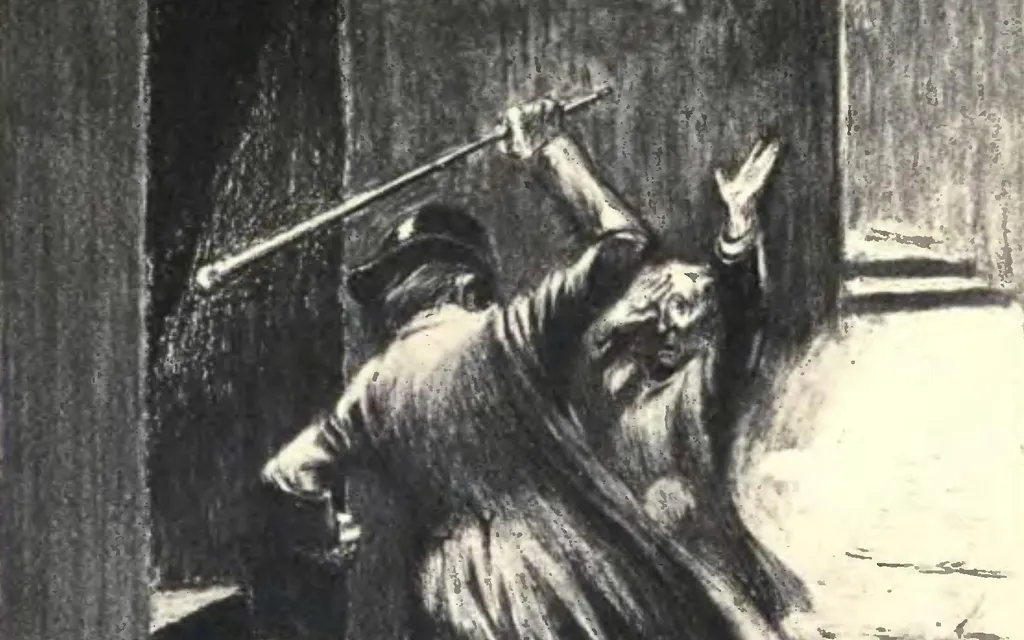
Picture the film poster. A hunched giant, a jaw like a shovel, hair over the eyes, hands the size of dinner plates. Now open the book, and the first person to meet Edward Hyde describes a little man stumping along eastward at a good walk.
Every witness in the novella agrees that Hyde is small. Not one of them can say what is actually wrong with him, and that combination is the effect Stevenson is after. The horror in this book is a failure of description, which is a hard thing to photograph and an easy thing to lose.
- Five witnesses describe him and every one of them reaches for the word small before anything else.
- Nobody can name the deformity, including the doctor who examines him at close range.
- His clothes do not fit,because they are Henry Jekyll's, and the difference is visible from across a room.
- The word monster never appears in the book,and its one cousin, monstrous, describes Hyde's pleasures rather than his body.
Here is what the text actually says, witness by witness, and why a small Hyde is a scarier one. If you would rather meet him than read about him, the playable Dr Jekyll and Mr Hyde puts you at the window over the lane on the night of the murder.
🔍 Deformity without any nameable malformation
The novella's central description of Hyde is a description of a failure. Enfield, asked what the man is like to see, produces one of the strangest passages in Victorian fiction: he says there is something wrong, something displeasing, something downright detestable, that he has never disliked anyone so much and scarcely knows why, and that the man must be deformed somewhere without his being able to specify the point.
He then insists he could not describe him, and that this is no failure of memory, because he can see him at that moment. The reaction is contagious, which is the part the makeup departments have never managed to reproduce. In Enfield's account the crowd that gathers around the trampled child turns on Hyde as a body: the women are as wild as harpies, and the apothecary who has been sent for is the detail that sticks. He is described as about as emotional as a bagpipe, and Enfield watches him turn sick and white with the desire to kill the man every time he looks at him. A doctor with no imagination and no stake in the matter wants to commit murder in the street, and cannot say why either.
Utterson gets his own look later and does no better, though he produces the phrase everyone quotes.
“Mr. Hyde was pale and dwarfish, he gave an impression of deformity without any nameable malformation, he had a displeasing smile, he had borne himself to the lawyer with a sort of murderous mixture of timidity and boldness, and he spoke with a husky, whispering and somewhat broken voice.”
Read that list slowly and notice how little of it is a face. Pale, small, an unpleasant smile, a bad voice, a manner that is frightened and aggressive at once. A police artist could not work from it. Utterson knows this, casts about for an explanation, wonders whether the man is something troglodytic, and settles for the conclusion that there must be something else he cannot find a name for.
👁️ What the witnesses actually report
Five people describe Hyde across the novella, and their accounts agree on size and nothing else. Enfield and Utterson supply the two passages above. The maid who watches the murder from her window sees a very small gentleman and pays him less attention than she pays the white-haired man he is about to kill; the police officer who takes her statement passes it on as particularly small and particularly wicked-looking.
Poole, who has served Jekyll for twenty years and knows exactly where his master's head comes to in a doorway, says the thing in the cabinet was more of a dwarf. Lanyon, the fifth, gets the closest look of anyone and is the least able to say what he saw.
| The film version | The book |
|---|---|
| A hulking figure, larger than the doctor | Smaller, slighter and younger than Jekyll |
| Prosthetics: brow, teeth, jaw | A deformity nobody who sees him can locate |
| A roar, or a growl | A husky, whispering and somewhat broken voice |
| Clothes that strain and tear | Clothes far too large, trousers rolled up off the ground |
The clothes are the detail that settles the argument, because the plot uses them twice. Lanyon, opening his door at midnight, sees a small man in rich, sober fabric that is enormously too large for him in every measurement: the trousers rolled up to keep them off the ground, the waist of the coat below his haunches, the collar sprawling across his shoulders. He notes that the effect ought to be comic and is not. On the last night, the body on the cabinet floor is wearing the same problem, in clothes of the doctor's bigness.
What people notice instead of a face is a sound. Utterson, waiting in the entry on the night he finally catches him, hears an odd light footstep coming up the empty street and knows before he sees anything that this is the man; the tread springs out of the general clatter of London and arrests his attention as no footfall ever has. Poole hears the same walk from outside the cabinet door months later and describes it as falling lightly and oddly, with a certain swing, nothing like the heavy creaking tread of his master. Once, he tells Utterson, he heard it weeping.
Only the violence is oversized. Enfield says the trampling was not like a man but like some damned Juggernaut; the murder chapter reaches for ape-like fury and a cane of rare, tough, heavy wood that breaks in half against a body; Poole compares the masked thing that jumped from among the chemicals to a monkey. Small body, disproportionate force, and no adjective that will hold still.
🎬 Why the screen makes him enormous
Because a camera cannot photograph an absence. The novella's effect depends on witnesses failing to describe a man, which works in prose precisely because the reader keeps trying to assemble a face and cannot. Put that on film and you have an actor standing in a doorway looking ordinary while other characters insist he is dreadful.
So adaptations manufacture something nameable. The change gets written into the makeup department: a heavier brow, worse teeth, more hair, a stoop that reads at the back of a theatre. The habit is older than cinema, since the stage version that made the story famous in the 1880s already needed the transformation to be visible from the stalls, and it has been the default ever since.
The exceptions are worth seeking out, and the most convincing of them are much older than you would expect. Our ranking of the screen versions starts with the one that got closest by using almost no makeup at all.
🧪 Why Stevenson made him small
Because Hyde is a portion of a man rather than an addition to one. That is the whole logic of the transformation, and the size is the visible sign of it: what walks out of the cabinet is less than what went in.
Jekyll writes that the second body came out smaller, slighter and younger than his own, and the novella never asks you to be frightened of Hyde's strength. It asks you to be frightened of how little of a person is required. The physical ugliness follows the same rule. Jekyll describes evil as having left on that body an imprint of deformity and decay, and calls Hyde, alone in the ranks of mankind, pure evil, which he means as a statement about proportion rather than about horns. Everyone else is a mixture. Hyde is the only person anybody in the book has ever met who is unmixed, and the flinch he produces in strangers is a reaction to that arithmetic showing through a face.
The novella keeps one physical prop for this and puts it in the same room as the confession. On the night of the first change there is no looking glass in the laboratory room at all, so he has to steal across the yard and along his own corridors in the dark, a stranger in his own house, to reach the mirror in his bedroom. The tall glass that stands beside him as he writes the last chapter was carried into the cabinet later and, in his own phrase, for the very purpose of these transformations. A doctor who installs a mirror in his laboratory in order to watch himself become somebody else has already decided what the experiment is for.
There is one more line that a bigger Hyde makes impossible. Standing at the mirror the first time, Jekyll reports no repugnance at all, but a leap of welcome, and writes that this, too, was myself. A monster in the glass would let him off. A smaller, younger, worse version of his own face does not, and the whole moral machinery of the last chapter runs on the difference. Which is the reason the villain question stays open.
The full 1886 text is free at Project Gutenberg, and every description quoted here is in the first fifty pages of it.
Sources
- Strange Case of Dr Jekyll and Mr Hyde (1886), full text — Project Gutenberg
- Dr. Jekyll and Mr. Hyde (1920) — AFI Catalog of Feature Films
Frequently asked questions
- Why is Mr Hyde described as small?
- Jekyll offers an explanation and it is arithmetic, not horror. He reasons that the evil side of him was less robust and less developed than the good, because his life had been nine tenths a life of effort, virtue and control, and had exercised the other part very little. The part he had starved came out smaller, slighter and younger than the man who starved it.
- Is Mr Hyde actually deformed?
- Nobody can say where. Lanyon, the one doctor who examines him at close range, records a shocking expression and a remarkable combination of great muscular activity and great apparent debility of constitution, plus a physical reaction in himself that he first puts down to personal distaste. He is a trained physician describing a patient and he still cannot name a symptom.
- How old is Mr Hyde?
- Younger than Jekyll, which the book makes concrete by giving Jekyll an age. In the dinner-party chapter he is a large, well-made, smooth-faced man of fifty. The phrase young man is used of Hyde twice, once by Utterson and once by Jekyll himself, and Jekyll's own account says the second body came out younger as well as smaller. The gap is a generation, inside one person.
- Why can nobody describe Mr Hyde?
- The manhunt chapter says so directly: Hyde had few familiars, his family could not be traced, he had never been photographed, and the few who could describe him differed widely. They agree on exactly one thing, the haunting sense of unexpressed deformity. A police force cannot circulate a description made entirely of feelings.
- Which screen Hyde looks most like the book's?
- The oldest famous one. In the 1920 Paramount film the early part of the first transformation is played with no makeup at all, using only John Barrymore's face and body, which is closer to a change nobody can quite name than any prosthetic since. The full ranking, including what the sound era did to him, sits in our adaptations piece.
Enjoyed this one?