Who Is Mr Utterson in Jekyll and Hyde? The Dull Man the Story Runs Through
Two men are in the title and neither one tells the story. It belongs to a lawyer whose defining trait, on the page, is that nothing about him is interesting.


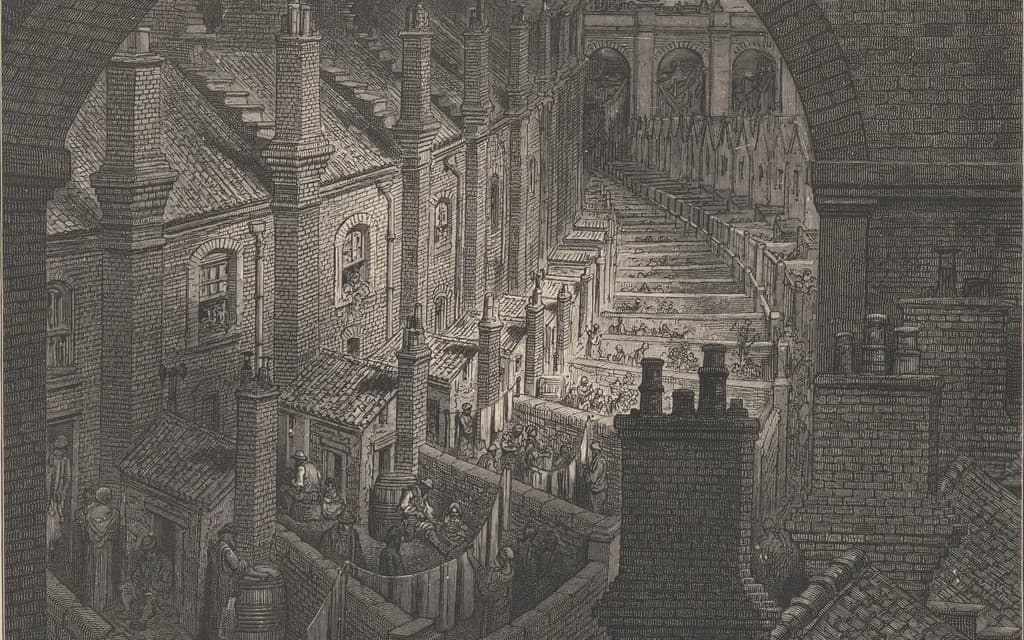
Two men are named on the cover and neither one of them tells you the story. It belongs to a London solicitor called Gabriel John Utterson, who is on stage for eight of the ten chapters, and whose most striking quality, as Stevenson introduces him, is that there is nothing striking about him at all.
Study guides tend to file him under narrative device and move on. Readers who finish the book tend to come away oddly fond of him. Both reactions are correct, and the second one is the more interesting, because the dullness is not an accident of characterisation. It is the instrument the whole novella is played on.
- He holds eight of the ten chapters, and the plot is simply his investigation, in order, with nothing he does not witness.
- Jekyll appears in person three times before the confession: a dinner party, a cabinet and a window.
- His virtue is incuriosity, which makes him the last man in London who would guess the answer.
- He is the reason the story stays believable, because a fantastic event reported by an unimaginative man reads as evidence.
What follows is the case for Utterson as the real main character, and why a story about a transformation was handed to the least transformable man available. If you would rather walk the by-street than read about it, the playable Dr Jekyll and Mr Hyde opens on his Sunday walk.
🧭 Whose story is it?
Utterson's, by any test you would normally apply. He is present for every event in the first eight chapters, the investigation is his, and the reader learns nothing before he does. Jekyll, whose name is in the title, is physically present in three scenes: he hosts a dinner and deflects a question about his will, he receives Utterson in the cabinet after the murder and hands over a letter, and he sits at a window and has the smile struck out of his face.
That is the entire on-page career of the man the book is named after until his confession arrives in an envelope. Even the two chapters he is absent from are addressed to him. The narrative left by Hastie Lanyon, the third friend in the group and the only other doctor in it, is superscribed for the hands of G. J. Utterson alone, and Jekyll's confession is written for him to read after the fact. There is no page of this novella that is not either watched by Utterson or written to him, which is a stricter arrangement than most first-person novels manage.
Hyde does even less. He is on the page for one conversation, one murder witnessed from an upstairs window by a fainting stranger, and one appearance in a doctor's consulting room at midnight. Everything else about him reaches us as report and rumour, filtered through people who cannot describe him.
So the shape of the book is a slow professional investigation carried out by a man whose entire training is in not jumping to conclusions. Stevenson is not withholding the answer from the reader so much as routing the whole story through the one consciousness in London least likely to arrive at it, which is a different and more durable trick. It is also why the ending survives being known in advance.
🕵️ “If he be Mr Hyde, I shall be Mr Seek”
This is the moment Utterson stops holding information and starts pursuing it — and the joke he makes to himself as he does it is the closest this dry, incurious man comes to enjoying anything. Thought rather than spoken, in the chapter called Search for Mr Hyde, it follows a will he cannot explain and no answer from anyone who might know one: he decides to find the beneficiary himself, by standing outside the door until the man turns up.
Before he becomes a detective he has the one imaginative episode of his life, and Stevenson gives it two full pages. Lying awake after reading the will, Utterson finds the story told by Enfield, his distant kinsman, replaying itself in his head as a scroll of lighted pictures: a nocturnal city of lamps, a man walking swiftly, a child running, the two of them meeting at a corner. Then the vision changes into a rich house where his friend lies asleep and smiling, and the curtains of the bed are drawn apart by a figure to whom power has been given, and the sleeper has to get up and do its bidding. The detail that keeps him awake is that the figure has no face. Even in his dreams, Stevenson writes, it had no face, or one that baffled him and melted before his eyes.
The pun is the moment Utterson stops being a worried friend and becomes an investigator, and it is the only joke he makes in the whole novella. Having dreamed a faceless man all night, he decides to go and look at the real one, and he stakes out the door in the by-street: in the morning before office hours, at noon when business is plenty and time scarce, at night under the face of the fogged city moon.
“If he be Mr. Hyde, I shall be Mr. Seek.”
Readers quote it because it is funny and slightly embarrassing, in the way an entirely serious person is funny when they surprise themselves. It is also the only glimpse of appetite the character allows himself. Stevenson has just told us Utterson mortifies his own tastes as a matter of habit, and here is the one he cannot mortify: he wants, badly, to see this face.
When he gets it, the stakeout pays off in a way that is worth reading twice. He touches Hyde on the shoulder, asks outright to see his face, and stares at him for a few seconds in a lit street. Then he walks home and reasons his way, carefully and professionally, to the wrong conclusion, deciding that the man carries the mere radiance of a foul soul and that his old friend must be paying for some concealed disgrace. The evidence was in his hand. His character would not let him hold it up to the light.
🪨 What the dullness buys
Credibility, mostly, and it is bought with a line in the first paragraph. Utterson is described as austere with himself, backward in sentiment, and inclined in any extremity to help rather than reprove, and then Stevenson gives him a motto that explains every decision he makes for the rest of the book.
“I incline to Cain’s heresy,” he used to say quaintly: “I let my brother go to the devil in his own way.”
A man with that principle is exactly the wrong person to save Henry Jekyll and exactly the right person to narrate him. He will not pry. He will not gossip. He will not accept the obvious supernatural explanation, and when Poole, Jekyll's butler of twenty years, tells him the thing in the cabinet is a different size from his master, his first move is to construct a medical theory involving a disease that both tortures and deforms the sufferer. Every reasonable man in the story reaches for a reasonable answer, and the reasonable answers keep failing, which is how the unreasonable one earns its place.
Stevenson also spends real care establishing that Utterson has no inner life he is willing to discuss, and does it through the one relationship the book gives him. He and his kinsman Enfield take the same walk every Sunday. People who pass them report that they say nothing, look singularly dull, and greet the arrival of any third person with obvious relief. Both men nevertheless treat these excursions as the chief jewel of the week and turn down other pleasures to keep them. That is a friendship conducted almost entirely in silence, and the novella presents it without irony, as the ordinary shape of male company in that world.
The friendship is the other half of it. Utterson's loyalty is the engine of the plot: he keeps the will he disapproves of, promises to look after a man he loathes, and after everything is over his instinct is still to protect a reputation, telling Poole they will say nothing of the paper so that they may at least save his master's credit. He is a decent man being decent at exactly the wrong moments, and the tragedy runs on that.
🚪 The room he never gets to enter
For all his persistence, Utterson never actually sees the thing he spends the book chasing. He gets close twice. At the window in the court he watches Jekyll's face change for a second and turns away without a word, and all he can say afterwards, twice over, is God forgive us.
Then, on the last night, he takes a kitchen poker into the yard while Poole, the butler, swings an axe at the cabinet door, and it takes five blows to break a lock made by good Victorian workmanship. Inside there is a fire, a singing kettle and the tea things laid out ready by the chair, and a body on the carpet whose face is the wrong one, so recently dead that the cords of it are still moving. He has arrived, as he says himself, too late to save or to punish. The explanation he has been hunting for eight chapters is on the desk in an envelope with his own name on it, and he takes it home to read alone.
That is the last thing the novella does with him. The final two chapters are other men's documents, and the book ends inside Jekyll's account without ever returning to the lawyer reading it. We never see his face when he finishes. Stevenson gives the last word to the man who ruined everything and leaves the man who tried to help sitting in a room with a candle, which is a colder ending than the monster gets.
The full 1886 text is free at Project Gutenberg, and Utterson is on the first page. If you want the other half of the argument, the man he is looking for looks nothing like the posters.
Sources
- Strange Case of Dr Jekyll and Mr Hyde (1886), full text — Project Gutenberg
- Strange Case of Dr Jekyll and Mr Hyde — Wikipedia
Frequently asked questions
- Is Mr Utterson the protagonist of Jekyll and Hyde?
- Technically yes, and the book tells you why in its second paragraph. Utterson is described as the man who tends to be the last reputable acquaintance and the last good influence in the lives of downgoing men. That is a job description, not a character note. The plot is what happens when he applies it to a friend who is past saving.
- Why is Mr Utterson so boring?
- Because Stevenson builds him that way, in detail, on the first page. He is cold, scanty and embarrassed in discourse. He enjoys the theatre and has not entered one for twenty years. He drinks gin when he is alone in order to mortify a taste for vintages. A man who rations his own pleasures is the right man to investigate someone who stopped.
- Who narrates Jekyll and Hyde?
- Nobody, in the strict sense. Eight chapters are third-person but locked to Utterson, and the last two are documents in other men's handwriting: Lanyon's narrative and Jekyll's statement, which together are roughly two-fifths of the text. The story reaches you the way it reaches Utterson, which is to say late and on paper.
- What happens to Mr Utterson at the end?
- He inherits and then vanishes. Among the papers on the cabinet table is a second will, drawn in the same eccentric terms as the first, with Edward Hyde's name replaced by Gabriel John Utterson's. He pockets the sealed confession, walks home to read it, and the novel ends inside Jekyll's account without ever cutting back to him.
- Who is Mr Enfield in Jekyll and Hyde?
- Utterson's distant kinsman and a well-known man about town, and his opposite in every way except one. They walk together every Sunday, reportedly saying nothing, and both hold the same rule about other people's business. Enfield states it outright: the more a thing looks like Queer Street, the less he asks. The plot only starts because he breaks it once.
Enjoyed this one?