The Twist You Already Know, and How to Read Jekyll and Hyde Anyway
Every reader arrives knowing. That has been true for a century, and the novella survives it, because the person being kept in the dark was never the reader.


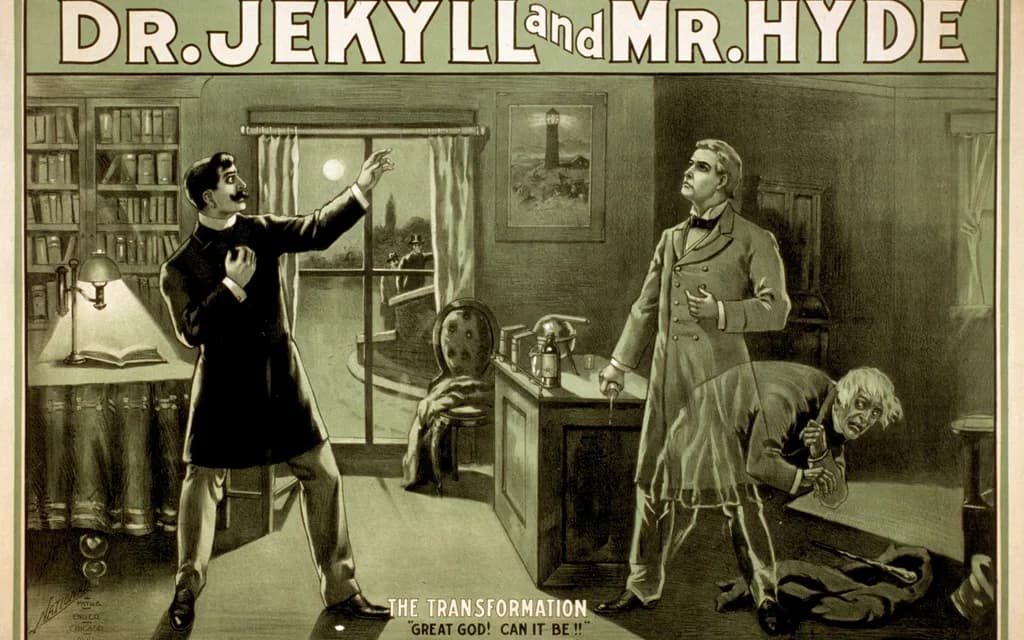
There is no polite way to preserve the surprise in this one. The two names are on the cover, they have been on the cover since 1886, and the phrase has been in ordinary English for longer than anyone reading this has been alive. Teachers have tried banning the word in class. It does not work, and it was never going to.
The useful news is that the novella was not built to fool you. It was built to fool a middle-aged solicitor with a good memory and a rule about not asking questions, and watching him fail is a better hundred pages than the reveal would have been.
- The book withholds nothing from you that it does not also withhold from its own narrator, who is in every scene.
- Utterson has a theory, and it is confident, professional and completely wrong for eight chapters.
- The clues are legible to a modern reader in a way they were not in 1886, which changes what the suspense is made of.
- It is short enough to read in an afternoon, which is the other reason knowing the ending costs so little.
Below is what the first readers had that we do not, what the book keeps hiding after the secret stops being one, and the true story of how it got written. If you would rather stand in the fog than read about it, the playable Dr Jekyll and Mr Hyde starts at the door in the by-street, where Utterson starts.
🗞️ What the first readers did not know
They did not know the ending, and they also did not have the phrase. In January 1886 nobody could reach for a comparison, because the comparison had not been invented yet. That absence is worth holding on to, because the novella was written for a reader who had to assemble the idea from scratch, and it paces its clues for that reader.
The information is dealt out in an order that only makes sense if the audience is starting cold. Enfield, Utterson's distant kinsman, sees a small man trample a child at three in the morning and pay her family off with a cheque signed by somebody famous. Utterson reads a will leaving everything to a man he has never heard of. Lanyon, a fellow doctor who has known Jekyll since school, refuses to hear the name spoken and is dead within three weeks. Poole, Jekyll's butler of twenty years, tells him the thing in the cabinet is more of a dwarf than his master. Each of those is a hard piece of evidence, and none of them can be assembled by anyone who is not allowed to consider the obvious answer.
The publication history was a two-country affair, and both halves of it survive. The novella appeared in 1886 from Longmans in London and from Scribner's in New York, and library scans of both of those printings are open on the internet today, which is a strange thing to be able to say about a book whose whole subject is a document nobody was supposed to read. What happened afterwards is the reason nobody comes to it cold now. The two names turned into an ordinary English idiom, and the idiom travels further and faster than the novella ever could.
What the first readers had, in other words, was permission to be confused. We have lost it and gained something else, which is the pleasure of watching intelligent men reason carefully towards the wrong door. How they finally get through the right one, in the order the last three chapters reveal it, is traced in the Jekyll and Hyde ending explained.
🔍 The book hides it from Utterson, not you
Utterson's theory is blackmail, and he holds it for most of the novella with real professional conviction. Enfield gets there first and even names the building for it, calling the place with the door Black Mail House on the strength of one night's evidence. From that point on, every new fact gets filed under the same heading by both men.
This is why the pursuit chapter is stranger than its reputation. Utterson stakes out the door at all hours and does eventually get his man. Hyde stops, answers civilly enough, agrees to show his face, and then volunteers his home address in Soho, unprompted, to a stranger who has just accosted him in the dark. Utterson walks home convinced he has met something barely human and concludes that his old friend must be paying for a sin committed decades ago. He is holding almost the entire solution and reading it upside down.
The strongest single piece of evidence arrives later, over a bottle of wine, in the flattest possible language. Utterson shows a letter to Guest, his head clerk, who is a student of handwriting, and Guest compares it with a dinner invitation from Jekyll.
“Well, sir,” returned the clerk, “there’s a rather singular resemblance; the two hands are in many points identical: only differently sloped.”
Nobody in the room draws the conclusion. Utterson locks the note in his safe and thinks, with his blood running cold, that Henry Jekyll has forged for a murderer. A man holding all the facts will still pick the reading that leaves his friend innocent of the worse thing, which is, incidentally, the same reason Stevenson gave the story to this particular lawyer.
🕯️ The dream, the burnt draft, and what Stevenson said
The legend says Stevenson dreamed the whole book, wrote it in three days, burnt the draft when his wife criticised it, and was on cocaine throughout. Stevenson published his own version of events in an essay called A Chapter on Dreams, and it is both stranger and considerably less lurid.
By his account he had been hunting for years for a story that could carry his sense of man's double being, spent two days racking his brains for a plot, and then dreamed precisely three scenes: the scene at the window, and a scene that was later split in two, in which Hyde takes the powder and changes in front of the men hunting him. Everything else, he writes, was made awake and consciously. He is careful about the credit, giving his dreaming self the machinery and keeping the meaning for himself, and he cheerfully blames that same dreaming self for the business of the powders, which reviewers had complained about.
The burnt manuscript is the part that does not survive contact with the record. Scholars note there is no direct factual evidence for the burning, and the one manuscript Stevenson does report destroying in that essay is a different story altogether, an earlier attempt at the same idea called The Travelling Companion, which he burnt on the grounds that it was not a work of genius and that Jekyll had replaced it. The three-day draft comes to us from his stepson's recollection, and the cocaine has no direct evidence behind it at all.
Nothing in the sober version makes the story less interesting. A man who has been trying to write one idea for a decade finally gets three usable images in his sleep and then does the actual work at a desk, twice, quickly, under money pressure, while seriously ill. That is a better story about writing than the binge.
📖 How short is it, really?
Short enough that the question of spoilers is close to academic. The full text runs to roughly 25,500 words, which most people will finish in one sitting, and the page counts you see advertised vary between about eighty and a hundred and twenty only because publishers choose different type. There is no abridgement involved and no long version to hunt for.
The proportions inside it are the surprising part. Nothing is explained until the ninth chapter, and the confession that explains everything is a little over a quarter of the whole book on its own. Stevenson spends three quarters of his length on an investigation that cannot succeed and then hands you two documents that answer every question at once, which is a structure almost no modern thriller would risk.
Knowing the answer also changes which scenes carry the weight. On a first blind read the strong material is the mystery: the door, the trampled child, the will. On a read where you already know, the strong material is the friendship. Utterson calling on a man who will not come down; Utterson at the window watching a face change and turning away without a word; Utterson promising to look after a person he cannot stand because his friend asked him to. None of that depends on surprise, and all of it is doing more work than the reveal ever did.
So the honest recommendation for anyone who has been putting it off on spoiler grounds is to stop treating it as a puzzle box. Read it as the story of a decent man watching a friend disappear behind a door he has a key to, and the ending you already know arrives as confirmation rather than revelation. That is how its first readers experienced the second half anyway, once they had guessed.
The 1886 text is free at Project Gutenberg, and Stevenson's own account of the dream is in A Chapter on Dreams. If the version in your head came from a film rather than the page, here is which one to trust.
Sources
- Strange Case of Dr Jekyll and Mr Hyde (1886), full text — Project Gutenberg
- Across the Plains, with Other Memories and Essays (1892), including 'A Chapter on Dreams' — Project Gutenberg
- Strange Case of Dr Jekyll and Mr Hyde — Wikipedia
- The Plays of W. E. Henley and R. L. Stevenson, including 'Deacon Brodie, or The Double Life' — Project Gutenberg
Frequently asked questions
- How long does it take to read Jekyll and Hyde?
- An afternoon. The Project Gutenberg text runs to roughly 25,500 words, which is well under two hours at a brisk pace and about three at a slow one. Printed editions range from about eighty to a hundred and twenty pages because the type size changes, not the book. The final chapter alone is a little over a quarter of the whole.
- Did Stevenson write Jekyll and Hyde in three days on cocaine?
- There is no direct evidence for the drugs. Stevenson credited a dream with exactly three scenes and said the rest was made awake and consciously. The three-day draft comes from his stepson Lloyd Osbourne's recollection, which the standard reference itself queries, and scholars note there is no factual evidence that the first manuscript was ever burnt.
- Is Jekyll and Hyde worth reading if you know the ending?
- Yes, because the suspense was never the mechanism. What you are watching is a careful lawyer build a confident, completely wrong theory: Enfield decides the place with the door is a blackmailer's address and christens it Black Mail House, and Utterson then devotes eight chapters to buying his friend out of a crime nobody is committing.
- Did The Picture of Dorian Gray invent the plot twist?
- Readers raise this because Wilde's novel has the louder reputation, but the dates run the other way. Stevenson's novella was published in January 1886 and Dorian Gray followed in 1890. Neither one invented anything so large. They share a shelf, a decade and a preoccupation, and the claim that either invented the twist is a pub argument rather than literary history.
- Who was Deacon Brodie?
- An Edinburgh cabinet-maker, trades-guild deacon and city councillor who kept a second life as a burglar. Stevenson was gripped by him as a teenager, wrote a script about him, and reworked it with W. E. Henley into a play first produced in 1882 under the title Deacon Brodie, or The Double Life. The novella followed four years later.
Enjoyed this one?