Painted Skin, Explained: The Demon Behind Liaozhai's Most Famous Ghost Story
Modern versions make the demon a woman wronged into monstrosity. Pu Songling gives her no history and no excuse, and the scholar who took her in never gets a warning he is willing to hear.


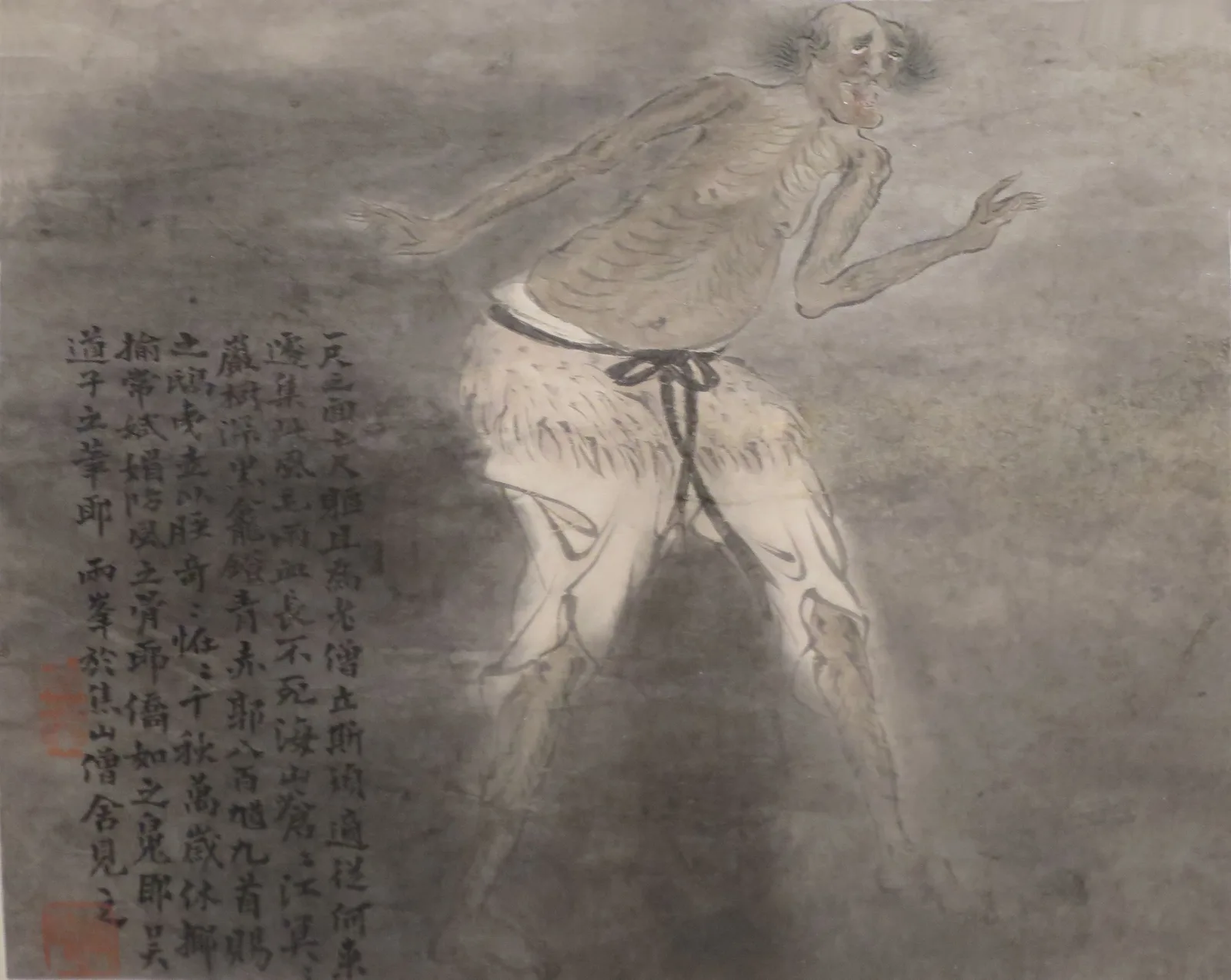
Painted Skin is the one story from this collection that almost everyone has met in some form, and the form most people meet it in has the sympathy pointed the wrong way. Modern retellings tend to make the demon a tragic figure, a woman wronged into monstrosity. Pu Songling’s version gives her no such history and no such excuse.
Every quotation below comes from Herbert Giles’ 1880 translation, free at Project Gutenberg, with its line reference attached. The same scene opens the playable Strange Tales from a Chinese Studio, where you are standing outside the study when the woman talks her way in, and what you do about it is yours to decide.
The short answer: she was never the victim
A man named Wang meets a young woman on the road early one morning, carrying a bundle and struggling to keep up a pace. She tells him her parents sold her as a concubine into a rich household where the wife “beat and abused me morning and night”, and that she has run away with nowhere to go. He takes her home and hides her in his library. Everything she has said is a lure, and the story never at any point suggests otherwise.
This matters because the tale is frequently summarised as a story about a woman driven to monstrosity by abuse. The abuse is her cover story. What the text gives her instead is one line of motive, delivered by the priest who has to deal with her, and it is a motive of pure need rather than grievance.
“The creature must be in great distress to be seeking a substitute for herself.”
That is as close as Pu Songling comes to a backstory, and it is not an excuse so much as an explanation of appetite. Something is owed somewhere, and a human life will settle it. The priest who says this is also the one character in the tale who declines to kill her on sight, because he “could hardly endure to injure a living thing”, which is a piece of moral texture the screen versions tend to hand to somebody else.
What actually happens, plainly
The sequence is short and it moves fast. Four things happen, in this order, and the whole tale is over in a handful of pages.
- A stranger warns him and he ignores it.Wang meets a Taoist priest in town who looks at him in astonishment and says “you are bewitched”. Wang decides the man is touting for business. The priest walks off remarking that some people do not seem to know when death is at hand.
- He looks through the window.Finding his library door shut, Wang climbs the wall and sees “a hideous devil, with a green face and jagged teeth like a saw, spreading a human skin upon the bed and painting it with a paint-brush”, then shaking the skin out and throwing it over its shoulders “just as you would a coat”, at which point it is the girl again.
- The ward fails.The priest gives him a fly-brush to hang at the bedroom door. The demon circles it, grinds her teeth, comes back, tears it to pieces and says “do you think I am going to give up what is already in my grasp?” Then she walks straight to the bed and takes his heart.
- The priest finishes it. She has moved on to another household under another face. The priest strikes her down in the courtyard, the skin drops off, and he beheads the thing underneath with a wooden sword and corks the smoke of it into a gourd.
Note what is missing from that sequence. There is no duel, no reveal withheld for a final act, and no moment where the demon is shown regretting anything. The horror is procedural, and the tale’s interest is plainly in the man who would not listen rather than in the creature who ate him.
The part almost every retelling skips
Wang is dead by the middle of the story. Bringing him back takes up nearly as many words as killing him did, and it is the section adaptations reliably cut, because it is humiliating rather than heroic and it happens to his wife instead of to him.
The priest tells her plainly that he cannot raise the dead, and sends her to a man he describes as a maniac in the town who passes his time grovelling in the dirt. She finds him raving by the roadside, so filthy that her husband’s brother can barely go near him. She kneels. He leers at her and asks “do you love me, my beauty?” When she explains why she has come, he laughs, tells her she can get plenty of other husbands, and then beats her with his staff in front of a crowd that grows while it watches. She takes all of it without a word of complaint, because the priest told her to show no sign of anger whatever he did.
Read in sequence, the tale is doing something colder than a rescue. A man is destroyed by a lie he wanted to believe, and the person who pays for the cure is the wife he lied to in the first place, in public, on her knees. Pu Songling does not comment on the arrangement. He simply puts it on the page in the same flat voice he used for the skin and the paint-brush. She does what she is told, and by the next morning her husband is alive again.
Why the villain reading is right here, and only here
The fan wikis file this demon straightforwardly as a villain, villains.fandom.com included, and on this tale they are correct. She lies, she kills, she moves on to the next house, and the text supplies no counterweight. If your only exposure to this collection is Painted Skin and its screen versions, you would reasonably conclude that Pu Songling wrote monsters.
He mostly did not, and that is the more interesting fact about this book. Across the collection the foxes, ghosts and spirits are far more often the sympathetic party than the threat, which makes this demon an outlier rather than a template. The argument and the counting are set out in the essay on whether this book’s spirits are villains or victims, which treats Painted Skin as the exception it is.
The screen history is a separate subject with a separate logic, since the 2008 feature and its sequels reworked the demon into something the tale would not recognise; that history is covered in the adaptation essay. The tale itself is a page or two long and free to read at Project Gutenberg, where it appears under Giles’ own heading, The Painted Skin.
Sources
- Strange Stories from a Chinese Studio, translated by Herbert A. Giles (1880) — Project Gutenberg
Frequently asked questions
- Is Painted Skin based on a true story?
- The tale makes no claim to be. It opens the way most of this collection opens, with a place and a surname: at T'ai-yüan there lived a man named Wang. That formula is the book's standing gesture towards reportage, borrowed from historical writing, and it is applied identically to talking foxes and underworld clerks.
- What is the demon in Painted Skin?
- The tale refuses to say. It fixes only two appearances for her: on the road, where Giles has her as “a pretty girl of about sixteen”, and in the next household, where she turns up as an old woman taken on as a maid-of-all-work. The playable edition supplies the modern label 画皮鬼; Pu Songling supplies no name, no species and no origin at all.
- Does the scholar Wang die in Painted Skin?
- Yes, and he stays dead for a good stretch of the story before he is brought back. The tale closes on the evidence rather than the reunion: where the wound had been there was “a cicatrix about as big as a cash”, and it soon after disappeared. That vanishing scar is the only trace the whole episode leaves on him.
- How is Wang brought back to life in Painted Skin?
- By swallowing something. The filthy madman who abuses his wife in the street finally hands her a loathsome pill and tells her to get it down, which she barely manages. Later, while she is preparing the body, a lump rises in her throat, comes out with a pop and falls into the wound, and it is a human heart.
- Is the 2008 Painted Skin film based on this story?
- Loosely. Gordon Chan's film gives the demon a name, Xiaowei, and a history the tale withholds, and it ends with her spending her own power to revive the dead rather than being destroyed in a courtyard. The adaptation record for this and the other filmed Liaozhai tales is covered in a separate essay.
Enjoyed this one?