Best Chinese Ghost Story Adaptations: Why Liaozhai Keeps Getting Remade
A scholar lodges at a derelict temple, a ghost is sent to kill him, the swordsman next door is not what he says. Almost nobody who has watched a version has read the six pages.


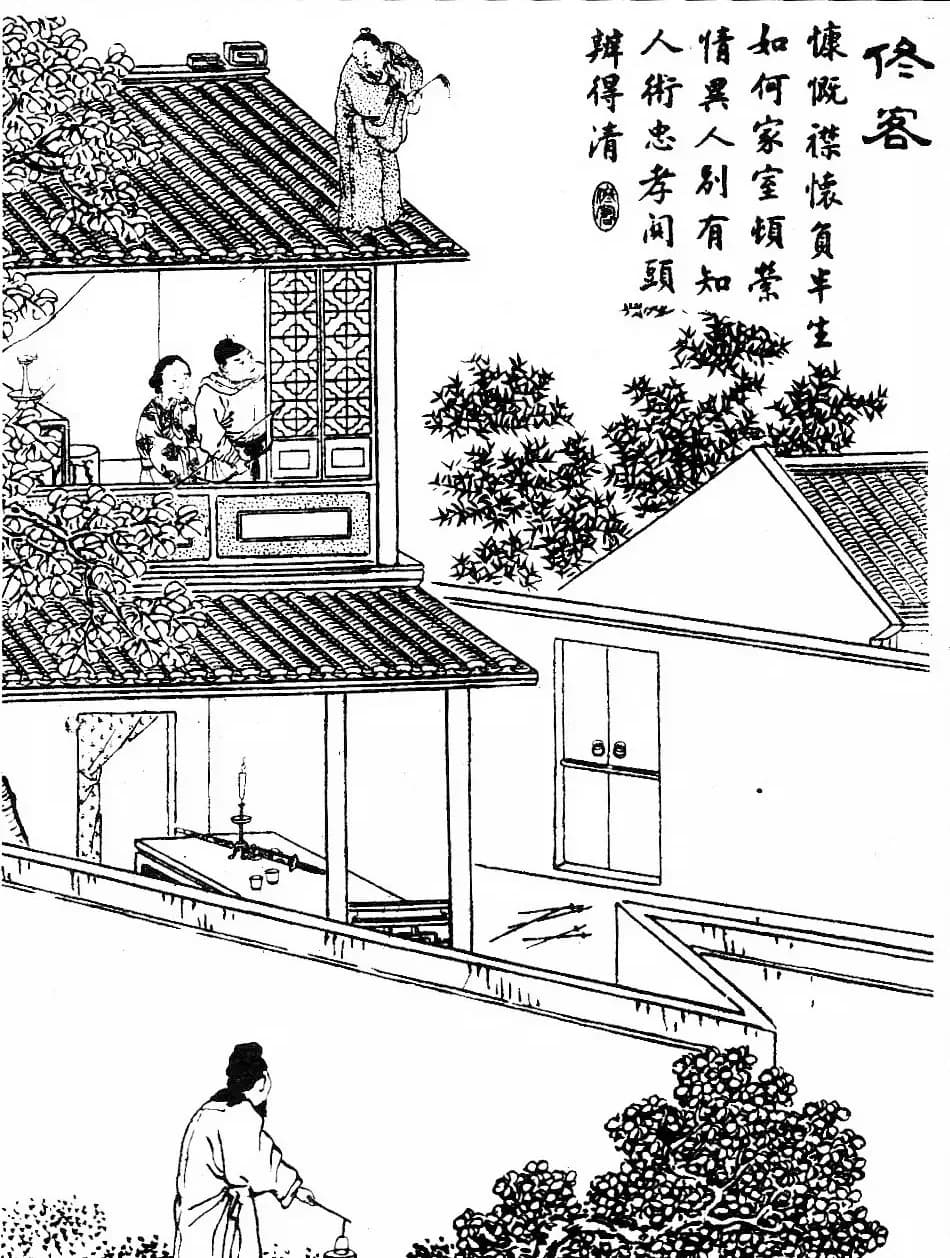
One short story in this collection has been filmed, re-filmed, animated and remade for longer than most film industries have existed. A scholar lodges at a derelict temple, a ghost is sent to kill him, a swordsman in the next room turns out to be more than he said he was. Almost nobody who has watched a version of it has read the six pages it came from.
Every adaptation fact below was checked against published sources this month and is cited where it appears. The tale itself is quoted from Herbert Giles’ free 1880 translation with line references. The temple is also a doorway in the playable Strange Tales from a Chinese Studio, where you arrive at dusk with nowhere else to sleep.
The short answer: one tale carries the franchise
Liaozhai has supplied Chinese cinema with material for decades, but the traffic is concentrated. A handful of tales account for most of the screen versions, and one of them accounts for most of that handful: the story of a poor, upright traveller named Ning, a ghost who has been press-ganged into luring men to their deaths, and the sword that settles the matter.
The version most people mean is A Chinese Ghost Story (1987), directed by Ching Siu-tung and produced by Tsui Hark, with Leslie Cheung, Joey Wong and Wu Ma. It is a horror film, a comedy and a wire-work action film at once, and it is very loosely based on the tale. Exactly how loosely is the most interesting thing in the whole adaptation record.
What the original tale actually says
Giles did not name the story after its ghost. He called it The Magic Sword, which tells you where he thought the interest lay. The plot is lean and the supernatural machinery is explained almost bureaucratically, the way this collection explains most things.
- The ghost identifies herself immediately.“I, Hsiao-ch’ien, whose family name is Nieh, died when only eighteen, and was buried alongside of this temple.” (l.4092-4094) She is not a mystery to be solved. She tells him what she is on the second night.
- She is working under duress.A devil took possession of her corpse and, in her own words, “employed me to bewitch people by my beauty, contrary to my inclination” (l.4094-4097). The thing that kills travellers is not her.
- The swordsman is a priest in disguise.Ning takes his fellow lodger, Yen Ch’ih-hsia, for a candidate up for the provincial examination from Shensi. Only after the sword flies out of the box by itself does Yen admit it: “the fact is I am a Taoist priest” (l.4144-4149). The weapon is “a bright little miniature of a sword”, kept in a case.
- The tree marks her grave, not a monster.She asks Ning to collect her bones from “the foot of the aspen-tree on which there is a bird’s nest” (l.4115-4116). He finds the tree among a number of graves the next day and keeps the promise. Nothing else lives in it.
“The fact is I am a Taoist priest. But for the window-sill the devil would have been killed; as it is, he is badly wounded.”
That is the whole supernatural mechanism: a hidden professional, a small sword that works by itself, and a wounded adversary who gets away for now. There is no forest, no vast antagonist, and no duel staged for an audience.
What the famous film invented
The single largest change is the villain. The 1987 film’s antagonist is a tree demoness, a towering supernatural presence with a forest of her own, and she is the image most viewers carry away from it. That figure is a screen creation; the tale gives its unnamed devil no body, no home and barely a description, and its one tree belongs to the ghost’s grave. See the film’s own production and plot record against the passage quoted above.
The second change is register, and it is total. Pu Songling’s tale is dry, brief and administrative about the supernatural. The film is a comedy with flying swordplay and a romance at its centre, and the franchise history traces how that blend of horror, comedy and martial arts became a genre of its own across the sequels. Neither change is a defect. They are what made a six-page classical anecdote into something a cinema could sell, and they are also why the tale surprises people who go back to it.
What survives the translation to screen is the shape: an honest man with no money, a woman who cannot stop doing harm on someone else’s orders, and an older professional who can actually fight the thing. That skeleton has held for sixty years of remakes because it is a good skeleton, not because anyone was being faithful.
Painted Skin’s separate film life
The other Liaozhai tale with a real screen career is Painted Skin, and it runs on a different logic. In the 2008 feature directed by Gordon Chan, the demon is given a history, a name and an interior life, and the film ends with her spending her own power to bring the dead back rather than being destroyed. Pu Songling’s demon gets none of that and is beheaded in a courtyard.
That is a straightforward inversion of the source, and it is the clearest case in this whole adaptation record of a film disagreeing with its book on purpose. The tale’s own version, including the part the films never stage, is set out in the essay on what Painted Skin actually says.
The newest chapter
This is not a closed history. In July 2025 the Chinese studio Light Chaser released an animated anthology built out of several Liaozhai tales, including this one, framed by a night spent at the same ruined temple the story is set in; Xinhua’s own feature on the release covers its structure and its six directors. More than three hundred years after Pu Songling wrote it down, the temple is still a set.
If you want to see why, the honest answer is to read the six pages. The free English text is at Project Gutenberg under Giles’ heading, The Magic Sword, and the whole thing takes about fifteen minutes. Most of what the films add is visible the moment you have the original in your head, and most of what they keep turns out to be the plainest part of it.
Sources
- Strange Stories from a Chinese Studio, translated by Herbert A. Giles (1880) — Project Gutenberg
- A Chinese Ghost Story (1987) — Wikipedia
- Painted Skin (2008 film) — Wikipedia
- Feature: "Curious Tales of a Temple" continues studio's journey into Chinese heritage — Xinhua
- The Weird History of A Chinese Ghost Story Franchise — Den of Geek
Frequently asked questions
- Is A Chinese Ghost Story (1987) based on a real Liaozhai tale?
- Yes, the one about the ghost Nie Xiaoqian, and the team was open about how far they moved from it. The film's own production record says they changed a lot of the stories for the adaptation because the stories turned out to be against their initial interpretation. It also drew on the 1960 Shaw Brothers version rather than on the tale alone. That is an unusually candid note for a film that became a genre landmark.
- Does the original tale have a tree demon like the film?
- No. The tale's devil has no body, no lair and no description, and the only tree in it marks the ghost's own grave. What the tale does give is method: a hole bored in the sleeping victim's foot so the blood can be drawn off, or a gift of false gold that is really the bone of some horrid demon. Whoever accepts it loses their heart and liver.
- How many film adaptations of Liaozhai stories are there?
- There is no reliable total for the collection, and anyone quoting one is guessing. For this single tale, Wikipedia's own list runs to roughly twenty screen versions between 1960 and 2020, across Hong Kong, mainland and television production. No other story in the book comes close to that record.
- Is there a modern English translation of Strange Tales?
- Yes. John Minford's Penguin Classics selection is the standard modern one and is still in copyright, so it is a purchase rather than a download. The free text everyone links to is Herbert Giles's 1880 version, which is a different selection with different titles, so the two do not line up story for story.
- What is the 2008 Painted Skin movie based on?
- The tale Pu Songling called 〈畫皮〉, which sits in juan 1 of the Chinese text. Gordon Chan's film keeps the premise and inverts the verdict: its demon is named Xiaowei and given a history, where the tale's demon is never named and given no history at all. A separate essay covers what the tale itself says.
Enjoyed this one?