A Guide to Liaozhai's Recurring Characters: the Scholar, the Fox Spirit, and the Underworld Judge
Read twenty of these tales in a row and you start recognising the cast before the plot arrives. The names change every time and the parts do not.


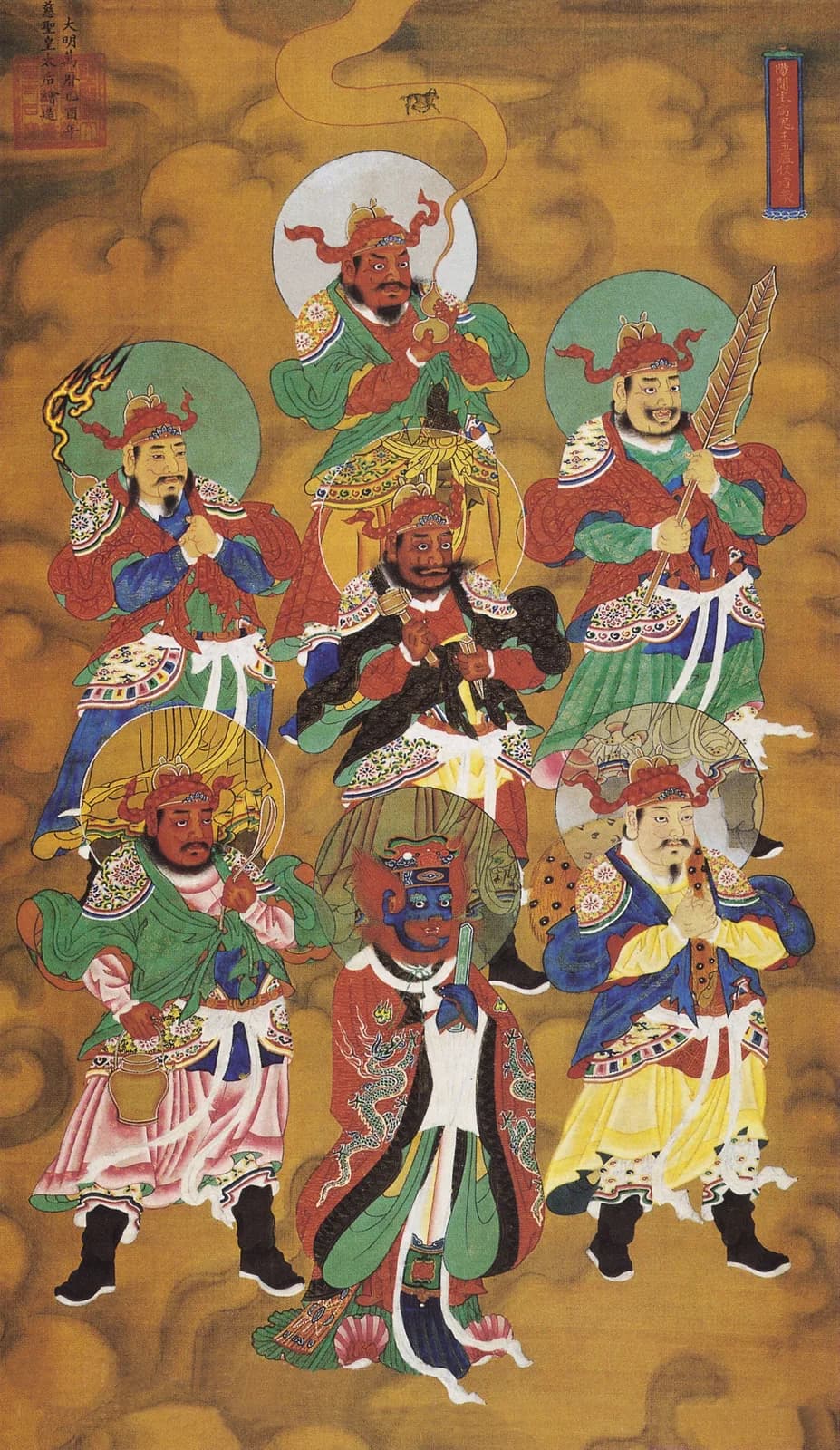
Read twenty of these tales in a row and something starts happening: you recognise the cast before the plot arrives. A young man is studying alone somewhere cold. Someone arrives who should not be able to. An official turns up from a department that does not exist, or a scruffy priest walks past and says something nobody wants to hear. The names change every time and the parts do not.
Quotations below come from Herbert Giles’ free 1880 translation with line references attached. All four of these figures are playable in Strange Tales from a Chinese Studio, where you meet them in the same order the book’s own readers do.
The short answer: four parts, five hundred variations
This is a repertory company rather than an ensemble. Nobody carries over between tales, but the roles do, and once you can see them the collection becomes much easier to read at speed. Here are the four parts, in rough order of how often each one turns up across the collection.
- The scholar.Poor, literate, alone, frequently useless in a crisis. He is the reader’s way in and he is almost never the person who solves anything.
- The fox spirit or ghost bride. Arrives uninvited, is more competent than the household she joins, and usually has an obligation of her own driving her.
- The underworld official. A judge, clerk or enforcer from the administration of the dead, which in this book is run on the same paperwork and the same favours as the living one.
- The wandering Taoist priest. Turns up, correctly diagnoses the supernatural problem the scholar has been ignoring, and is usually not believed the first time.
The scholar and the fox bride
The clearest example of the pairing is the story Giles called Miss Ying-ning; or, the Laughing Girl. A young man falls ill with longing after a chance meeting with a girl holding a spray of blossom, his cousin tracks her down, and a marriage is arranged. She laughs constantly, inappropriately, at everything, and the household cannot work out whether she is simple or dangerous.
She is neither. Her mother was a fox who bewitched a man named Ch’in; after he died she was left in the care of a ghost, who raised her in a garden away from people. The laughter is what a child raised outside human company does with human company.
Then the tale takes its one hard turn. A prank of hers ends in a neighbour’s death and a lawsuit, the magistrate throws the case out, and her mother-in-law tells her plainly what a less intelligent official would have done to her in open court.
“Ying-ning looked grave and did not laugh this time ... and from that moment Ying-ning laughed no more, no matter what people did to make her, though at the same time her expression was by no means gloomy.”
That is the whole arc of the character in two clauses. She learns what laughing costs in a society that keeps records, and she stops, and the story is careful to tell you she did not become sad. It is a sharper piece of writing about assimilation than the ghost-story packaging suggests, and it is the reason this particular tale keeps attracting scholarly attention: the title Giles chose in 1880 is the same one John Minford’s later Penguin Classics selection keeps, and how her laughter should be rendered in English has its own published translation-studies literature.
The underworld official who helps
Western ghost stories tend to make the administration of the dead frightening. This book mostly makes it collegial. The standing example is Judge Lu, who enters the collection as a painted wooden statue with “a green face, and a red beard, and a hideous expression in his features”, sitting in a temple full of carved infernal scenes.
A group of students dare one of their number, Chu Erh-tan, to fetch the statue in the middle of the night. Chu is described as “a fine manly fellow, but an egregious dunce, though he tried hard to learn”, and he does it, carries the image back on his shoulders, and pours it a drink. The Judge subsequently starts visiting. They become friends over wine, and the Judge reads Chu’s essays and tells him they are worthless.
Then he fixes it, surgically, while Chu is asleep and drunk.
“Don’t be afraid ... I am only providing you with a more intelligent heart.”
The Judge has swapped Chu’s heart for a better one procured from Hades, explaining afterwards that the old one “wasn’t at all good at composition, the proper orifice being stuffed up”. Chu wakes with a red seam at his waist and becomes an able scholar. Later, emboldened, he asks the Judge to do something about his wife’s looks, and the Judge arrives one night with the head of a young woman, the blood still warm, and takes the wife’s off “as if it had been a melon”.
What makes the sequence remarkable is the tone. Nobody in the tale treats any of this as horror. It is described as two favours between friends, the second slightly excessive, and the domestic complications afterwards get more attention than the surgery did. That flatness is the book’s signature, and it is why its underworld reads as a workplace with unusually good colleagues rather than as hell.
The priest who fixes what the scholar cannot
The fourth part is the specialist. A Taoist priest turns up, recognises what the scholar has invited in, and is ignored until it is nearly too late. In Painted Skin the priest spots the possession in the street, warns the man to his face and is dismissed as a hustler; what that costs is set out here.
In the temple tale that became the 1987 film A Chinese Ghost Story, the same figure arrives in disguise, lodging in the next room as an ordinary traveller and letting the scholar think what he likes until the moment he admits it: “the fact is I am a Taoist priest.” The adaptation record for that story is covered in a separate essay on the films.
The pattern underneath both is the same, and it is a very seventeenth-century piece of social observation. Expertise in this book belongs to people with no status: a wandering priest, a beggar in the road, a butcher, a fox. The scholar has the education and the standing and cannot do a thing with either, which is a joke told by a man who spent his life failing the examinations, as his own preface makes clear.
How this compares with Journey to the West
The comparison comes up often and it is mostly a category error. Journey to the West is one continuous narrative with a fixed travelling party, and its supernatural cast is a cast: the same handful of characters, developing, across the whole book. Liaozhai has no such spine. Its recurring figures are roles rather than persons, filled by a different name every time.
The practical difference for a reader is where you can stop. Journey to the West asks for commitment and pays it back over a long distance. Liaozhai asks for ten minutes and pays it back immediately, and you can read it in any order for as long as you like. The complete English selection is free at Project Gutenberg.
Sources
- Strange Stories from a Chinese Studio, translated by Herbert A. Giles (1880) — Project Gutenberg
- Strange Tales from a Chinese Studio, translated by John Minford (Penguin Classics) — Penguin Random House
- 'Novelty' through narrative and paratextual voice: the case of John Minford's translation of 'The laughing girl' — Language and Literature
Frequently asked questions
- Who is Judge Lu in Strange Tales from a Chinese Studio?
- The title figure of 〈陸判〉, in juan 2 of the Chinese text. The playable edition tags him with four characters lifted straight out of it, 换心易首: swapping hearts, changing heads. One detail the retellings drop is what he does with the old one. In Giles' 1880 translation he says he procured the replacement from Hades and is keeping the original to put in its place (l.3304-3307).
- Why does Yingning laugh so much?
- Because nobody ever taught her when not to, and the tale pushes that to farce at her own wedding. Dressed in a bride's finery and required to kneel through the ceremony, she laughs so hard she cannot get down, and the household gives up and formally excuses her from the ritual rather than make her finish it.
- Is Yingning a villain?
- No, and the tale's own last line settles it. A year into the marriage she has a son who is not a bit afraid of strangers, laughs at everybody, and takes very much after his mother. Pu Songling ends a story about a fox's daughter by handing her an ordinary happy family and a child with her temperament.
- How is Strange Tales different from Journey to the West?
- One is a route and the other is a rack. Journey to the West runs a single pilgrimage with a fixed party across 100 chapters, start to finish. Liaozhai has no order at all: the playable edition opens 26 separate doorways into 26 unrelated tales, and you can take them in any sequence without missing anything.
- What does the Taoist priest do in these stories?
- He hands over equipment and goes. At the end of the temple tale the priest, who gives his name as Yen Ch'ih-hsia, sees the scholar off with an old leather case, saying it holds a sword and will keep devils at a distance. The scholar asks to be taught the art itself and is refused, on the grounds that he is comfortably off and would never need it.
Enjoyed this one?