Romance of the Three Kingdoms Ending Explained: Who Wins in the End?
After 120 chapters the winner is a family of ministers, not one of the three houses. How each kingdom falls, in order.


Spoilers for the last three chapters of Romance of the Three Kingdoms. English renderings of the Chinese on this page are our own translation.
Readers who spend a hundred chapters with Liu Bei, Cao Cao and Sun Quan often feel cheated by this. Their heirs lose to a family that served Wei as ministers, and the last of the three courts gives up almost without a fight. The final turn is a doorway in the playable Romance of the Three Kingdoms, where you watch the three states fold into one and choose whose side you are standing on when it happens.
🏯 Which kingdom falls first, and which falls last?
The order is Shu, then Wei, then Wu. Shu is conquered from outside, Wei is taken from inside by its own chief ministers, and Wu holds out longest before surrendering to the new dynasty. All three endings happen in the last three chapters, after Zhuge Liang and every founding hero are long dead.
🎶 Shu falls: Liu Shan and “happy here”
After the Wei general Deng Ai slips through the mountains at Yinping in chapter 117, Liu Shan, Liu Bei’s son, decides in chapter 118 to surrender. His fifth son, the Prince of Beidi, refuses to live under the surrender and kills himself at the ancestral temple. Liu Shan goes out with his hands bound and a coffin carried behind him, and Deng Ai unties him and burns the coffin.
The scene readers remember comes in chapter 119, at a banquet in the Wei capital. Sima Zhao has musicians play the music of Shu, and every Shu official at the table weeps except their former emperor, who laughs and enjoys himself, and that is when Sima Zhao leans over to ask him something.
“Do you think much of Shu?” “I am happy here. I do not think of Shu.” (頗思蜀否?此間樂,不思蜀也。)
His old minister Xi Zheng takes him aside and tells him to answer next time with tears for his ancestors’ graves. Asked again, Liu Shan repeats the speech, cannot produce tears and shuts his eyes, and when Sima Zhao points out that this sounds exactly like Xi Zheng, he opens his eyes in surprise and says that is quite right. The whole room laughs, and from that evening Sima Zhao treats the former emperor of Shu as a man who will never be a threat to anyone.
🪑 Wei becomes Jin: Sima Yan takes the throne
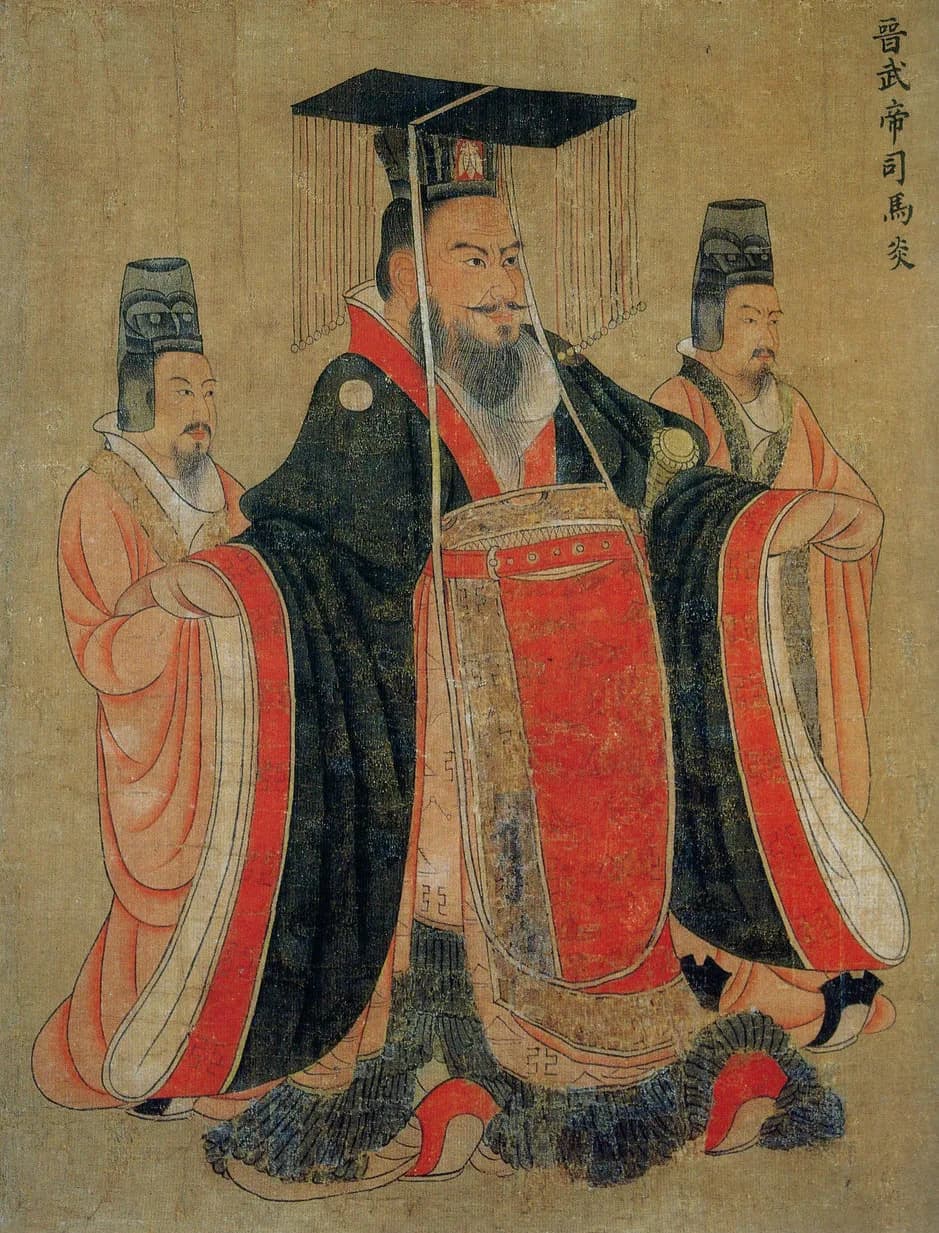
Wei does not fall to an enemy. Sima Zhao is raised to King of Jin, and after his death his elder son Sima Yan inherits the title and forces the last Wei emperor, Cao Huan, to abdicate. Cao Huan has an abdication platform built, climbs it holding the imperial seal, and hands the throne to Sima Yan, who sends him away with the title Prince of Chenliu.
The novel makes sure you notice the echo. The chapter title of 119 calls it an abdication done again by copying the old pattern, and a poem in the same chapter says the deeds before the platform were repeated, the same ceremony Cao Pi once used to take the throne from the Han. Sima Yan then names his grandfather Sima Yi, his uncle and his father emperors after their deaths.
🚩 Chapter 120: one surrender flag at Shitou
Wu’s last ruler, Sun Hao, is a cruel and erratic king by the novel’s account, and the Jin court argues for years about when to attack. When Wang Jun’s fleet finally comes down the river and reaches the walls of Shitou, Sun Hao thinks of killing himself. His ministers suggest he copy the surrendered Shu emperor instead, and he does: he binds himself, takes a coffin, and goes out to Wang Jun, who unties him and burns it. A Tang poem quoted in the chapter sums up the scene in one image, a single flag of surrender coming out of Shitou.
In Luoyang, Sima Yan offers him a seat and says he has kept it waiting for him a long time. Sun Hao replies that he kept a seat waiting in the south for the emperor too, and the emperor laughs. The Project Gutenberg Chinese text follows it with the line that ends the story proper.
🔁 The last line reverses the first
Chapter 1 opens by saying that the empire, long divided, must unite, and long united, must divide. Chapter 120 closes the story with the same saying, but the order is flipped so that the book ends on unity.
In this post’s translation of the chapter 120 line, the Three Kingdoms now belonged to Sima Yan, emperor of Jin, “and this laid the foundation of unity. This is what is meant by: the great trend of the empire is that what is long united must divide, and what is long divided must unite.”
The novel began with the Han dynasty coming apart and ends with China put back together, which is why the frame matters more than which of the three heroes’ families did the uniting. How closely that matches the historical record is a separate question, taken up in the essay on how much of the novel is true.
🥱 Why readers call the ending anticlimactic
The complaint is fair on its own terms. The heroes readers love die in the middle chapters, their sons are weaker men, and the winners are a family most readers first met as Cao Cao’s advisers. Players who come to the story through games see the same thing in miniature, a campaign that ends with a fourth state taking everything.
The book’s answer is that the cycle was always the point. The reference entry on the novel describes the same arc from the end of the Han to the reunification under Jin, and the closing chapters show loyalty and brilliance losing to patience and position, which is a harder lesson than any single battle.
- Shu surrenders in chapter 118. Liu Shan lives on in comfort in the Wei capital and laughs at a banquet.
- Wei becomes Jin in chapter 119. Sima Yan takes the throne through the same abdication ritual Wei used on the Han.
- Wu surrenders in chapter 120.Sun Hao copies Liu Shan’s surrender, coffin and all, and the land is reunited.
Sources
- 三國志演義 (Project Gutenberg eBook #23950) — Project Gutenberg
- Romance of the Three Kingdoms — Wikipedia
- Emperor Wu of Jin — Wikipedia
- Liu Shan — Wikipedia
Frequently asked questions
- What do you think of the end of Three Kingdoms?
- It is deliberately deflating, and the novel says so in its last poem. That long closing poem retells the whole century and ends on the line 鼎足三分已成夢, which this post translates as "the three-legged cauldron of power is now a dream". Read that way, the last page asks you to mourn the three houses more than it asks you to cheer for Jin.
- How did Romance of the Three Kingdoms end?
- With an inventory of what Wu handed over. After Sun Hao's surrender the novel lists four provinces, 83 commanderies, 313 counties, 523,000 households and 230,000 soldiers passing to Jin, along with more than 5,000 ships. The scale of the list is the novel's way of showing a whole kingdom being transferred in a single day.
- What is the aftermath of Romance of the Three Kingdoms in a nutshell?
- All three last rulers lived out their lives in captivity under Jin, and none was executed. The novel records that Cao Huan died in the first year of Taikang, Sun Hao in the fourth and Liu Shan in the seventh, and adds that all three died a natural death, a quiet end for the heirs of three warring houses.
- What happens to Liu Shan after he surrenders?
- He is given a comfortable retirement. Sima Zhao makes him Duke of Anle, a title meaning peace and happiness, with a house, a monthly allowance, 10,000 bolts of silk and 100 servants, and his sons and senior ministers are made marquises. The title fits the banquet line he is remembered for.
- Who is Sima Yan in Romance of the Three Kingdoms?
- The founding emperor of Jin and grandson of Sima Yi. The novel gives him an emperor's body, with hair reaching the ground and arms past his knees. His father Sima Zhao first favoured the gentler younger son, Sima You, until ministers warned that passing over the eldest broke the rites, and then died pointing at Sima Yan to name him heir.
Enjoyed this one?