Mercutio is the real heart of Romeo and Juliet — the friend who dies for a feud that wasn't his (2026)
Romeo and Juliet are the title. Mercutio is the heart. The most-loved character in the play is the best friend who gets pulled into the families' fight and dies in the middle of the story, cursing “a plague o' both your houses” — aimed not at the man who stabbed him but at the two families whose feud put him there. Everyone has a Mercutio. Some of us have made someone into one.


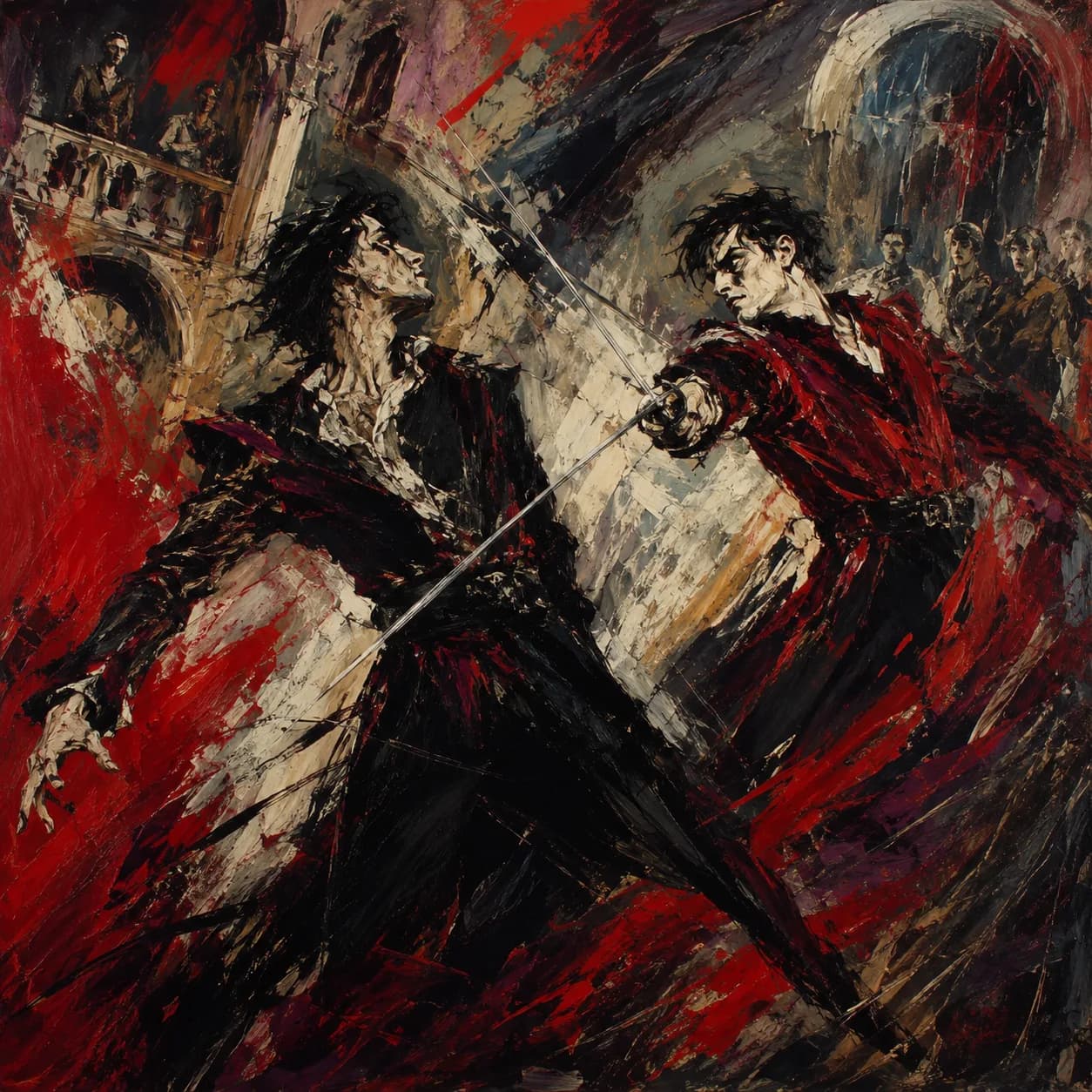
Everyone can name the two lovers. Far fewer can name the character whose death actually breaks the play in half — and he isn't either of them. He's Romeo's best friend, Mercutio, and he dies in the middle of the story, in a street brawl, bleeding out while he curses two families that aren't even his. Romeo and Juliet are the title. Mercutio is the heart.
- He dies in Act 3 of 5. The play named after two lovers kills its best friend first — right in the middle, at the exact hinge of the story.
- He belongs to neither house.Mercutio isn't a Montague or a Capulet. He's an outsider who gets pulled into a feud he has no stake in.
- His curse skips his killer.Dying, he doesn't curse the man with the knife — he curses both families, three times: “A plague o' both your houses.”
- Everyone has a Mercutio.The friend who quietly pays for other people's fights — or the friend you turned into one without noticing.
| What the title tells you | What the play is built on |
|---|---|
| Two lovers, one romance | A feud — and the friend caught in the middle of it |
| The lovers' deaths are the tragedy | The tragedy turns on Mercutio's death, in the middle |
| Mercutio is a supporting character | Mercutio is the heart; the story caves in when he's gone |
| He dies in the crossfire | He dies for a fight that was never his, cursing both sides |
🩸 The heart of the play dies in the middle of it
The death that actually reorganizes Romeo and Juliet lands halfway through, and it belongs to neither lover — it's Mercutio, Romeo's best friend. We file the play under romance and expect the deaths at the end; instead the one that breaks it open comes in the middle, and it's not a name on the cover. It's the friend.
That's Mercutio, Leo. And here's what gets me. Romeo and Juliet, the greatest love story ever written, and its actual heart, the best friend, is dead by the middle. Act three of five.
Mercutio is the wit of the play — the one who spins the dazzling Queen Mab speech and needles Romeo for being lovesick. He's also a kinsman of the Prince, which means he belongs to neither the Montagues nor the Capulets. When the brawl breaks out, he has no dog in the fight. He gets stabbed anyway.
☠️ “A plague o' both your houses” — the curse, explained
The famous line comes as Mercutio is dying in Act 3, Scene 1. What makes it land isn't the swearing — it's the aim. He doesn't curse Tybalt, the man who wounded him. He goes over the killer's head to the real cause.
And he doesn't even curse the man who stabbed him. He goes bigger. A plague o' both your houses. Not the guy with the knife, the two families whose feud put him in that alley.
He says it three times before he dies — on the wound, on his feet, and on the way down. It's a dying man's last clear thought, and he spends it naming the thing that actually killed him: not a person, but a grudge that two families can't remember starting and won't put down.
🤝 The friend who pays for a fight that isn't theirs
Mercutio outlives his own scene in memory because of the role he plays — the person who absorbs the cost of somebody else's conflict. That isn't a Shakespeare invention; it's a position most of us have stood in, on one side or the other.
And that's what stays with me. Because that role, the person who pays for somebody else's fight, that isn't a Shakespeare thing. I think everyone's either been that person or made someone into one.
On the podcast it stops being about Verona and starts being about the group chat — the friend who carries two people's argument for a year, texts first after every blowup, and then finds out they were never really in the friendship at all.
Then they made up. I found out from a photo at some barbecue. Neither one even thought to call me, the one who'd held it together. And that's when it landed. I was never actually in that friendship. I was the place they parked what they couldn't say.
And the other side of it stings too — being one of the two people fighting, and only realizing much later that someone in the middle was quietly holding it together the whole time.
Me and another guy on my team could not stand each other, a whole year of it. And the woman who managed us just quietly kept us apart. Took me off his projects, smoothed every meeting. When she finally left, it all came back, and that's when I got it. She'd been the reason I never felt any of it.
🔩 His death is the hinge the whole tragedy turns on
Mercutio's death isn't just sad — it's structural. Up to that point the play runs like a comedy: a masked ball, quick banter, a secret wedding. The instant he dies, Romeo kills Tybalt in a rage, gets banished, and the door to a happy ending slams shut. Everything tragic that follows is set in motion by the friend who wasn't even supposed to be in the fight.
One death in the middle, and the whole love story caves in around it. The thing we all remember as romance is built on the friend who paid first.
And nobody writes the play about him. Four hundred years, and we named it after the two who got the ending. Not the one who made the ending possible.
We named it after the two who got the ending — not the one who made the ending possible.
🎯 Who's quietly paying for a fight that's yours?
The usual question a Mercutio essay ends on is “who's your Mercutio?” — the friend you'd grieve. The episode flips it into something harder and more useful.
So maybe that's the real question it leaves you with. Not, who's your Mercutio. It's, who have you turned into one? Right now, who's quietly paying for a fight that's yours?
The romance you remember is built on the friend who paid first — the outsider who got dragged into two households' fight and never walked back out of it. It all started a few days earlier, when the same Romeo was still on the rebound from Rosaline, and it's wired, start to finish, to the same current the whole play runs on — the Romeo and Juliet Effect, where opposition is the fuel. Two households. Mercutio just happened to be standing between them.The Phantom of the Opera has its own doomed third wheel, and Leroux lets him ask the last question instead.
Sources
- Romeo and Juliet, Act 3, Scene 1 (full text) — MIT — The Complete Works of William Shakespeare
- Romeo and Juliet: A Modern Perspective — Folger Shakespeare Library
- Romeo + Juliet (1996) — reviews — Letterboxd
- Romeo and Juliet (reading text) — Folger Shakespeare Library
Frequently asked questions
- Why does Mercutio say “a plague on both your houses”?
- Mercutio says it as he is dying in Act 3, Scene 1, after being stabbed in a brawl between the Montagues and Capulets. He isn't cursing the man who wounded him (Tybalt) — he's cursing both feuding families, the Montagues and the Capulets, because their pointless quarrel is what dragged him into a fight that was never his. He repeats the curse three times before he dies. It's the exit line of the friend who pays for other people's war.
- Who kills Mercutio in Romeo and Juliet?
- Tybalt, Juliet's hot-tempered cousin, kills Mercutio. It happens when Romeo — newly and secretly married to Juliet — refuses to fight Tybalt and steps between the two men to stop the duel. Mercutio is stabbed under Romeo's arm. Romeo's attempt to keep the peace is exactly what gets his best friend killed, which is part of the tragedy's cruel design.
- Why is Mercutio such a beloved character?
- Mercutio is witty, wild, and completely his own person in a play full of people defined by their families — he belongs to neither house. He gets the play's most dazzling speech (the Queen Mab monologue) and its most-quoted curse, and he dies halfway through for a fight he tried to stop. Readers and audiences love him because he's the funniest character in the story and the one whose death you feel the hardest.
- When does Mercutio die in Romeo and Juliet?
- In Act 3, Scene 1 — right in the middle of the five-act play. His death is the structural turning point: up to that moment Romeo and Juliet plays largely like a comedy (a masked ball, witty banter, a secret wedding), and from his death onward it becomes a tragedy. The play named after the two lovers kills its best friend first.
- Is Mercutio a Montague or a Capulet?
- Neither. Mercutio is a kinsman of the Prince of Verona and Romeo's close friend, but he belongs to neither feuding house. That's the whole point of his death: the outsider who has no stake in the Montague–Capulet feud is the one who pays for it with his life. His dying curse falls on both families precisely because he was loyal to neither.
Enjoyed this one?