Is Jekyll and Hyde About Addiction? The Reading Readers Reach For First
Tolerance, dose escalation, a supply that fails, a promise to stop that lasts two months. The vocabulary was not available in 1886, and the pattern is all there.


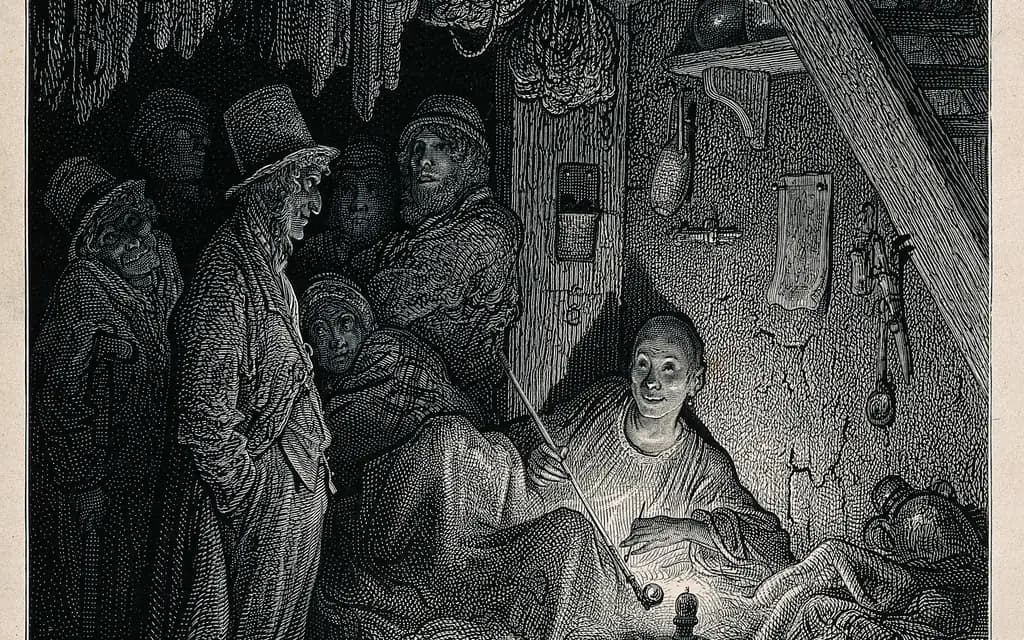
Ask a room of people who have just finished this book what it is about and the first answer is rarely horror. It is usually some version of the same sentence: this is a story about a man with a habit he cannot put down. The reading arrives before the analysis does, and it arrives so consistently that it is worth asking what in the text keeps producing it.
The answer is that Stevenson got there first. The vocabulary of addiction did not exist in 1886 in the form we use now, and the pattern is on the page anyway: escalating doses, a promise to stop, a relapse, a supply that fails, and a man organising his life around getting the next batch.
- Jekyll compares himself to a drunkard, in his own confession, in the paragraph where he relapses.
- The dose escalates, from one measure to two and once, at serious risk, to three.
- The last act is a supply problem, with a butler running between wholesale chemists to find one clean batch.
- The shame comes before the chemistry, which is where the second and third readings of the book begin.
Below is the evidence for that reading, followed by the two other readings the same evidence supports. If you would rather stand in the laboratory while the supply runs out, the playable Dr Jekyll and Mr Hyde has a doorway for exactly that night.
🥃 The line where the book says it itself
Jekyll draws the comparison in the middle of his own relapse, and he draws it against himself. He has been months without the drug, congratulating himself on the compensations of an approving conscience, and he is explaining how he came to compound the draught again. The sentence he reaches for has nothing to do with science.
“I do not suppose that, when a drunkard reasons with himself upon his vice, he is once out of five hundred times affected by the dangers that he runs through his brutish, physical insensibility.”
He is diagnosing his own thinking, and the diagnosis is that he made an allowance he had no business making. The paragraph continues into the admission that he had not reckoned with the insensate readiness to evil that was the leading characteristic of Edward Hyde, and the murder of Sir Danvers Carew follows within pages.
The word Jekyll uses about the arrangement earlier is even blunter. Describing how the disguise tempted him, he says he fell in slavery, which is a strange word for a doctor to apply to an experiment he controls, and the correct word for what happens next.
⚗️ Tolerance, dose, and the supply running out
The clinical detail is what makes the reading stick, and it is unusually specific for a story that began as a dream. The drug stops working reliably: Jekyll records having been obliged more than once to double the amount and, on one occasion and with infinite risk of death, to treble it.
The direction of effort reverses, so that where it had once been hard to shed Jekyll it becomes hard to hold on to him. By the final phase he is dosing to maintain his ordinary self rather than to escape it. He describes being able to wear the countenance of Jekyll only by a great effort as of gymnastics and only under the immediate stimulation of the drug, and he stops sleeping, because sleep returns him to the other body. A man taking a substance in order to appear normal at work is not a Victorian curiosity. It is the most modern thing in the novella.
Then the supply fails, and Stevenson stages the failure as pure procurement. Poole, Jekyll's butler, is sent flying to every wholesale chemist in town, brings each batch back, and is turned away again because it is not pure. The note the chemists finally refuse to answer is written in the doctor's own hand and breaks composure in its last line.
“For God’s sake,” he added, “find me some of the old.”
The dependence runs in both directions by the end, which is the detail that turns the reading from a metaphor into a mechanism. Hyde needs the drug too, and for the opposite reason: with the police hunting him, the only safe place left is Jekyll's body, so he keeps taking the draught to get back into it. Jekyll describes his terror of the gallows as driving him continually to commit temporary suicide and return to his subordinate station of a part instead of a person. Two appetites, one bottle, and neither of them able to stop.
The joke at the bottom of the whole book is that the original batch worked by accident. Jekyll concludes that his first supply of the salt was impure and that the unknown impurity was what gave the draught its power, which means the transformation was never repeatable science and the entire tragedy rests on a contaminated delivery. He has been chasing a batch he can never buy again, which is a sentence that could be lifted out of a modern case history without anyone noticing.
🎩 The other reading: the Victorian double life
Repression explains what the addiction reading cannot: why a respectable doctor built the apparatus in the first place. The novella says so in its own words two pages into the confession — the trouble was never the size of Jekyll's appetites but the height of his ambitions, and Jekyll spells that argument out before any chemistry is involved.
His account is that his faults were ordinary and would have been shrugged off by most men, and that it was the exacting nature of his aspirations rather than any particular degradation in his faults that made him what he was. He hid them, he says, with an almost morbid sense of shame. The split is manufactured by respectability, and Stevenson is precise about the machinery: a man who wants to be admired more than he wants to be honest will eventually need somewhere to put the rest of himself.
Stevenson builds the same idea into the property. Jekyll owns one building with two entrances that face opposite worlds. The front is a handsome house on a square with a hall Utterson, Jekyll's lawyer, calls the pleasantest room in London, warmed by an open fire and furnished with oak cabinets. The back, reached across what used to be a garden, is a windowless block on a shabby by-street, with a blistered and discoloured door that has neither bell nor knocker, where tramps strike matches on the panels. Enfield, who makes a rule of never asking questions, does not connect the two addresses until seven chapters in, and when he finally admits it he blames the lawyer for it: what an ass Utterson must have thought him, he says, for not knowing that this was a back way to Dr Jekyll's, and it was partly Utterson's own fault that he found it out even then.
The book then declines to say what any of it was. The pleasures Jekyll pursues in disguise are called undignified, and he adds that he would scarce use a harder term, and that is the whole disclosure. Readers have been filling that silence for a hundred and forty years, which is exactly what a silence that carefully placed is for. Around it stands a world of gentlemen with locked safes and unmentionable subjects: Hastie Lanyon, the doctor who witnesses the change, dies rather than describe it; Gabriel Utterson, the lawyer whose point of view holds most of the book, locks every document away; and nobody ever finishes a sentence about what Hyde actually does at night.
🚪 The queer reading, plainly
The best-known critical version of that argument reads the book as being about the closet, and it is worth stating carefully, because it is a reading of the text rather than a claim about Stevenson's intentions. Elaine Showalter set it out in a chapter called Dr Jekyll's Closet in her 1990 study Sexual Anarchy, and the case rests on three features of the novella that are hard to miss once they are pointed out.
The first is the population. This is a book about bachelors: a lawyer, two doctors, a man about town, a butler, a clerk. No wife is mentioned anywhere in it, nobody is courting, and the domestic arrangements are men visiting other men's houses after dinner. The second is the secret itself, which is a respectable professional man maintaining a second address, a second set of clothes and a housekeeper paid to be silent. The third is the vocabulary the other characters use, in which the unspeakable thing is always about to be named and never is.
The legal weather matters here as well. Private acts between men had recently been made prosecutable in Britain, and the novella appeared into a decade in which respectable men had concrete reasons to keep second addresses. Showalter's reading does not require Stevenson to have meant it. It requires only that the shape of the secret in the book matches the shape of a particular secret in the world outside it, which it does.
The most recent screen version takes the same idea somewhere else again, recasting the doctor as a woman, and our adaptations ranking has the production details. It is a reminder that all three of these readings are doing the same job: the book is a machine for keeping a secret, and every generation loads it with the secret it happens to have.
The full 1886 text is free at Project Gutenberg. If you want the moral half of the argument rather than the pharmacological one, the case against the doctor is a separate piece.
Sources
- Strange Case of Dr Jekyll and Mr Hyde (1886), full text — Project Gutenberg
- 'The Prisonhouse of My Disposition': A Study of the Psychology of Addiction in Dr. Jekyll and Mr. Hyde (1994) — Studies in the Novel
- The Strange Case of Addiction in Robert Louis Stevenson's Strange Case of Dr. Jekyll and Mr. Hyde (2012) — Victorian Review
- Sexual Anarchy: Gender and Culture at the Fin de Siecle (1990) — Viking / Internet Archive
- Labouchere Amendment — Wikipedia
Frequently asked questions
- Is the potion in Jekyll and Hyde a drug metaphor?
- The book keeps a dosing log, which is hard to read as anything else. Lanyon opens the drawer and finds powders, a phial and a version book that is little but dates, several hundred entries, with the word double written beside perhaps six of them and, once, very early on, total failure with three exclamation marks. That is a record of a habit being managed.
- Is Jekyll and Hyde a story about repression?
- It is certainly a story about a man with two front doors. The detail that makes the case is found after his death: on the shelf beside the tea things is a devotional book Jekyll had often praised, annotated in his own handwriting with startling blasphemies. Both the esteem and the blasphemies are his, written in the same room, probably in the same month.
- Is there a queer reading of Jekyll and Hyde?
- There is a well-established one. Its best-known version is Elaine Showalter's chapter Dr Jekyll's Closet in Sexual Anarchy (1990), which reads the bachelor households and the unnamed pleasures as a study in the Victorian closet. The context is legal as well as literary: the 1885 Labouchere Amendment had criminalised gross indecency between men the year before the novella appeared.
- Did Stevenson write Jekyll and Hyde about alcoholism?
- He never said so, and the addiction reading is an argument made about the book rather than a claim about his intentions. It has a serious critical history: Daniel L. Wright argued in 1994 that Jekyll is less a man of conflicted personality than a man suffering the ravages of addiction, and Patricia Comitini rebuilt the case in Victorian Review in 2012.
- Are there any women in Jekyll and Hyde?
- Five appear and not one of them is given a name. There is the child trampled at the corner, the maid who watches the murder from her window and faints, the ivory-faced housekeeper in Soho, the cook and housemaid huddled in Jekyll's hall, and a woman selling matches whom Hyde strikes in the street. Every named character in the book is a man.
Enjoyed this one?