The Odyssey vs the Iliad: is it a sequel, and do you need to read the Iliad first?
They share a cast and almost nothing else. The Iliad covers a few weeks of the war and ends before Troy falls; the Odyssey starts ten years later, in a living room, with a young man who has never met his father. Here is how the two connect, and the order to read them in.


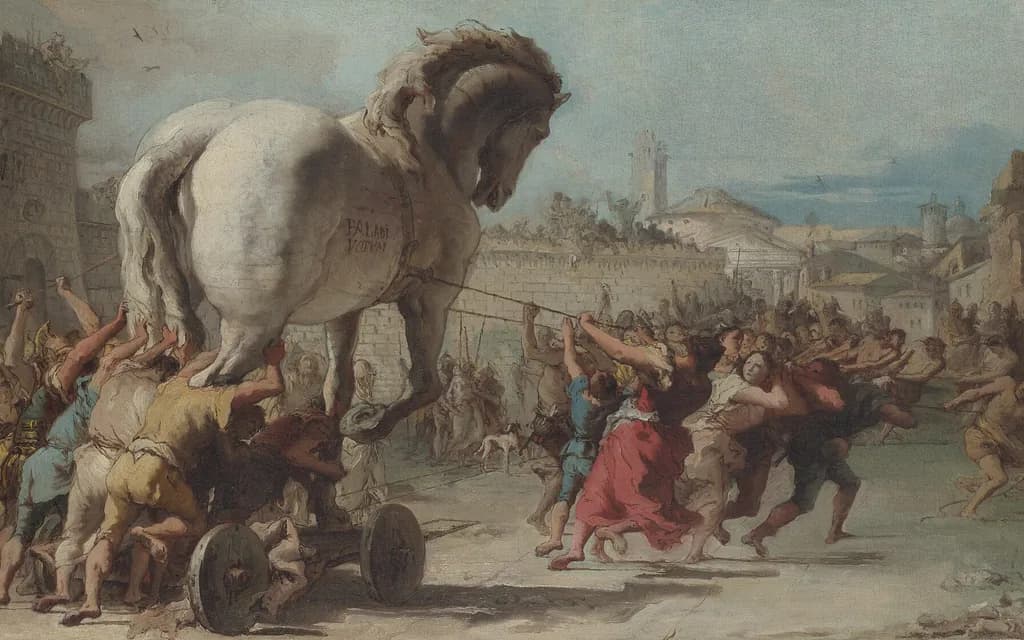
Somebody in the group chat has just said “wait, do I have to read the other one first?” and everyone has gone quiet, because none of you is completely sure how the two of them connect. Short answer: no, you don't, and the reason why is more interesting than the answer. They are not two halves of one series at all; they are two completely different kinds of story that happen to share a cast.
- The Iliad is a war story about a few weeks. It does not contain the wooden horse and it does not contain the fall of Troy. It ends with a funeral.
- The Odyssey starts ten years after that war ended— and twenty years after Odysseus left home.
- Its first four books are not about Odysseus at all. They are about his son.
- The two heroes are opposites on purpose. Achilles chooses a short glorious life. Odysseus keeps choosing to survive.
There is one more difference worth having in your head before you start, because it changes how you read everything: only one of these poems has a narrator you are supposed to doubt. The Iliad is told to you. Four whole books of the Odyssey (Books 9 through 12: the cyclops, Circe, the dead, the sirens) are told to you by Odysseus, at a dinner, to people he needs a favour from, and he is the most accomplished liar in either book.
🚪 Where the story actually starts
Almost everyone assumes the Odyssey opens on a beach with a fleet sailing home, and it opens in a living room instead.
Book 1 finds a young man named Telemachus sitting among a crowd of house guests who have been eating his father's food, drinking his father's wine and courting his mother for years, and who are not leaving. He has never met his father. He was a baby when Odysseus sailed. The war ended a decade ago and other men came home; his did not, and the island has quietly moved on to deciding who gets the house.
That is the situation the poem drops you into: a domestic occupation rather than an adventure. Twenty years have passed since Odysseus left, and the poem says so out loud in the reunion scene: Penelope is the woman who could “keep away from her husband when he had come back to her after twenty years of absence.” (Butler's 1900 prose calls him Ulysses and calls Athena Minerva; same people, Latin names.)
The arithmetic is worth doing once, because it explains the whole emotional situation. Ten years of war, then ten years of getting home. The son was a baby at the start and is a grown man by Book 1. The dog that recognises Odysseus in Book 17 was a puppy he trained before he sailed and is now dying on a dung heap. Nobody in this story is waiting for a hero to come back; they are living in the aftermath of someone who did not, and have organised their lives around it.
🐎 What Troy has to do with it
Here is the thing that surprises people: the Iliad does not contain the famous parts. No wooden horse. No burning city. No death of Achilles. It covers a stretch of a few weeks in the tenth year of the siege, it is mostly an argument between two Greek leaders that gets a lot of people killed, and it ends with the funeral of Hector while Troy is still standing.
You can read all twenty-four books of it, in Greek with facing English, at the Perseus Digital Library, which is also the fastest way to check any claim on this page. That surprises people because the phrase “the Iliad and the Odyssey” makes them sound like two halves of one shelf. In practice they overlap for about a paragraph. The Iliad stops with Troy intact and Achilles alive; the Odyssey starts a decade after the city fell. Everything in the gap (the horse, the sack, the deaths of Achilles and Ajax, the murder of Agamemnon on his first night home) happens off-page in both, and reaches you as gossip, songs and arguments told by people with reasons to shade them.
The horse is somewhere else entirely: in later poems, in Virgil's Aeneid, and, in fragments, inside the Odyssey itself, where it comes up the way war stories come up at dinner: told by a bard, told by Helen, told by Menelaus, each time slightly differently. Nolan's film reaches into the Aeneid to borrow Sinon, the man who talks Troy into wheeling the horse inside, precisely because the Odyssey doesn't stage that scene.
The reason those famous parts sit off-page is that they used to have their own poems. In antiquity these two sat inside a set of eight epics, the Epic Cycle, which told the war from its causes to the last man home: the years before the Iliad, the fall of the city, the scattered returns. Six of the eight are gone, surviving as scraps of quotation and a plot summary attributed to Proclus. One of the lost six is the Odyssey's own sequel, the Telegony, in which Odysseus is killed by Telegonus, his son by Circe, who has no idea who he is fighting. So the honest answer to “is it a sequel” is that the shelf both of them stood on has been missing for about fifteen centuries, and these are the two volumes somebody happened to keep.
| The Iliad | The Odyssey |
|---|---|
| A few weeks in the war's tenth year. | A few weeks, ten years after it. |
| Dozens of warriors; a battlefield. | One man, one wife, one son; a house. |
| Ends with Hector's funeral. Troy still stands. | Ends with a peace treaty on Ithaca. |
| Rage as the first word. | “Man” as the first word. |
| Gods take sides in a war. | One goddess takes an interest in one household. |
⚔️ Two completely different kinds of hero
The Iliad's hero is Achilles, who is offered the explicit choice between a long forgettable life at home and a short one that people will sing about, and takes the song. The Odyssey's hero is a man who is offered actual immortality by a goddess on an island with no responsibilities, and turns it down to go back to a middle-aged wife on a rocky island with a goat problem.
Homer knows exactly what he is doing, because he stages a meeting between them. In Book 11 Odysseus goes down to the land of the dead and finds Achilles there, and pays him the compliment the Iliad was built to earn: you were the most admired man alive, and now you are a prince among the dead, so don't take dying so hard.
Say not a word in death's favour; I would rather be a paid servant in a poor man's house and be above ground than king of kings among the dead.
That is one poem's hero telling the other poem's hero that he got it wrong. The whole value system of the Iliad, die young and be famous forever, gets audited by the man who chose to keep going, and it does not survive the audit. Then Achilles immediately asks about his son, which is the Odyssey's answer in miniature: the thing that turns out to matter is who is still alive at home.
Notice what makes Odysseus good at his job, too. Where Achilles is the strongest man on the field, Odysseus is the one who talks, and his signature moves are a disguise, a false name and a plan. The Greek word for it is mētis, cunning intelligence, and the poem treats it as excellence rather than as cheating.
The gods scale down with the story. The Iliad's are a second army, picking sides and wounding each other; the Odyssey has essentially two who matter, and both are interested in one household. Athena spends the poem disguised as ordinary people giving practical advice. Poseidon spends it drowning ships, because Odysseus blinded his son the cyclops and then shouted his own name across the water so the giant could tell his father who to curse.
And the difference in scale is the reason people who bounce off one often love the other. The Iliad asks what a life is worth when everybody dies anyway. The Odyssey asks a question you can answer on a Tuesday: what do you owe the people who kept your seat warm?
📚 So: read it first, or not?
Not first. If you only ever read one of them, read this one: it is the more approachable poem, the more modern-feeling story, and the one the film is adapting. The practical reading order is Odyssey, then Iliad, then, if the world of it has hold of you, Virgil's Aeneidfor the losing side's version.
- You saw the film and want the book. Go straight to the Odyssey. It is self-contained by design, because it was performed to audiences who already knew the war, so it explains itself constantly.
- You want the war. Read the Iliad. But know that you are reading a different genre: closer to a tragedy than an adventure, and it stops before the parts you think you are waiting for.
- You want both, in the best order. Odyssey first, Iliad second. Going backwards makes the Book 11 meeting with Achilles land like a punch instead of a footnote.
And if the film is your entry point, you are already meeting it in the poem's own order. The film opens in Ithaca with Telemachus, keeps the voyage as the past, and lets the war arrive as memory, which is exactly the structure Homer chose, for exactly the same reason. Neither of them thinks the interesting question is what happened at Troy. Both think it is what a man does with having been there.
One last practical thing, because it is the question underneath the question. People asking “do I need the Iliad?” are usually asking “am I going to be lost?” You will not be. The poem was performed to audiences who knew the war by heart, which paradoxically makes it the friendliest of the two to a newcomer: it re-explains everything constantly, because a bard cannot assume which night of the story you wandered in on. The names arrive with their fathers and their islands attached, every time. It is built to be joined late.
The fastest way to feel the difference is to be in it. Show up in Ithaca as Telemachus and try to hold a room full of grown men who are eating your inheritance, or arrive as the stranger nobody recognises and decide how much of the truth to hand over first.
Speaking of the son who has to grow up in four books: Telemachus and the coming-of-age story hiding inside the epic.
Sources
- The Odyssey, translated by Samuel Butler (1900) — Books 1, 11 and 23 — Project Gutenberg
- The Odyssey (2026 film) — structure and added characters — Wikipedia
- English translations of Homer — Wikipedia
- Homer, Iliad — Greek text with facing translation — Perseus Digital Library, Tufts University
- Homer, Odyssey — Greek text and A. T. Murray's facing translation — Perseus Digital Library, Tufts University
- Epic Cycle fragments — Cypria, Aethiopis, Little Iliad, Sack of Ilium, Returns, Telegony — Theoi Classical Texts Library
- Telegony — the lost sequel to the Odyssey, known from Proclus's summary — Livius.org
Frequently asked questions
- Is The Odyssey a sequel to the Iliad?
- Loosely, and it never says so. Both were volumes in a set of eight poems, the Epic Cycle, that covered the war end to end; six of those eight are lost, so the two survivors look like a pair. Inside the Odyssey, Troy arrives only as songs performed in the story — a bard's account of the wooden horse in Book 8 makes Odysseus weep into his cloak before he has told anyone his name.
- What happens after The Odyssey?
- Antiquity had an answer and then lost it. The Telegony, the Epic Cycle's last poem, sent Odysseus travelling again and had him killed by Telegonus, his own son by Circe, who did not recognise his father. It survives only in fragments and an ancient summary. Homer's own hint points the same way: Tiresias tells him in Book 11 that he must walk inland with an oar before he is finished.
- Do I need to read the Iliad before The Odyssey?
- No. The Odyssey re-explains the war constantly, because it was performed to audiences who could arrive at any point. Read the Odyssey first, then the Iliad, then Virgil's Aeneid if the world has hold of you. If you only have an hour, read Iliad Book 24 and Odyssey Book 23: one idea of an ending each.
- Is the Trojan Horse in the Iliad?
- No — the Iliad stops with Hector's funeral and Troy still standing. The fullest ancient account of the horse is not Homer at all but Virgil's Aeneid, Book 2, written around 19 BC, roughly seven centuries later, told from the losing side by a survivor. That is also where Nolan's film borrows Sinon from.
- How is Odysseus different from Achilles?
- Achilles is offered a short famous life or a long obscure one and takes the song. Odysseus is offered actual immortality by a goddess and turns it down for a rocky island. Homer stages their meeting in Book 11, where Achilles says he would rather be a poor man's hired servant alive than king among the dead.
- Where does The Odyssey begin?
- In Ithaca, in Book 1, roughly ten years after the war and twenty after Odysseus left. His son Telemachus — an infant when his father sailed — lives in a house occupied by suitors courting his mother and eating the estate. Odysseus himself does not appear until Book 5, and does not speak in his own voice until Book 9.
Enjoyed this one?