The Odyssey movie vs the book: what Christopher Nolan changed
Christopher Nolan's film is neither a betrayal of Homer nor a transcription of him. It keeps the poem's strange non-linear shape, borrows a character from Virgil, gives the dog his due — and then changes the last ten minutes in a way that changes what the whole thing was about.


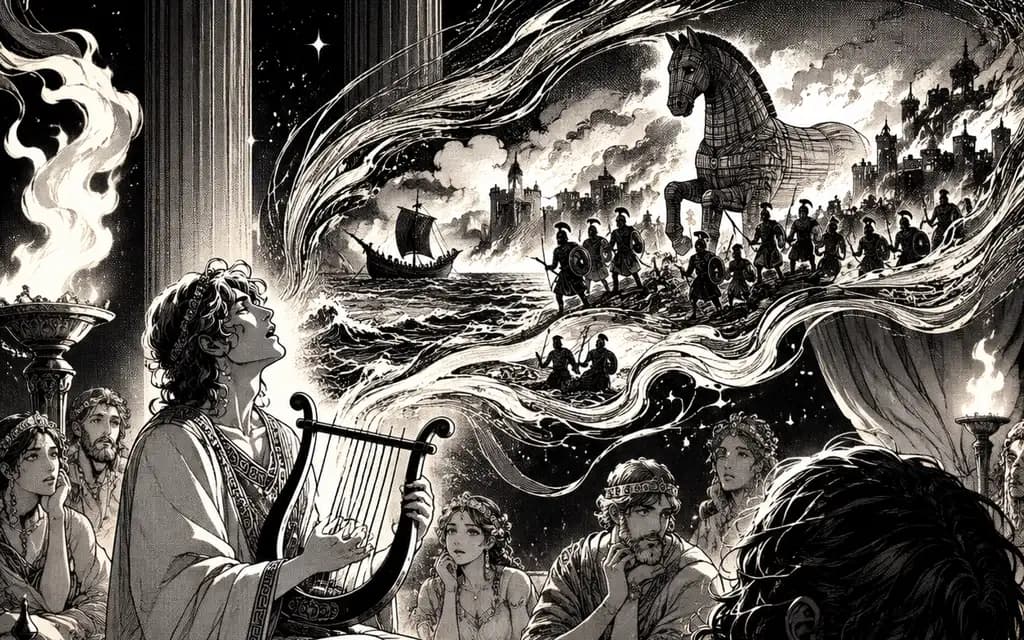
Spoilers for the 2026 film and for a poem that has been out for about 2,700 years.
You have probably had the argument in the lobby. Someone loved it, someone says that's not how it goes, and nobody in the group has actually read the thing since a classroom made them. So here is the honest version: Christopher Nolan's The Odyssey is neither a betrayal of Homer nor a transcription of him. It keeps the shape, keeps most of the furniture, and then changes one thing at the very end that changes what the whole story was about.
- The film starts where the poem starts— not at Troy, but years later, in a house full of men eating a missing man's food.
- Nolan adds people Homer didn't write. Sinon, the liar who talks Troy into opening the gates, comes from Virgil, not from the Odyssey.
- The dog is not an invention. Argos is in the poem. The film just refuses to let him be a footnote.
- The ending is the real change.Homer's Odysseus keeps the throne. Nolan's gives it away.
🏛️ Both of them start in the same strange place
The most common thing people expect from an Odyssey movie is a war film that turns into a monster movie. The poem is something else. Homer opens ten years after Troy has already fallen, in a house, with a young man who is sick of the guests.
The famous creatures (the cyclops, the sirens, the witch) are told in flashback, out loud, at a dinner party, by Odysseus himself, starting in Book 9: eight books into a poem of twenty-four. Nolan keeps that. The film uses a partially non-linear narrative, opening in Ithaca with Telemachus and the suitors and interweaving the voyage rather than marching through it in order. If you came expecting a straight line from the beach at Troy to the front door at Ithaca, that is the first thing the film will not give you, and the poem does not give it to you either.
The reason matters. Starting in the house makes the story about what an absence does to the people left standing in it. The sea monsters are a man's account of why he is late.
And that account has a catch that any adaptation has to solve. In the poem, Books 9 to 12 (the cyclops, the lotus, Circe, the underworld, the sirens, the whirlpool) come out of Odysseus's own mouth, not Homer's. He tells them out loud, to a room of strangers he is trying to persuade to lend him a ship. He is a professional liar with a motive, describing events for which every witness is conveniently dead.
A book can leave that hanging. A camera cannot: the moment you photograph a cyclops, the cyclops is a fact. Every filmed Odyssey quietly settles the poem's best ambiguity by pointing a lens at it, and the only real question left is how much strangeness it keeps around the edges. Nolan's opening intertitle, “A time of apparent magic…”, is doing that job in six words.
🧵 What the film adds that Homer never wrote
The additions are not random. Each one plugs a hole a modern audience feels and an ancient one didn't.
| In the film | In the poem |
|---|---|
| Sinon, played by Elliot Page — the Greek who stays behind to sell the horse story. | Not an Odyssey character. Sinon is Virgil's, from the Aeneid, written seven centuries later. |
| Argos, the dog, made prominent. | Argos is already there. In Book 17 the old dog lifts his head, drops his ears, wags his tail on a dung heap, and dies — and nobody in the scene is allowed to say anything about it. |
| Circe as unsettling but sympathetic. | A goddess who turns men into pigs, then keeps Odysseus for a year, then helpfully gives him directions to the land of the dead. |
| A complicated reunion for Helen and Menelaus. | Book 4: they are back in Sparta, hosting, telling stories about Troy that quietly contradict each other while the wine goes round. |
| More scenes between Odysseus and Telemachus. | They share very little page time. That is arguably the point — but it is thin material for two of the most expensive actors alive. |
The casting carries an argument too. Lupita Nyong'o plays both Helen of Troy and Clytemnestra: two roles, one face, and that is a reading rather than a budget decision. The poem keeps pairing those two women as the cautionary examples that make Penelope look like a miracle, and in Book 24 Agamemnon's ghost does it out loud, praising Penelope's constancy and cursing his own wife's name in the same breath. Casting one actor as both says they were never two women. They were always one anxiety.
The Helen scene is the one worth arguing about, because Homer already put the crack there. In Book 4, over dinner in Sparta, Helen tells a story in which she recognised Odysseus under his beggar disguise inside Troy, washed him, swore an oath, and let him go, because she was already homesick for the husband sitting next to her. Then Menelaus tells a story in which she walked three times around the wooden horse, patting it, calling the hidden Greeks by name and, in Butler's rendering, mimicking “all our wives” to make them answer. Both of them are smiling. The film did not invent that discomfort; it just declined to serve it with wine.
⚓ Where the two part company
Here is the actual change, and it is not a small one.
In Homer, Odysseus comes home disguised, is recognised first by his dog and then by his old nurse, strings a bow no one else can string, and kills every suitor in the hall. Then Penelope makes him prove it. She has him describe their bed, which he built around a living olive tree still rooted in the ground and could not be moved without cutting it: a fact only the two of them have ever known, and therefore the one password no impostor could hold. Then the dead suitors' fathers arm themselves and march on him, and there is nearly a second massacre, until Athena stops it. In Butler's translation the last sentence of the poem is a peace treaty. He is still king.
In the film, the massacre happens and then the crown does not come back. Odysseus hands the throne to Telemachus, and he and Penelope sail into exile. He goes because of what he did, not in spite of it. The film has him confess to Penelope that he was ashamed of what his men did at Troy, and it treats the wooden horse itself as a violation rather than a masterstroke.
Then Minerva assumed the form and voice of Mentor, and presently made a covenant of peace between the two contending parties.
That is Homer's last line in Butler, whose 1900 prose uses the Roman names, so Athena is “Minerva.” A goddess in disguise ends the fighting by decree and everyone goes back to normal. Nolan replaces a divine reset button with a man deciding he has forfeited the right to sit down.
Whether that is a betrayal depends on what you think the poem is for. If it is a story about order restored, the film breaks it. If it is a story about a man who cannot stop travelling, and Homer does put a prophecy in Book 11 that sends him inland with an oar on his shoulder after the homecoming, then the film has simply moved a departure Homer already scheduled.
🌊 The Bronze Age underneath the myth
The stranger liberty Nolan takes is historical rather than narrative. The film ties Odysseus and his men to the “People From the Sea”, the raiders associated with the collapse of the eastern Mediterranean Bronze Age around the twelfth century BC.
In that reading the heroes are the leading edge of a world's ruin rather than the restorers of it, and the palaces the poem remembers as ordinary are about to stop existing. That is a very Nolan move, and a defensible one. Homer's audience was already looking back at a lost age with better metal and bigger halls than their own. The poem is set in a past that had ended. The film just says out loud what the ending was.
The format serves the same idea. At 173 minutes, and the first feature shot entirely on IMAX 70mm film cameras, it is built so that the sea is physically bigger than you are in the room. That is a fair translation of something Homer does with sound and repetition: the sea in this poem is an antagonist with a grudge rather than scenery, and its scale is the argument. The same commitment runs all the way down to the props, with Troy standing as a real set of sixty-odd structures and the cyclops played by a sixty-foot animatronic with Bill Irwin working inside it instead of a creature added months later, which is why so much of the public argument about this film has been about how it was made rather than what it changed. It is also, for whatever it is worth, the format on which a three-hour non-linear film about a war criminal going home passed a billion dollars worldwide, Nolan's first to do that since The Dark Knight Rises.
The liberties people actually notice are smaller and funnier than the Bronze Age framing. Odysseus fights in a Corinthian helmet, a style that arrives around 700 BC, roughly five centuries after the Mycenaean world the story is set in, while the helmet the Homeric tradition actually gives him is a leather cap sewn with rows of boar tusks. The cast speaks contemporary English in mostly American accents, which collected its own round of complaint from the first trailer onward. Both are the bargain Homer struck first. His heroes carry a mix of half-remembered Bronze Age equipment and the ordinary gear of the Iron Age audience listening, because a poem that wants to be understood tonight arms its heroes in tonight's metal. The jokes about the helmets are a form of literacy: an audience that knows perfectly well it is not watching a documentary and has decided it does not need one.
Where the two most obviously part is tone. Homer is funny: genuinely, repeatedly funny, in a dry, cruel, domestic way. A beggar wins a boxing match in his own front yard. A goddess laughs out loud at a man for lying to her face. A suitor complains, seriously, that the queen is too clever. Almost no adaptation of this poem has ever been willing to be funny, and this one is not the exception. Whatever brought a billion dollars of audience through the door, it was not the monsters, and it was not the jokes either.
If the lobby argument is still going, there is a cheaper way to settle it than re-reading twelve thousand lines: go stand in the house yourself. Refuse the disguise and walk in as yourself on day one. Take the throne back the way Homer wrote it, or hand it to your son the way the film does. The story will hold you to whichever one you pick.
Next in this series: the ending, in detail — the massacre, the bed, and the prophecy that means Odysseus was never going to stay put. The Odyssey ending explained.
Sources
- The Odyssey (2026 film) — cast, structure, production and reception — Wikipedia
- 'The Odyssey' Ending Explained: What Christopher Nolan Changed — TheWrap
- 'The Odyssey' Surpasses $1 Billion at the Global Box Office — Variety
- The Odyssey, translated by Samuel Butler (1900) — Project Gutenberg
- Homer, Odyssey — Greek text and A. T. Murray's facing translation — Perseus Digital Library, Tufts University
- How Christopher Nolan's The Odyssey changes the Cyclops showdown — SlashFilm
- How 'The Odyssey' Pulled Off Those Practical Effects — No Film School
- 7 Most Impressive Practical Effects In The Odyssey — ScreenRant
- What Nolan's Odyssey Gets Wrong About Ancient Greece, Seen in Its New Trailer — Greek Reporter
- What Armor Did the Heroes in the Odyssey and the Iliad Wear? — Encyclopaedia Britannica
- 'The Odyssey' trailer sparks criticism over accents and 'daddy' issues — Euronews
- Christopher Nolan's Artfully Woven Odyssey — The New York Review of Books
Frequently asked questions
- How faithful is Nolan's The Odyssey to the book?
- Structurally, very. Homer withholds Odysseus until Book 5 and withholds his voice until Book 9, and the film keeps that patience, opening in Ithaca with Telemachus. It diverges in exactly two places: characters Homer never wrote, and the last ten minutes, where Homer's Odysseus keeps the throne and Nolan's hands it away.
- What did Nolan change in The Odyssey?
- Additions first: a prominent Argos, more father-and-son scenes, a sympathetic Circe, a strained Helen-and-Menelaus reunion, and Sinon, borrowed from Virgil. Two things also go missing. The cyclops's 'Nobody' pun is gone, which Nolan says was untranslatable, and so is Homer's imposed peace treaty at the end.
- Does the film include the Trojan Horse?
- Not as a staged scene, and Homer does not stage it either: in the poem the horse arrives as stories told over dinner, each teller shading it differently. What Nolan adds is Sinon, the Greek who talks Troy into opening its own gates, imported from outside Homer — and a reading in which the trick is a war crime rather than a masterstroke, with Odysseus confessing his shame about it to Penelope.
- Do I need to read The Odyssey before seeing the film?
- No. The poem was performed to listeners who could arrive halfway through, so it re-explains itself constantly, and the film inherits the habit. If you want half an hour of preparation instead of twelve thousand lines, read Book 9 and Book 23. The film's two biggest departures both answer back to those two scenes.
- Is The Odyssey movie historically accurate?
- Not in the armour, and deliberately so. Odysseus wears a Corinthian helmet that postdates his own Mycenaean setting by roughly five centuries, where the Homeric tradition gives him a leather cap sewn with boar tusks, and the cast speaks contemporary English in mostly American accents. On the larger frame it is more historical than Homer: it ties Odysseus's men to the 'People From the Sea' of the Bronze Age collapse around 1200 BC.
- Is Odysseus actually clever in the Odyssey movie?
- Less than he is in the poem, which is the most common complaint from readers who know it. Homer's Odysseus wins by mētis — a disguise, a false name, a plan laid an hour early — and the film's single biggest cut is the 'Nobody' trick itself. Even admiring critics note the trade: this Odysseus processes guilt more than he out-thinks the room in front of him.
- Was The Odyssey movie shot with CGI?
- Mostly not. Nolan built Troy as roughly sixty real structures and had Bill Irwin perform the cyclops inside a sixty-foot animatronic on location rather than adding a creature digitally later. Digital effects still exist — mainly to blend Irwin's performance into the cave footage and smooth edges — but the production's own case is that puppets and practical sets did the work CGI usually does.
Enjoyed this one?