The Odyssey characters guide: who's who in Homer's poem and Nolan's 2026 film
A third of the names you need belong to people who never leave one room, and the rest to monsters, gods and dead men who appear once and matter for twenty books. Here is the whole cast in the order you meet them, with the book each first appears in and the actor playing them in 2026.


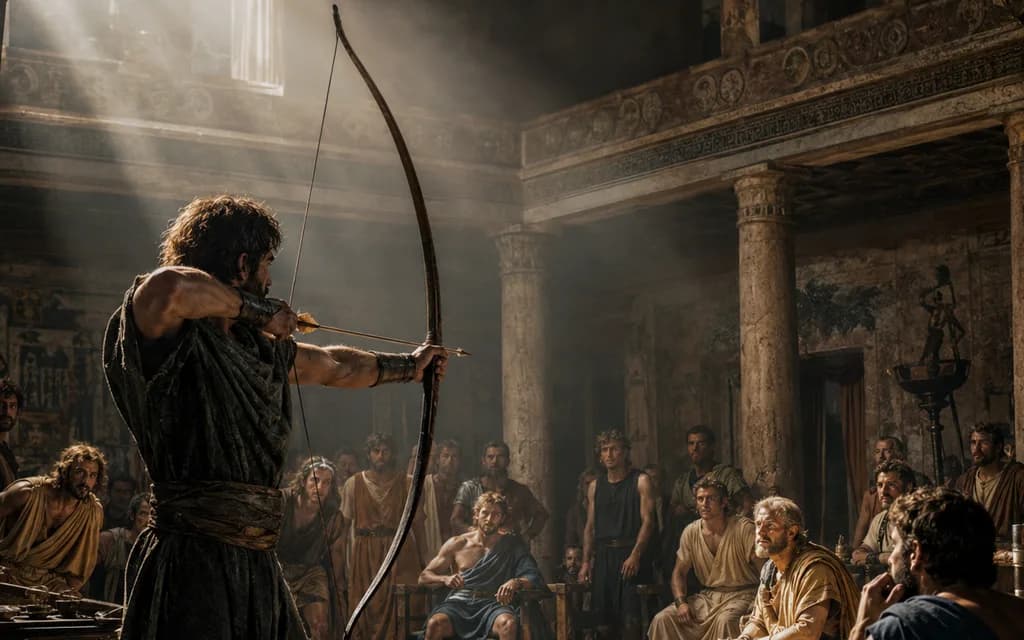
Spoiler note: this guide names who everyone is and who plays them in Christopher Nolan's film. It does not discuss how either version ends.
The Odyssey has a cast problem that no other famous poem has: a third of the names you need belong to people who never leave one room, and the rest belong to monsters, gods and dead men who each appear once and then matter for twenty books. Add a film with forty credited roles and the reasonable question becomes very hard to answer from a plot summary. So here is the whole cast in the order you meet them, with the book each one first appears in and the actor playing them in 2026.
One convention first. Quotations come from Samuel Butler's 1900 public-domain translation, which uses the Roman names: Ulysses for Odysseus, Minerva for Athena, Neptune for Poseidon, Jove for Zeus. Same people. Our own prose uses the Greek names throughout, which is what the film uses too.
🏠 The household: who is actually in the house
The Ithacan household is the poem's centre of gravity, and Homer introduces almost all of it in Book 1 before the hero has said a word. Odysseus is named in the poem's first sentence and does not appear in person until Book 5, which is roughly a fifth of the way in.
Odysseus (Book 1; Matt Damon) is a king who is extremely good at three things: fighting, lying and coming back. His defining trait in Greek is mētis, cunning intelligence, and the poem is unembarrassed about preferring it to strength.
The casting has a longer joke behind it than a stunt-cast usually does. Damon has spent thirty years playing men other people are organising expeditions to bring home — the private in Normandy, the botanist stranded on Mars, the scientist waiting on an ice planet in Nolan's own Interstellar. Handing him the original of the type is the least random decision on the call sheet.
Penelope (Book 1; Anne Hathaway) has held a house and a kingdom for twenty years against a hundred and eight armed guests, using a loom, a rumour and eventually an archery contest. When her husband finally comes home she tests him with a lie about their marriage bed — and it is his instant, indignant correction, not her deception, that proves who he is.
Telemachus (Book 1; Tom Holland) was an infant when his father sailed and is about twenty when the poem opens. Books 1 to 4 are entirely his, and they are the oldest coming-of-age story that survives.
Eurycleia (Book 1, spelled Euryclea in Butler; Kate Fuglei) is the enslaved nurse who raised both Odysseus and his son, and the first person in Ithaca to know he is home, because she washes his feet and finds the scar.
Eumaeus (Book 14; John Leguizamo) is the swineherd, a kidnapped prince who ended up enslaved, and the man who feeds a beggar he has no reason to feed. Homer likes him so much that he switches to addressing him directly, in the second person, which he does for no one else.
Argos (Book 17) is the dog Odysseus raised before Troy, lying on a heap of dung, too weak to stand, who recognises his master through a twenty-year disguise that has fooled every human being in the building.
Also in the house: Laertes (Book 1), the father who has retired to a farm to grieve; Melanthius the goatherd (Book 17; Logan Marshall-Green) and Melantho the maid (Book 18; Mia Goth), the two members of staff who have gone over to the suitors; and Mentor (Book 2; Ryan Hurst), the old family friend whose name Athena borrows and whose name English later borrowed back.
⚡ Which gods are on Odysseus's side
The divine politics are simpler than they look, and all of it is set up in Book 1. Athena is his patron and advocate, Poseidon is his enemy, and Zeus is the chair of a committee that meets whenever Poseidon is out of the room.
Athena (Book 1, Minerva in Butler; Zendaya) does more practical work than any other character. She disguises herself repeatedly — as the visitor Mentes in Book 1, as Mentor in Book 2, as a girl carrying a pitcher in Book 7, and as a young shepherd in Book 13 — argues his case to her father, and openly admires him for lying to her face. Their relationship is the warmest thing in the poem and reads much more like professional respect than like worship.
Poseidon (Book 1, Neptune in Butler) is the engine of the plot and almost never on the page. He is furious because Odysseus blinded his son, he wrecks one raft and petrifies one ship, and he never once speaks to the man he is punishing.
Zeus (Book 1, Jove in Butler) opens the poem by complaining that mortals blame the gods for disasters they bring on themselves, which is as close to a thesis statement as the Odyssey gets. Hermes (Book 1, Mercury in Butler) is the errand-runner who delivers the herb on Circe's island and the eviction notice on Calypso's.
🌊 Who Odysseus meets on the way home
Everything most people picture when they hear “the Odyssey” happens in Books 9 to 12, which is four books out of twenty-four, and Odysseus narrates all of it himself after dinner at somebody else's palace.
Polyphemus (named Book 1, on stage Book 9; Bill Irwin) is the Cyclops who eats six men and gets blinded by a man calling himself Noman. That pun is Butler's rendering of the Greek Outis, and it is the reason the giant's neighbours refuse to help him.
Circe (named Book 8, on stage Book 10; Samantha Morton) turns the crew into pigs, then turns into the most useful ally in the poem, telling him exactly how to survive the Sirens, Scylla and Charybdis before he sails.
Calypso (named Book 1, on stage Book 5; Charlize Theron) keeps him on her island for seven of the ten years and offers him immortality to stay. He turns it down, which is the single strangest and most human decision in Greek myth.
Nausicaa (Book 6) finds a naked shipwrecked stranger on a beach and hands him laundry and directions instead of raising an alarm, which is how the poem introduces its actual moral subject: what a household owes a stranger.
Tiresias (named Book 10, on stage Book 11; James Remar) is the dead prophet who tells him how to get home and then tells him about the journey he has to make afterwards, inland, carrying an oar until someone mistakes it for a winnowing fan.
The crew get names too, and the film keeps several: Eurylochus (Book 10; Himesh Patel), the second in command who argues with him and loses; Polites (Book 10; Andrew Howard), the one he “valued and trusted more than any other”; Elpenor (Book 10; Jovan Adepo), who dies falling off a roof drunk and turns up in the underworld asking for a funeral; and Antiphates (Book 10; Josh Stewart), the Laestrygonian king whose people destroy eleven of the twelve ships.
Two more names belong here because the poem keeps them at its edges and the film brings them in. Homer introduces Menelaus (Book 1, in person Book 4; Jon Bernthal) and Helen (Book 4; Lupita Nyong'o) as the homecoming that worked, living in Sparta with their war behind them, and Agamemnon (Book 1, as a ghost in Book 11; Benny Safdie) and Clytemnestra (Book 3, played by Nyong'o as well) as the homecoming that ended with a king murdered in his own hall by his wife. Every warning Telemachus receives about his mother is really a warning about her.
🏹 The suitors, and the film's cast crosswalk
The suitors are the reason the poem exists. A hundred and eight young noblemen have moved into a house whose owner is presumed dead, are eating his herds at a rate that will bankrupt the estate, and are waiting for his widow to pick one of them. Homer is careful to make them individuals rather than a mob, and careful to make two of them the ones you remember.
Antinous (Book 1; Robert Pattinson) is the worst of them and the loudest, the one who throws a footstool at a beggar and organises an ambush for a boy. Eurymachus (Book 1) is the more dangerous kind: polite, plausible, and privately identical. Behind them Homer names a working ensemble, and Nolan cast part of it — Amphimedon (Book 22; Iddo Goldberg) and Agelaus (Book 20; Jamie Harris), plus Irus (Book 18; Brian Vernel), the resident beggar who makes the mistake of picking a fight with the new one. Two named suitors stay poem-only: Ctesippus (Book 20) and Leiodes (Book 21) are not in the film's cast.
| Actor | Character (first appearance in the poem) |
|---|---|
| Matt Damon | Odysseus (named Book 1, on stage Book 5) |
| Anne Hathaway | Penelope (Book 1) |
| Tom Holland | Telemachus (Book 1) |
| Zendaya | Athena, “Minerva” in Butler (Book 1) |
| Robert Pattinson | Antinous, chief suitor (Book 1) |
| Charlize Theron | Calypso (named Book 1, on stage Book 5) |
| Samantha Morton | Circe (named Book 8, on stage Book 10) |
| Elliot Page | Sinon — not in the Odyssey; from Virgil's Aeneid |
That last row is the one worth staring at. Sinon is the Greek who talks Troy into hauling the horse through its own gates, and he belongs to Virgil's Aeneid rather than to Homer; search Butler's Odyssey for the name and there are zero occurrences. Casting him is a deliberate import, and it tells you that the film is interested in the war the poem keeps at arm's length.
The production details are worth knowing before you argue with anyone about it. Nolan wrote and directed; Universal released it on 17 July 2026 at 173 minutes, on a $250 million budget, as the first feature shot entirely on IMAX 70mm film, with a partially non-linear structure that follows Homer's own habit of starting in the middle and letting the hero narrate his own back story.
Every name on this page is a person you can talk to rather than read about, which is a different way of learning a cast list.
If it is the ending you came for, that has its own page: The Odyssey ending explained.Journey to the West runs its own decades-long quest with a cast just as crowded, start with the Monkey King.
Sources
- The Odyssey, translated by Samuel Butler (1900) — every first appearance checked against this text — Project Gutenberg
- The Odyssey (2026 film) — full cast, running time, format and structure — Wikipedia
- Homer, Odyssey — Greek text and A. T. Murray's facing translation — Perseus Digital Library, Tufts University
- In Christopher Nolan's 'The Odyssey' Matt Damon Will Do the Same Thing He's Done in So Many Movies — Collider
- Sinon — the Greek of the wooden horse, from Virgil's Aeneid rather than Homer — Wikipedia
- "They All Passed" — Christopher Nolan Jokes He Didn't Want Matt Damon for the Lead Role in 'The Odyssey' at First — Netflix Junkie
- Matt Damon Reveals He Was Nolan's Fallback Choice After a Star-Studded 'Odyssey' Wishlist Fell Through — Fiction Horizon
Frequently asked questions
- Who are the main characters in The Odyssey?
- Odysseus, his wife Penelope and their son Telemachus, plus the household that keeps faith with them: the swineherd Eumaeus, the nurse Eurycleia, the old dog Argos and the father Laertes. Against them stand a hundred and eight suitors led by Antinous and Eurymachus. Above both, Athena helps and Poseidon obstructs.
- Who plays who in Nolan's The Odyssey?
- Matt Damon is Odysseus, Anne Hathaway Penelope, Tom Holland Telemachus, Zendaya Athena, Robert Pattinson the suitor Antinous, Charlize Theron Calypso, Samantha Morton Circe and John Leguizamo the swineherd Eumaeus. Lupita Nyong'o takes a dual role as Helen and Clytemnestra, the two wives whose homecomings frame Odysseus's own.
- Who are the suitors and why are they in Odysseus's house?
- Young noblemen from Ithaca and three neighbouring islands who assume the king is dead and are courting his widow. Telemachus counts them in Book 16: fifty-two from Dulichium, twenty-four from Same, twenty from Zacynthus, twelve from Ithaca. Greek custom made them guests, which is exactly why nobody can simply throw them out.
- Which gods help Odysseus and which ones want him dead?
- Athena is his advocate and Hermes runs her errands; Zeus adjudicates and generally sides with her. Poseidon is the enemy, because Odysseus blinded his son Polyphemus. Helios forces the issue over his stolen cattle. The sea-goddess Ino, also called Leucothea, saves him with a veil in Book 5 for no stated reason at all.
- Who is Sinon in the 2026 Odyssey film?
- The Greek who persuaded Troy to drag the wooden horse inside its walls, played by Elliot Page. He is not a Homeric character: search Butler's Odyssey and the name occurs zero times. Sinon comes from Book 2 of Virgil's Aeneid, so casting him signals that the film means to dramatise the war the poem only remembers.
- Why is Matt Damon playing Odysseus?
- Partly the trying-to-get-home typecast, and partly a joke about who almost got there first. On the film's press tour, Damon said the part reportedly went through a list of Nolan regulars — Leonardo DiCaprio, Christian Bale, Tom Hardy, Matthew McConaughey and Cillian Murphy among them — before it reached him, and Nolan capped the bit with two words: "They all passed."
Enjoyed this one?