Telemachus and the Telemachy: the coming-of-age story hiding inside The Odyssey
The poem's first four books are not about Odysseus. They are about a stuck young man in a house full of guests eating his inheritance, and the stranger who tells him to stop pleading childhood and go. It is the oldest recorded version of a conversation everyone eventually needs.


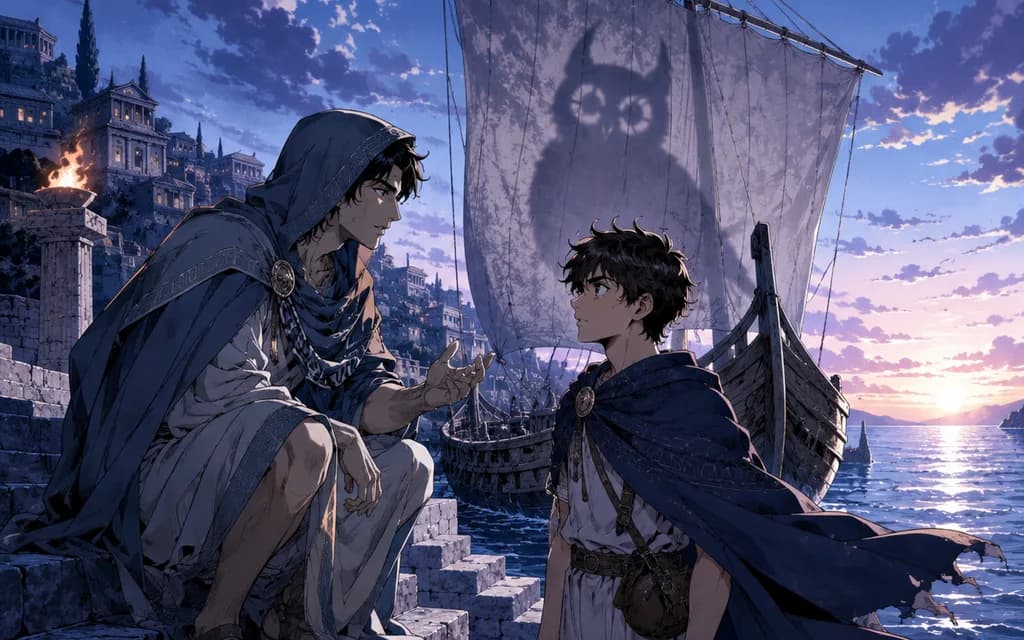
There is a specific kind of stuck that everyone recognises: you are technically an adult, you are living in a situation someone else built, and everyone around you is treating you like the person you were at fifteen, partly because you keep behaving like him. What breaks it is almost never a plan. It is usually one person, from outside, saying a version of you know you're allowed to just go, right? The oldest recorded example of that conversation is the first hundred lines of the Odyssey.
- The poem's first four books are not about Odysseus. They are about a son who has never met him.
- He is stuck, and he knows it. He sits among the men eating his house and imagines his father walking in.
- A stranger tells him to grow up— and the stranger is a goddess in disguise.
- The word “mentor” comes out of this story, though not quite the way people think.
It also gives the poem a shape that modern audiences will find familiar from television. Two storylines run in parallel for four books, in different places, about people who cannot reach each other, and both of them are about the same absence. When they finally converge, in a hut belonging to a swineherd, a father and a son meet for the first time as adults, and it is the father who finally says who he is out loud.
🪑 The boy in the room
We meet Telemachus doing nothing, which is exactly right. He is sitting among the suitors while a bard sings, thinking about his father coming home and throwing them all out. It is a daydream, and Homer says so: the boy is picturing rather than planning.
His situation is worse than embarrassing. Every night, dozens of the most powerful young men in the region eat his inheritance in his own hall. He cannot throw them out, having neither force nor standing. He cannot send his mother away, because that would mean paying back her dowry and admitting his father is dead. He is twenty-ish years old and every option he has is a way of losing.
This is the part modern readers get instantly and ancient audiences also got instantly: being the son of a legend is what is making him invisible, and there is no version of it that works as an advantage.
Homer keeps a comparison running in the background to make sure you feel it. Everyone in the poem keeps bringing up Orestes: the boy whose father was murdered coming home from the same war, who grew up and killed the man who did it, and whose name is now shorthand for a son who handled it. Telemachus hears about Orestes from a goddess, from Nestor, from Menelaus. Nobody says the quiet part, and nobody has to: that is what a son is supposed to look like, and you are sitting down.
🦉 The stranger who tells him to grow up
A visitor arrives: a family friend called Mentes, passing through. It is Athena. (Butler's 1900 prose calls her Minerva and calls Odysseus Ulysses; same gods, Latin names.) She eats, she asks questions, she listens to him explain how hopeless it all is. And then she stops being polite.
You are too old to plead infancy any longer… You are a fine, smart looking fellow; show your mettle, then, and make yourself a name in story.
Everything she gives him is procedural, not magical. Call a public assembly tomorrow. State your case out loud, in front of witnesses. Then take a ship and twenty men and go ask Nestor at Pylos and Menelaus at Sparta what they know. If your father is alive, wait another year. If he is dead, bury him properly, marry your mother off, and then work out how to deal with these men.
No sword. No prophecy. A goddess turns up, and what she hands a stuck young man is an agenda. The magic in the scene is small and entirely psychological: Homer says she gave him courage, and made him think about his father more than ever. He notices the change in himself, is surprised by it, and works out afterwards that the visitor was a god. That is Homer describing what it actually feels like when someone gets to you, where the difference registers before the reason does.
The immediate result is not admirable, and Homer does not pretend otherwise. Within a page Telemachus is telling his own grieving mother to go upstairs and get back to her weaving, because “speech is man's matter, and mine above all others, for it is I who am master here.” It is the first thing he does with his new spine, and it is obnoxious. The poem lets it be obnoxious. That is what the first draft of an adult voice sounds like: too loud, aimed at the wrong person.
⛵ Leaving is the whole skill
Books 2 to 4 are the part that would be cut from any modern adaptation, and they are the reason the character works.
He calls the assembly and is publicly humiliated. He asks for a ship and is laughed at. So he takes one anyway, at night, without telling his mother, with a crew Athena assembles for him. Then he does the least heroic and most useful thing available: he goes and talks to older people who were there.
The assembly is worth pausing on, because it is a failure and it is the turning point. It is the first meeting the island has held in the twenty years since Odysseus left, and Telemachus calls it, takes the speaker's staff, and cries in front of everyone before he can finish. The suitors run rings around him. They tell him the problem is his mother. The crowd does nothing. He gets no ship, no support and no ruling.
And yet everything afterwards is different, because he said it out loud in public. He has made the occupation a matter of record, and he has told an entire island that he is no longer a child who can be ignored. Homer's idea of growing up has nothing to do with winning the argument; it is being willing to have the argument where people can see.
At Pylos, Nestor tells him long stories that circle the question and never quite answer it. At Sparta he is fed by Menelaus and Helen: the king whose wife left with a Trojan prince, and the wife herself, back home and hosting as though the ten-year war fought over her had been someone else's. They weep at him and tell contradictory versions of Troy while he sits there being the spitting image of a man they both loved. He gets one hard fact, that his father is alive on an island with a goddess, and a great deal of something more useful: the experience of being received as a guest, in halls that are not his, by people who address him as an adult because he arrived like one.
Homer keeps his eye on the mechanics of this. The real Mentor is introduced as “a friend of Ulysses, and had been left in charge of everything with full authority over the servants”, and he is the man Athena chooses to impersonate for the rest of the poem. She does not borrow a warrior's face. She borrows the face of the person the household was actually entrusted to.
📘 The word that came out of this
Everybody knows “mentor” comes from the Odyssey. What almost nobody knows is that the English word did not really come from Homer at all. Mentor barely appears in the poem, and when the wise guidance shows up it is Athena wearing his face.
The word entered common use through Fénelon's 1699 Les Aventures de Télémaque, a French novel written for a royal pupil that expanded Telemachus's journey into a whole education, with Mentor as the tutor. Our idea of mentorship is fan fiction of this poem, and it took about two and a half thousand years to write. You can read Books 1 to 4 for yourself in the original and in facing English at the Perseus Digital Library, which is where most of the scholarship on the Telemachy starts. Which is a better joke than it looks, because the poem's own version is stranger and truer. The mentor here is somebody who shows up wearing a familiar face, tells you the thing you already knew, gives you a to-do list, and leaves. No god fights for Telemachus. He becomes impressive because he went to Pylos.
The payoff arrives in the last book, in a farmyard, when three generations put on armour together and old Laertes says the happiest line in the poem: “My son and grandson are vying with one another in the matter of valour.” The boy who could not get a ship is now standing in a battle line his grandfather is proud of.
Nolan's film gives Tom Holland's Telemachus the opening of the movie and considerably more time with his father than Homer allows, and then hands him the throne at the end. Homer would recognise the instinct even where he would not recognise the scene: the poem has been building an heir since its first hundred lines.
Casting him carries its own logic: Tom Holland has spent his film career playing exactly this, the young man an ordeal forces to prove himself, from his 2012 debut as a boy tested by a tsunami in The Impossible through the unravelling war veteran of Cherry and the fractured identity at the centre of The Crowded Room. Homer's plot was already his type, years before he picked up a bow.
The four books nobody adapts are the ones that play best. Be the son: call the assembly and watch it go badly, take the ship anyway, and decide in Sparta how much of what Helen tells you to believe. Or stay home and see how long the house holds without you.
If it is the father you want, start with the trick that made him famous and the boast that undid it: Nobody, and the cost of a name.
Sources
- The Odyssey, translated by Samuel Butler (1900) — Books 1, 2, 19 and 24 — Project Gutenberg
- Mentor (Odyssey) — and the word's route into English via Fénelon — Wikipedia
- The Odyssey (2026 film) — cast and structure — Wikipedia
- Tom Holland — filmography — Wikipedia
- Homer, Odyssey — Greek text and A. T. Murray's facing translation — Perseus Digital Library, Tufts University
Frequently asked questions
- What is the Telemachy in The Odyssey?
- The name scholars give to Books 1 to 4, the quarter of the poem in which Odysseus does not appear at all. It follows his son: an infant when his father sailed, a grown man by Book 1, who calls Ithaca's first assembly in twenty years, fails, sails anyway, and comes home someone the suitors have to take seriously. It is effectively the oldest surviving Bildungsroman.
- Why does The Odyssey start with Telemachus instead of Odysseus?
- Because the poem is about an absence and what it does to the people living inside it. Starting in the occupied house, with a son who cannot act, establishes the stakes of the homecoming before the hero appears in Book 5. It also gives the poem a coming-of-age arc that runs in parallel with the voyage.
- Is Athena Mentor in The Odyssey?
- Mentor is a real character — an old friend of Odysseus left in charge of the household. Athena repeatedly takes his form and voice to advise and accompany Telemachus, and in Butler's translation the poem's final sentence has her, as Mentor, making the covenant of peace that ends the story. She first appears, though, disguised as a different family friend, Mentes.
- Does the word 'mentor' come from The Odyssey?
- Indirectly, and the real Mentor would be surprised. He speaks in two scenes and is shouted down in one of them; the wise guidance is Athena wearing his face. The word entered English through Fénelon's 1699 novel Les Aventures de Télémaque, written for a royal pupil, which expanded the journey into an education with Mentor as the tutor.
- What does Athena tell Telemachus to do?
- She hands him an agenda, not a weapon: call a public assembly, state your case in front of witnesses, take a ship and twenty men, ask Nestor and Menelaus what they know. If your father lives, wait a year; if not, bury him and settle the house. It may be the oldest to-do list in Western literature, and nothing on it is supernatural.
Enjoyed this one?