Nobody (Outis): the Cyclops, the name Odysseus couldn't resist, and what it cost him
The trick works perfectly: a false name, planted an hour early, beats a giant that no weapon in the cave could. Then, from a ship that has already got away, Odysseus shouts his real name, his father's name and his home address — and the rest of the poem is the invoice.


You have done the small version of this. You handled something difficult, you got out clean, and then, from a safe distance where it could not possibly help, you made sure the other person knew it was you. The reply-all. The subtweet. The one extra line in the exit interview. It felt necessary at the time. Homer built an entire epic on the consequences of that impulse, and the bill came to ten years.
- The trick works perfectly. A false name, planted before it is needed, beats a giant that strength could not.
- His own crew beg him to stop. They are already rowing. They are already safe.
- He shouts his real name anyway— with his father's name and his home address attached.
- That is the curse. Everything that happens for the next ten years is what the giant asks for out loud.
It helps to know what the giant actually is, because “monster” flattens him. Polyphemus is a shepherd. When the Greeks let themselves into the cave, what they find is a working dairy: cheese-racks loaded with cheeses, lambs and kids sorted by age into separate pens, bowls and milk pails swimming with whey. Homer warns you what kind of owner that implies, someone who would “respect neither right nor law,” and the horror of Book 9 has nothing to do with something inhuman being in the cave with you. It is that the person whose house you walked into does not think the rules apply to him.
And the reason they are still there when he gets back is the detail nobody ever quotes. The crew begged Odysseus to grab the cheeses, drive off the lambs, and sail. He refused because, in his own words, he “wanted to see the owner himself, in the hope that he might give me a present.” Six men die of that. The trap in this story is sprung twice by the same appetite, and both times it is his.
🍷 The best trick in the book
Odysseus and twelve men are trapped in a cave behind a boulder they cannot move, and the thing that lives there has already eaten some of them. Killing it in its sleep would kill them too: nobody else can shift the door. So the plan has to be something else entirely.
He offers the giant wine. Strong, undiluted, the good stuff he happened to bring. The giant drinks three bowls and, pleased, asks his guest's name so he can give him a present.
Cyclops, you ask my name and I will tell it you; give me, therefore, the present you promised me; my name is Noman; this is what my father and mother and my friends have always called me.
(Butler's 1900 prose renders the pun as “Noman” and calls the hero Ulysses and Poseidon Neptune; other translations use “Nobody.”) The giant, delighted with himself, promises his present: he will eat Noman last.
Then the stake, the eye, the screaming, and the punchline, which is the whole point of the plan. The other cyclopes come running to the mouth of the cave and shout through it asking who is killing him. Nobody is. So they leave. A man who has just been blinded cannot get help because of a sentence he agreed to an hour earlier while drunk. It is the most efficient weapon in the poem and it weighs nothing.
The Greek is sharper than any English can be, and it is worth thirty seconds. The word Odysseus gives is Outis(Οὖτις), which simply means “nobody.” But when the neighbours put the question in the negative — a grammatical form Greek requires here — the word becomes mē tis, and mētisis the poem's own word for Odysseus's defining quality: cunning intelligence, the thing Athena praises him for. He escapes by pronouncing the name of the skill he is escaping with. The alias has its own entry as a name in its own right, and the Greek is at the Perseus Digital Library, Book 9, if you want to watch it happen line by line.
The film does not have this problem, because the film does not have the joke. Nolan cut it, and said so plainly: “It's a pun. Puns in translation are tough. I tried. It was not possible to work it in.” His cyclops is mostly silent instead, which also means there are no neighbouring cyclopes to misunderstand anything, and the scene becomes a horror set-piece rather than a riddle.
There is a second joke inside the first, and it is the reason the scene is more than a riddle. The name is offered as part of a guest-gift exchange: the giant asks for it so he can give a present, which is what a host owes a visitor. The whole cave sequence is about hospitality going wrong: a guest who helps himself to the cheese, a host whose “present” is to eat him last. In a world where a stranger's safety depends entirely on the ritual being honoured, Odysseus wins by weaponising the one part of it the monster is still observing.
📣 And then he ruins it
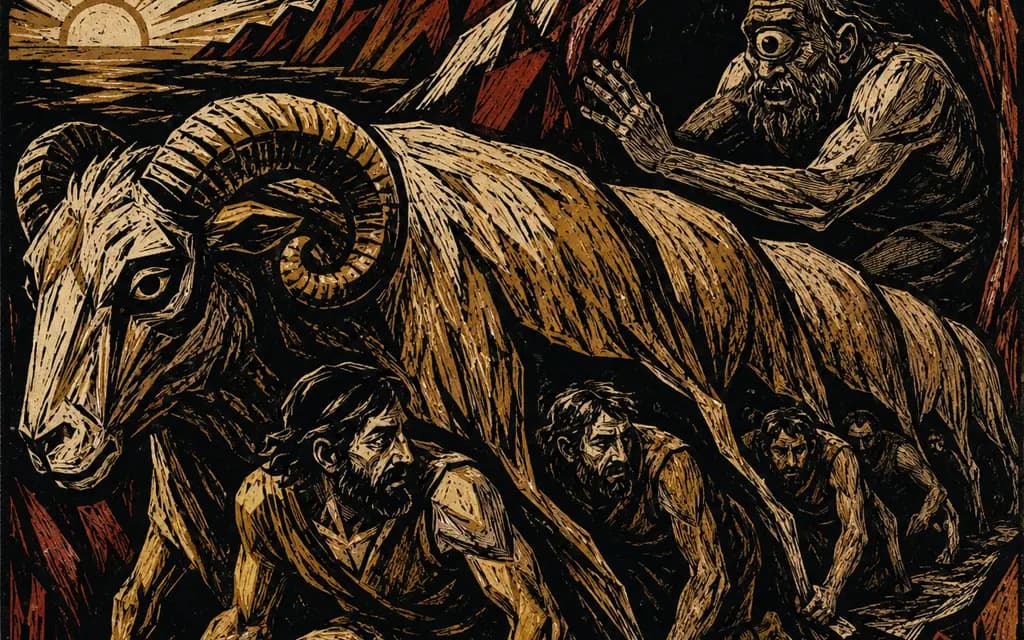
The escape works. They are out, under the sheep, on the ship, rowing, alive. And Odysseus cannot leave it.
He shouts back at the shore. His men beg him not to. The giant is throwing rocks the size of hills by sound alone, and one has already nearly swamped them. Homer is precise about the reason he does it anyway.
But I would not listen to them, and shouted out to him in my rage, “Cyclops, if any one asks you who it was that put your eye out and spoiled your beauty, say it was the valiant warrior Ulysses, son of Laertes, who lives in Ithaca.”
Look at what he hands over. Not just a name: a name, a father, and a home address. He does it because being Nobody worked and being Nobody is unbearable. The whole point of the plan was that nobody would ever know it was him, and he has just discovered that he cannot live with the price of his own best idea.
And it is a second shout, not a first. He has already yelled once, from closer in, and the rock the giant threw at the sound very nearly ended the ship. His crew have already told him what the arithmetic is. Homer gives him the word for what happens next, and the word is not courage: he shouts “in my rage.” And remember who is telling you this. Odysseus is narrating his own boast, out loud, at someone else's dinner table. The bravest-sounding line in the poem reaches you as a confession.
There is a detail that makes it worse. The giant answers that a prophet told him, long ago, that he would lose his sight at the hand of Odysseus, and that he had been expecting somebody of imposing presence and superhuman strength, not this small, insignificant man who managed it by getting him drunk. Even in the moment of his triumph, Odysseus is being told that his victory does not look like one. He has traded ten years of his life for acknowledgement, and the acknowledgement, when it arrives, is an insult.
🌊 The invoice, itemised
Polyphemus is Poseidon's son. With the name, he can finally pray properly, because a curse needs someone to be about.
Hear me, great Neptune… grant that Ulysses may never reach his home alive; or if he must get back to his friends at last, let him do so late and in sore plight after losing all his men, let him reach his home in another man's ship and find trouble in his house.
Now read that as a plot summary, because that is what it is. He gets home, ten years late. He loses every one of his men. He arrives asleep in a ship belonging to strangers, and he finds his house full of trouble. Homer's response to it is a single clause: “Thus did he pray, and Neptune heard his prayer.”
The entire remaining structure of the poem (the storms, the ten years, the dead crew, the occupied house) is the itemised bill for one sentence shouted from a boat that had already got away.
🪞 Why anyone does this
Every schoolbook files this under pride, and that reading misses what the poem is anxious about. In Odysseus's world, a deed nobody can attribute to you does not fully exist. Fame is the only durable form of a life, not vanity: the whole reason we are reading about him is that somebody sang his name afterwards.
So “Nobody” is a small death dressed as an alias, and the boast is a man refusing it. He wins by disappearing and then cannot bear to have disappeared. The cleanest proof is the frame around the cave story itself. Odysseus has been a guest of the Phaeacians for two full books without telling them who he is, listening to a bard sing about Troy and weeping into his cloak. When he finally gives it up, he does not simply say his name.
I am Ulysses son of Laertes, renowned among mankind for all manner of subtlety, so that my fame ascends to heaven.
Then he tells them about the cyclops. So the story of the man who could not resist shouting his name across the water arrives immediately after an introduction like that, from the same man, to people who had not asked. The poem is not solemn about this. It is watching him do it again, in a nicer room.
Nolan's 2026 film builds the cave sequence around a performance rather than a creature effect: the giant is performed by Bill Irwin, in a film shot entirely on IMAX film cameras, which is a very expensive way of saying the scariest thing in the cave is a person. Homer would agree. The monster in Book 9 does nothing that a bad host would not do; he just does it at scale, and he is owed a favour by a god.
The scream became the scene's real special effect. Reviewers singled out Polyphemus's cry after the blinding as the strangest sound in the film, closer to horror filmmaking than blockbuster spectacle. It works as an apt substitute for the pun the film cut: Homer's Odysseus wins the cave by choosing exactly the right word, and Nolan's version wins it by making one sound no one could mistake for anything but pain.
Here is the one choice in the whole poem worth playing twice. When the drunk giant asks who you are, hand him the lie. Then get to the ship, and decide, with your crew begging you not to, whether you can genuinely sail away as Nobody, or whether you shout your name across the water like everyone who ever has.
If it is the lying itself that fascinates you, the poem has a whole argument about it, and a goddess on the side of the liar: why Odysseus lies.
Sources
- The Odyssey, translated by Samuel Butler (1900) — Book 9 — Project Gutenberg
- The Odyssey (2026 film) — cast and format — Wikipedia
- English translations of Homer — how translators render the 'Nobody' pun — Wikipedia
- Outis — the name Odysseus gives the Cyclops — Wikipedia
- How Christopher Nolan's The Odyssey changes the Cyclops showdown — SlashFilm
- Viewers on the Odyssey moment that left them shaken — the Cyclops scream — LADbible
- The Odyssey and the magic of horror — on the Cyclops scene's sound design — Girl at the Movies (Substack)
- Homer, Odyssey — Greek text and A. T. Murray's facing translation — Perseus Digital Library, Tufts University
Frequently asked questions
- Why does Odysseus say his name is Nobody?
- So that the blinded giant's neighbours hear that 'Nobody' is hurting him and go home. The Greek is Outis, and the pun goes deeper than English can carry: put in the negative, as the neighbours' question requires, it becomes mē tis — and mētis is Homer's own word for Odysseus's cunning. He escapes by saying the name of the skill he is escaping with.
- What does Odysseus shout at the cyclops?
- From the escaping ship he shouts, in Butler's translation, 'Cyclops, if any one asks you who it was that put your eye out and spoiled your beauty, say it was the valiant warrior Ulysses, son of Laertes, who lives in Ithaca.' He gives his name, his father's name and his island — everything a curse needs.
- Why does Poseidon hate Odysseus?
- Polyphemus is Poseidon's son. Once he has Odysseus's real name, he prays to his father that Odysseus never reach home alive — or, if he must, that he arrive late, having lost all his men, in a stranger's ship, to find trouble in his house. Homer says the god heard the prayer, and that curse is the plot of the rest of the poem.
- Was blinding the cyclops a mistake?
- The blinding was the only escape available: killing Polyphemus in his sleep would have sealed them in behind a boulder they could not move. The mistake was earlier and later — refusing to take the cheese and leave before the owner returned, and then shouting his name from the ship once they were already clear.
- Is the 'Nobody' joke in the 2026 Odyssey film?
- No. Nolan cut it and said why: 'It's a pun. Puns in translation are tough. I tried. It was not possible to work it in.' His Polyphemus — performed by Bill Irwin — is mostly silent instead, which also removes the neighbouring cyclopes who exist in Homer only to misunderstand the joke.
Enjoyed this one?