Why Odysseus lies: mētis, the Cretan tales, and the hero who wins by deception
His most famous victory is a pun. His second-most-famous is a disguise. Odysseus lies to monsters, to strangers, to his wife and to his grieving father days after it stopped being necessary — and Athena's reaction to catching him at it is delight. Here is what the poem actually thinks about that.


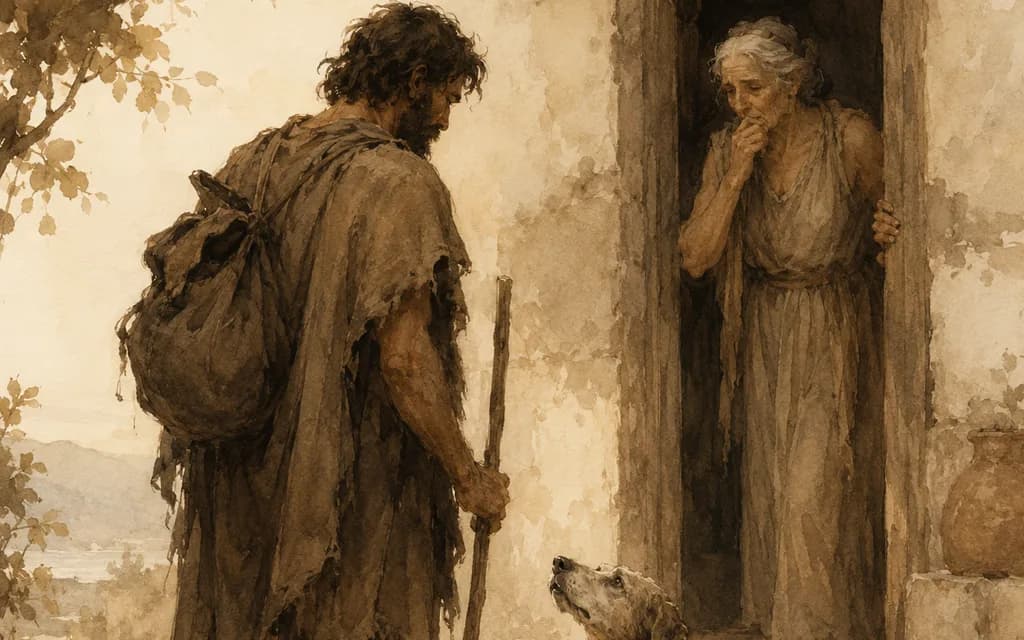
Think of the last person you watched talk their way out of something. Not a bully — the other kind. The one who reads a room in four seconds, decides who needs which version, and hands it over smoothly enough that everyone leaves satisfied. You probably admire them a little and trust them slightly less than you say you do. Homer wrote the founding text on that person, and then made him the hero.
- His most famous victory is a pun. He beats a giant by giving a false name and then talking about it.
- He lies when he doesn't have to.Home, safe, on his own beach, to a goddess — he still invents a biography.
- He lies to the people who love him. His wife. His father. Days after it stopped being necessary.
- Athena approves. Her reaction to catching him lying to her face is delight. Poseidon, whose son he tricked, spends ten years proving the other gods do not have to agree.
It is worth naming the thing this poem does not do, because it is unusual. It never has a character stand up and say that lying is wrong. Nobody is punished for deceit; the only people punished are punished for greed, for disrespecting guests, and for eating the wrong cattle. In a poem this interested in divine justice, the hero's defining habit is simply never put on trial, which tells you it was never being charged.
🕳️ The trick everyone remembers
Trapped in a cave with a monster who has eaten several of his crew, Odysseus does not fight. He offers the wine, waits for the drink to land, and then answers a polite question with the best lie in literature — a name he must have chosen hours earlier, while the door was still shut and there was nothing to do but think.
Cyclops, you ask my name and I will tell it you… my name is Noman; this is what my father and mother and my friends have always called me.
(Butler's 1900 prose spells it “Noman” and calls the hero Ulysses; other translations use “Nobody.”) The blinding follows, and then the payload: the other cyclopes hear screaming, come running, and ask through the door who is hurting him. Nobody is. They go home. The lie does the work that no weapon in the cave could have done, and it works because it was planted an hour before it was needed.
That is the shape of every Odysseus victory: it is won by the better prepared sentence rather than the stronger arm, and the preparation always happened somewhere the reader did not see.
And it was already his method before the poem starts. In Book 4, Helen tells a story about the siege: a filthy beggar covered in self-inflicted wounds and bruises walked into occupied Troy, and she was the only person who recognised him. He had disguised himself so completely that the enemy city ignored him, and he was “too cunning” for her even after she knew. Rags, false skin and a false story, twenty years before he wears the same costume into his own house.
🎭 The lies he tells when he has already won
Here is the part that gets left out of the children's versions. Odysseus finally lands on Ithaca in Book 13, asleep, delivered by friendly sailors, treasure stacked beside him on the sand. He wakes up not knowing where he is. A young shepherd appears and tells him: this is Ithaca. He is home. He has made it.
And this is what he does with that information:
Ulysses was glad at finding himself… in his own country, and he began to answer, but he did not speak the truth, and made up a lying story in the instinctive wiliness of his heart.
The instinctive wiliness of his heart. That is a reflex, not a plan. He improvises an entire life (a man from Crete, on the run for killing someone in a dispute over plunder) and he does it to a stranger, for no advantage, on the safest beach in the world.
The craft of it is the tell. The false life is not vague; it has a father, a victim, a grievance about unpaid loyalty at Troy, an ambush by a roadside on a dark night, and a plausible reason for the treasure lying on the sand next to him. He builds a story that explains the evidence. Twenty seconds after waking up in an unknown country, this man is already accounting for the props.
He tells versions of that Cretan story again and again through the rest of the poem: to the swineherd who is feeding him, in his own hall, to his own wife. They are internally consistent, richly detailed and mostly unnecessary, and they are the strongest evidence in the poem that lying is not a tactic he reaches for but the shape of the man reaching.
The Book 14 version, told to the swineherd who is feeding him, is the one to read closely, because it has no monsters in it. A bastard son of a Cretan house, nine raiding voyages before Troy, a raid on Egypt that goes wrong, a Phoenician planning to sell him. It is his own life with the gods taken out, and that is exactly why a working man believes it.
💔 Lying to the people who love him
He lies to Penelope while she is crying in front of him. Disguised as a beggar, he tells her he hosted her husband in Crete twelve days ago; she asks him to prove it by describing what Odysseus was wearing, which he can, because he was wearing it.
And in the middle of that , with his wife weeping at his own fabricated hospitality, Homer holds the camera on his face.
Ulysses felt for her and was sorry for her, but he kept his eyes as hard as horn or iron without letting them so much as quiver, so cunningly did he restrain his tears.
Hard as horn or iron, on purpose, while she thaws “as the snow wastes upon the mountain tops.” Escape is not what the lie is for. He lies because he has decided the plan needs another day, and because he has worked out that he can hold it that long.
He lies to his father last, and worst. Book 24, the killing is over, the house is his, and he walks out to a vineyard where old Laertes is working in filthy clothes, ruined by grief. There is nothing left to protect, and this is still what he opens with:
“I will tell you everything,” answered Ulysses, “quite truly. I come from Alybas, where I have a fine house… My own name is Eperitus.”
Quite truly. He watches his father take dust in both hands and pour it over his own head before he relents. Whatever you think a hero is, this is a man who cannot stop performing, even when the only audience left is someone who has been mourning him for twenty years.
It is worth being precise about why this is different from the other lies. Lying to the cyclops saves twelve lives. Lying to the suitors is a soldier keeping his cover in hostile territory. Lying to Laertes accomplishes nothing except a few more minutes of a game only one player knows is being played, and the poem, which has been on his side for twenty-three books, quietly notes the cost. That is Homer's ethics: the skill is not condemned, but the bill for it always gets itemised.
And there is a mirror to it that no one talks about. Penelope lies too, for three years, to a house full of armed men, with a loom. When she finally tests her husband about the bed, Homer's narrator gives the whole marriage away in four words: “She said this to try him.” They are the same person, and the recognition of that is the closest thing this poem has to a love story.
🦉 A goddess who thinks this is wonderful
The moment that settles what the poem thinks about all this comes right after the beach lie. The shepherd is Athena. She has heard the whole invented Cretan biography, and instead of punishing him for it she laughs, which is the poem telling you what it thinks of all this.
Dare devil that you are, full of guile, unwearying in deceit, can you not drop your tricks and your instinctive falsehood, even now that you are in your own country again? We will say no more, however, about this, for we can both of us deceive upon occasion.
She goes on to call him the most accomplished counsellor and orator among all mankind, and to say that for diplomacy and subtlety she has no equal among the gods. It is a professional compliment between two specialists: recognition rather than forgiveness. Then she immediately puts his skill to work, telling him to keep the homecoming secret from everyone, man and woman alike, and to “bear everything, and put up with every man's insolence, without a word.” The reward for lying well is an assignment that requires more of it.
The goddess of wisdom likes this man precisely because he lies well; that is what wisdom looks like in this poem, and it is why another famously practical old book arrives at the same first principle from the other side of the world.
Nolan's 2026 film is the first big adaptation to press hard on the bill for it. Rather than treating the wooden horse as a masterstroke, the film reframes it as a violation, with Odysseus confessing his shame to Penelope before he says who he is. That is not in Homer. But it is a fair reading of a poem in which the hero's gift keeps working perfectly and keeps costing him the only people he wanted to get back to.
The interesting thing about playing it rather than reading it is that the choice becomes yours. When the giant asks your name, you can hand him a lie. When your father asks who you are, you can say Eperitus, or you can be the first Odysseus in three thousand years who just tells him.
The other half of this argument is the woman who out-thought him at his own game: Penelope is the smartest person in the poem.
Sources
- The Odyssey, translated by Samuel Butler (1900) — Books 9, 13, 19, 23 and 24 — Project Gutenberg
- 'The Odyssey' Ending Explained: What Christopher Nolan Changed — TheWrap
- The Odyssey (2026 film) — plot and additions — Wikipedia
- Homer, Odyssey — Greek text and A. T. Murray's facing translation — Perseus Digital Library, Tufts University
Frequently asked questions
- Why does Odysseus lie so much?
- The Greek has a word for it: mētis, cunning intelligence, which is what Homer's characters admire in him and what Athena claims as her own speciality. His standing epithet, polytropos, means 'of many turns'. Lying is not a lapse from the heroic standard in this poem; for this particular hero it is the standard, and the poem never once argues otherwise.
- What are the Cretan lies in The Odyssey?
- Four false autobiographies, all set in Crete, told after he is already home: to Athena in Book 13, to the swineherd Eumaeus in 14, to Penelope in 19, and to his father in 24. Each has a father, a grievance and a plausible reason for the treasure at his feet. None of them is necessary by the fourth.
- Why does Odysseus lie to his father Laertes?
- Homer declines to explain, which is the point. The suitors are dead, the house is his, and there is nothing left to protect — and he still tells a grieving old man that his name is Eperitus and he comes from Alybas, prefacing it with 'I will tell you everything, quite truly.' It reads as a reflex he cannot switch off.
- Do the gods approve of Odysseus lying?
- One does. Athena catches him inventing a biography on his own beach and laughs, calling him full of guile and unwearying in deceit before admitting 'we can both of us deceive upon occasion.' Poseidon is the counterexample, and he matters more: the ten-year punishment that drives the whole poem starts from the lie that worked best.
- Is Odysseus a hero or a liar?
- Both, with no tension between them in Homer's terms. The poem never puts deception on trial; the people it punishes are punished for greed, for abusing guests and for sacrilege. Nolan's 2026 film presses harder on the cost, reframing the Trojan Horse as a violation and having Odysseus confess his shame to Penelope before he says who he is.
Enjoyed this one?