Penelope in The Odyssey: character analysis — and why she's the smartest person in the poem
She has been filed for three thousand years under 'the faithful wife who waited,' which is roughly like filing a chess grandmaster under 'sat down a lot.' Penelope stalls an occupying army with a loom, sets the contest that arms her husband, and then traps him with a question about furniture.


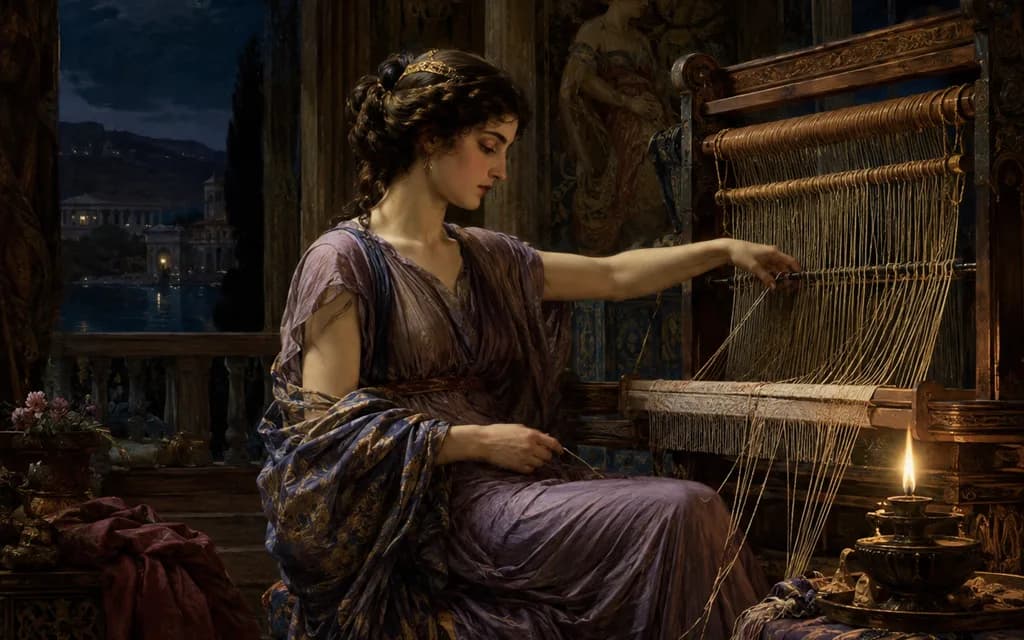
You know the person at work who never raises their voice, never wins the meeting, and somehow gets the outcome they wanted three months later. Everyone else is arguing. They are running the clock. Penelope has been filed for three thousand years under “the faithful wife who waited,” which is roughly like filing a chess grandmaster under “sat down a lot.” She is the best strategist in the poem, and the poem knows it.
A word about the reputation, because it is the reason she gets underrated. The poem does praise her constancy, endlessly, and that is the half that survived into the summary. But constancy is a description of the outcome, not the method. The method is deception, timing, procedural excuses and controlled information: the same toolkit her husband is celebrated for. Homer gives them the same skill and different weather to use it in.
🧶 Three years of undoing her own work
Her house is full of armed men who will not leave until she marries one of them. She cannot refuse outright, because refusing would end the pretence of courtship and start something worse. So she agrees in principle, and then attaches a condition that nobody can honourably object to: she must first finish weaving a burial shroud for her father-in-law, so the old man is not laid out without one when his time comes.
One of the suitors explains, in Book 2, how that went. (Butler's 1900 prose is quoted throughout here; it calls Odysseus “Ulysses” and Athena “Minerva.”)
We could see her working on her great web all day long, but at night she would unpick the stitches again by torchlight. She fooled us in this way for three years and we never found her out.
Three years: not one clever night but a thousand of them, in a room she could be walked into at any moment, with the evidence of the crime physically in her hands. And it only ended because one of the enslaved women in the house informed on her.
The suitor telling this story is furious about it, and the fury is the interesting part. Listen to what he complains about: her “airs,” her accomplishments, the fact that she is “so clever.” Cruelty is not the charge. The charge is that she is better at this than they are, and he is right about that.
Look closely at the design of the trick, too, because it is doing more than stalling. The excuse she chooses is a shroud for her husband's father, an act of family duty so obviously correct that objecting to it would make a suitor look like a monster in front of the whole island. She has picked a delay her enemies have to publicly approve of, which is politics, not patience.
🏹 The contest is hers, not his
Everybody remembers Odysseus stringing the bow. Almost nobody remembers who put the bow in the room.
In Book 19, talking to a beggar she has never met (it is Odysseus, home at last and in disguise, and she does not know it), Penelope announces that tomorrow she will finally choose, by contest.
I am about to hold a tournament of axes… whichever of them can string the bow most easily, and send his arrow through all the twelve axes, him will I follow, and quit this house of my lawful husband.
Read that as a tactician and it is beautiful. She has chosen the one physical test in the world that she knows only her husband has ever passed. If he is dead, it settles a question that has to be settled, and settles it in favour of whoever is most like him. If he is alive and in the room, she has just walked a weapon and a quiver of arrows into a hall of unarmed men and handed him a legitimate reason to pick them up.
Homer never tells us which of those she is doing. The poem is genuinely, deliberately ambiguous about how much Penelope has worked out and when, and that ambiguity is the characterisation rather than a gap in it. She is the one person whose interior the narrator will not open for you.
The scene just before it makes the ambiguity worse, in the best way. She tells the beggar a dream: twenty geese she is fond of, eating grain in her yard, and an eagle that swoops down and kills every one of them, then perches on a rafter and speaks with a human voice to say that the geese are the suitors and the eagle is her husband, come home. She tells this dream, complete with its own interpretation, to a stranger, the night before she announces the contest.
The beggar tells her, eagerly, that it can only mean one thing: the suitors are going to die, and not one of them will escape. And she flatly declines the good news. Dreams come through two gates, she says, horn for the true ones and ivory for the empty ones: “I do not think, however, that my own dream came through the gate of horn.” Then, in the very next breath, she announces the contest.
Sit with that order of events. She describes an eagle killing the suitors, watches the stranger jump at it, refuses to be encouraged, and then arms the hall. She may be sincerely frightened of hoping. She may be showing a suspicious beggar exactly what she expects to happen, to see what his face does. Homer will not tell you, and three thousand years of readers have not settled it.
🛏️ She tests him, and he fails first
The suitors are dead. The house is retaken. Her son is telling her to stop being stubborn and go to her husband. And Penelope sits down opposite the man and says nothing.
He cracks first. He tells the nurse to make him up a bed elsewhere, because this woman has a heart like iron. And Penelope, mild as anything, agrees, and adds an instruction.
Nevertheless, Euryclea, take his bed outside the bed chamber that he himself built. Bring the bed outside this room, and put bedding upon it with fleeces, good coverlets, and blankets.
Then Homer, who has spent twelve thousand lines admiring how well his hero improvises, drops the shortest sentence in the poem:
She said this to try him.
Odysseus, the man who lied to a goddess for fun on his own beach, loses his temper instantly. Who moved my bed? He built it himself around a living olive tree, root still in the ground, and carved the trunk into the bedpost: “There is no man living, however strong and in his prime, who could move it from its place.”
That is the confession. She has extracted the one fact only her husband could know, by making him angry. Twenty years of professional deception, and he is undone in nine seconds by his wife asking a servant to move some furniture.
🏛️ Twenty years of holding a house
Strip out the sea monsters and look at the job description. She has run an estate under occupation, kept a teenage son alive whom several of the guests would happily murder, managed a hostile household of dozens of men without either marrying one or giving them an excuse for violence, and kept the succession open for a husband everyone else has written off.
She has done it for twenty years with no army, no vote and no title of her own. The poem is honest about what that costs. She weeps constantly. She cannot sleep. In Book 20 she sits up in bed and prays to a goddess to put an arrow through her heart, or to have a whirlwind carry her off, rather than wake up to another day of it. Endurance in the Odyssey is not serene; it is exhausting, and both of these people are being ruined by it in separate rooms.
And the poem knows exactly what it has built. In Book 24, down in the house of the dead, Agamemnon's ghost, a man murdered by his own wife on the day he came home, hears how Odysseus was received and delivers the verdict: he is blessed in a wife of such rare understanding, and the gods will make a song about Penelope's constancy that the whole world will want to hear, while his own wife's song will be hated. That is a dead king from another story reviewing this one, and choosing her as the reason it counts as a happy ending.
Which is what makes the 2026 film's ending land the way it does. Anne Hathaway's Penelope does not get the throne restored and the story closed; she sails into exile with him. You can argue it robs her of the house she spent two decades defending. You can also argue it is the first adaptation to notice that she was never waiting for the furniture. She was waiting for him, and she said so with a bed.
🎬 Anne Hathaway's Penelope, and what the film gives her
The 2026 film hands Hathaway the half of the poem most adaptations cut: the Ithaca years, in real time, opposite Tom Holland's Telemachus rather than opposite Odysseus. Reviewers have read that as the film's best decision and its most revealing one.
One notes that the adaptation shortchanges many of the female characters, and yet gives Hathaway's Penelope a rich character arc and at least three Oscar-clip scenes, which is a fair description of Homer's own arithmetic too: the poem gives her less page time than her husband and more to do with it. The ending is where the film departs hardest from the poem, and it departs through her. Instead of the throne coming back, the two of them sail west, which is what Penelope dreamed they would do when news of the Trojan War first broke. Homer's Penelope wins the house. This one wins the voyage.
The version worth trying is the one Homer left open. Play her: keep unpicking the weaving, or finish it and see what tomorrow costs. Set the bow contest early, or late. And when a beggar sits down opposite you carrying the old boar-scar the nurse recognised on his thigh, decide whether you believe him, or whether you ask about the bed.
Her son has his own four-book story running in parallel, and it is the best coming-of-age in ancient literature: Telemachus, Books 1 to 4.
Sources
- The Odyssey, translated by Samuel Butler (1900) — Books 2, 19, 20, 23 and 24 — Project Gutenberg
- The Odyssey (2026 film) — cast and ending — Wikipedia
- 'The Odyssey' Ending Explained: What Christopher Nolan Changed — TheWrap
- Review: 'The Odyssey' Is Most-Importantly a Great Anne Hathaway Movie — Matthew Huff
- The Odyssey ending explained — TODAY
- Homer, Odyssey — Greek text and A. T. Murray's facing translation — Perseus Digital Library, Tufts University
Frequently asked questions
- What is Penelope's shroud trick?
- She tells the suitors she will choose a husband once she has finished weaving a burial shroud for her father-in-law Laertes — an act of family duty none of them can object to. She then unpicks the day's weaving every night by torchlight. Homer's suitors say it fooled them for three years, and it only ended when one of the household's enslaved women informed on her.
- Why does Penelope set the bow contest?
- She announces it in Book 19, choosing the one physical test she knows only her husband has ever passed: stringing his bow and shooting an arrow through the sockets of twelve axe heads. Whether she suspects the beggar is Odysseus is left deliberately unresolved — but the practical effect is that she walks a weapon into a hall of unarmed men on the day he is standing in it.
- Why does Penelope test Odysseus with the bed?
- Because she has been lied to for twenty years by strangers claiming news of him, and the bed is the one fact no impostor could hold. In Book 23 she tells a servant to move it outside the bedroom; Odysseus loses his temper and blurts out that he built it around a living olive tree still rooted in the ground. Homer says plainly that she said it to try him.
- Is Penelope smarter than Odysseus?
- She is the only character in the poem who successfully deceives him, and she does it twice on two different clocks: three years with a loom, and about nine seconds with a question about furniture. He deceives monsters, kings and gods. Nobody at all deceives her. Homer's suitors complain, resentfully, that she is 'so clever.'
- What happens to Penelope in Nolan's film?
- Anne Hathaway plays her, and the film ends by sailing the two of them west rather than restoring the throne — which is, reviewers note, what Penelope had dreamed they would do when news of the war first broke. Critics have also called the adaptation short-changing to its female characters generally while handing Hathaway its richest arc.
Enjoyed this one?