The Odyssey ending explained: the film, the poem, and the part nobody agrees on
Homer's homecoming doesn't stop at the door. A quarter of the poem is still to go when Odysseus gets home, and it contains a massacre, a test set by his wife, a near civil war stopped by a goddess, and a prophecy that says he has to leave again. Here is the real ending, and what the film changed.


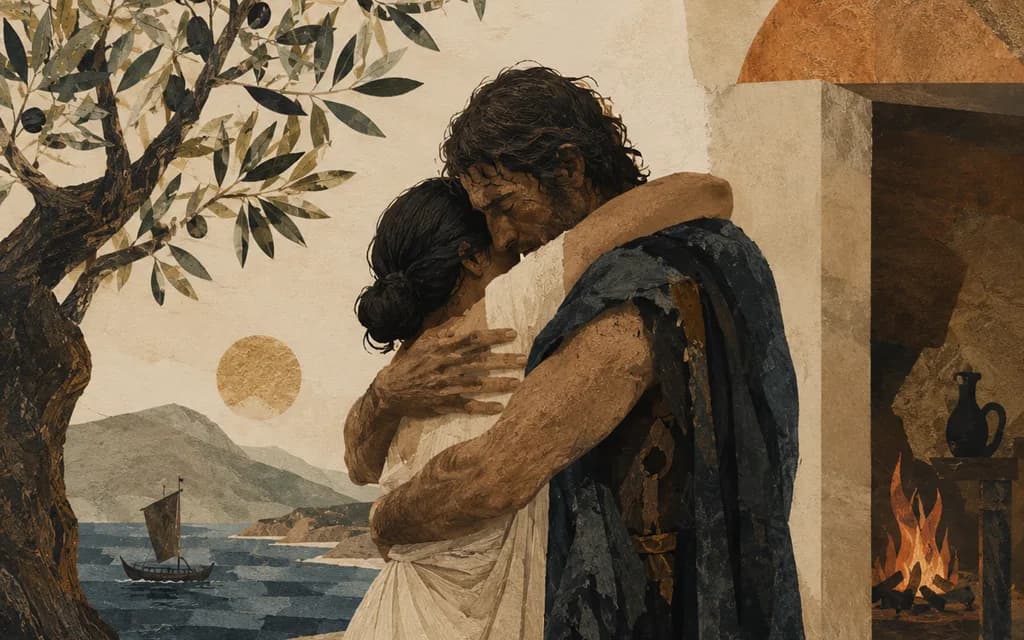
Spoilers for the 2026 film, and for Books 22 to 24 of the poem.
Every story you have ever been told about coming home ends at the door. You get off the plane, you get the hug, credits. Homer's does not. The reunion happens with a quarter of the poem still to go, and what fills that quarter is a massacre, a test, a near civil war, and a prophecy that says the man is going to have to leave again. If the ending felt strange to you in the cinema, it is because the ending is strange in the book.
- The reunion is not the climax.Odysseus kills every suitor in the hall first — a room full of them, in his own house.
- Penelope does not take his word for it. She sets him one last trap, about a bed, and he walks straight into it.
- The poem's last scene is a riot.The dead men's fathers come for him, and a goddess has to stop the fight by shouting.
- He is prophesied to leave again— inland, on foot, carrying an oar until someone mistakes it for a shovel.
🎬 The film's ending, and the part nobody agrees on
The film's last movement is short and deliberately unsettled. Odysseus takes the hall, takes several arrows doing it, and tells Penelope the sentence the whole ending turns on:Not death. Exile. Then Telemachus has Ithaca and the two of them are on a ship heading west. What the film withholds is whether that ship is real.
The wounds are the reason people argue. Odysseus is badly hurt in the throne room and the film refuses to confirm whether he survives, and the departure is cut against him lying in Penelope's arms, so the same footage supports two different films. As one explainer puts it, Nolan never explicitly confirms that Odysseus dies, leaving audiences to decide whether they are watching a real departure or a more metaphorical farewell.
Three readings are live, and the film supports all of them. One: he lives, and exile is the sentence he passes on himself for the hall and for the crew who never came home. Two: he dies on the floor, and the voyage is what a dying man sees. Three: the voyage is the marriage finally getting what it wanted, because sailing west is what Penelope dreamed they would do when news of the Trojan War first broke, which makes the last shot hers as much as his. Homer settles none of this, because Homer does not have this problem. His hero stays. Knowing what the poem does instead is what makes the film's choice legible, so the rest of this piece is the poem's ending, in order.
🏹 First, the part nobody puts on the poster
Odysseus comes home disguised as a beggar and spends four books being humiliated in his own house: a footstool between the shoulder blades in Book 17, a bare-knuckle fight with the resident tramp in 18, a maid's abuse in 19, a cow's hoof thrown at his head in 20.
He takes all of it. The one member of the household who knows him on sight is the dog, and Argos dies on his dung heap in Book 17 before the beggar is allowed to acknowledge him, which is the scene most readers name as the poem's worst gut-punch and which the film-and-book comparison handles in full. Then Penelope announces a contest. String her husband's bow, shoot an arrow through the sockets of twelve axe heads lined up in a row, and marry her. Every suitor fails to bend the bow. The beggar asks for a turn.
But Ulysses, when he had taken it up and examined it all over, strung it as easily as a skilled bard strings a new peg of his lyre.
(Butler's 1900 prose uses the Roman names throughout: Ulysses for Odysseus, Minerva for Athena, Neptune for Poseidon. Same people. Every quote below keeps Butler's wording; everywhere else this piece uses the Greek names.)
What follows has none of the shape of a duel. It is a locked-room killing that takes an entire book. The doors are barred, the weapons have been quietly removed from the walls, and Odysseus, his son, and two loyal servants work through a hall of unarmed men. Then the twelve maids who had slept with the suitors are made to carry out the bodies and clean the blood, and then they are hanged. The poem does not flinch and does not apologise. That scene is why the film's ending is a coherent response rather than a betrayal: somebody eventually has to answer for a room like that.
🛏️ Then his wife makes him prove it
Here is the detail that most people forget and that is the best thing in the poem. Odysseus has just won. The house is his, his son is beside him, his enemies are dead. And Penelope will not accept him.
She has been lied to for twenty years by beggars claiming news, and she is not about to fail at the last step. So she says something cruel and casual to the housekeeper: take his bed outside the bedroom and make it up for him there. Butler gives the narrator four words for what she is doing, and they are the whole marriage:
She said this to try him.
Odysseus loses his temper, the one moment in the poem where the great tactician is genuinely caught off guard, and blurts out the secret: he built that bed himself around a living olive tree still rooted in the ground, and carved the trunk into the bedpost. “There is no man living, however strong and in his prime, who could move it from its place.” Nobody could move it. That is the answer. She has just made the most controlled man in Greek literature give himself away by being annoyed.
Read it once and it is a lovely recognition scene. Read it twice and notice what it is structurally: the hero's final test is not set by a god or a monster. It is set by his wife, and it is the only test in the poem he passes by accident.
It also closes a question the poem has been asking since Book 1. Two other homecomings shadow this one. Agamemnon came back from the same war to a wife who had taken up with someone else and killed him at his own dinner table. Menelaus came back with Helen and a marriage that has visibly not recovered. The whole poem has been asking which of the three Odysseus is going to get, and the answer arrives, characteristically, in the form of a piece of furniture that only two people know about.
⚖️ Book 24: the fathers come, and a goddess ends the war
Most readers would happily stop a few lines later, with the couple finally going to bed. The poem refuses, and what it does with the extra book is uncomfortable and very modern.
Odysseus goes out to the farm to see his father Laertes, who has gone to pieces in old age, working a vineyard in rags. And Odysseus, standing in front of a grieving old man who has lost his son, lies to him. He invents a name, Eperitus, and a hometown, Alybas, and a story about hosting Odysseus five years ago, and watches his father pour dust over his own head before finally relenting.
Meanwhile the suitors' families arm themselves. Ithaca is one insult away from a blood feud between every house on the island, and the poem is honest about what a hall of corpses actually costs. So Zeus proposes a settlement, in the flattest language in the poem:
Now that Ulysses is revenged, let them swear to a solemn covenant, in virtue of which he shall continue to rule, while we cause the others to forgive and forget the massacre of their sons and brothers.
“Forgive and forget the massacre” is a god legislating amnesia. Athena comes down; Laertes gets one glorious spear throw and the happiest line in the poem — “My son and grandson are vying with one another in the matter of valour”; Odysseus charges the retreating mob like an eagle; Zeus throws a thunderbolt in front of Athena to make everyone stop; and the poem's final sentence is administrative:
Then Minerva assumed the form and voice of Mentor, and presently made a covenant of peace between the two contending parties.
That is the ending. Not a kiss. A treaty, imposed from above, over the bodies, so that tomorrow can happen.
Notice who has to be stopped. The mob needs no stopping: their weapons drop out of their hands at the sound of the goddess's voice and they run for the city. Odysseus keeps going, and it takes a thunderbolt landing in front of him to make him put the sword down. The last thing the poem shows you about its hero is a man who has to be physically prevented from killing more people in a fight that is already over. Whatever else Book 24 is, it is not a victory lap.
🌊 The oar — and what the film does instead
There is one more thing hanging over that truce. Back in Book 11, in the land of the dead, the prophet Tiresias told Odysseus what would happen after he got home, and it was not “you live happily ever after.”
You must take a well made oar and carry it on and on, till you come to a country where the people have never heard of the sea and do not even mix salt with their food… A wayfarer will meet you and will say it must be a winnowing shovel that you have got upon your shoulder; on this you must fix the oar in the ground and sacrifice a ram, a bull, and a boar to Neptune.
Walk inland carrying the tool of your whole life until you meet someone who does not recognise it. Plant it there. That is the ritual that finally settles his account with the sea god, and only then, Tiresias says, will death come to him gently, from the sea, in old age. The poem's happy ending is conditional on one more journey it never shows you.
Which is exactly the gap Nolan's film walks into. The film keeps the slaughter, and then, instead of the covenant, has Odysseus hand the throne to Telemachus and sail into exile with Penelope, ashamed of what was done at Troy rather than triumphant about what was done in the hall. You can call that a rewrite. You can also call it the oar prophecy taken literally: a man who was told he could not stay, leaving.
The honest difference is who decides. Homer's Odysseus stays because a goddess makes the island swallow it. The film's Odysseus leaves because he has looked at the room and judged himself. One is a poem about order; one is a film about guilt.
The change also lands differently on Penelope, and that is worth arguing about. In Homer she gets the house back, the exact thing she spent twenty years refusing to lose. In the film she gets the man and gives up the house. Depending on where you sit, that is either the first adaptation to notice the marriage was the prize all along, or the first one to take away the only thing she actually won.
What the two endings share is a refusal to let the story close. Homer sends him inland with an oar; the film sends him west across the water. Neither will let him sit down. If there is one thing the Odyssey has been saying for three thousand years, it is that arriving and being finished are not the same event.
There is a third option, which is to hold the bow and decide for yourself. Kill the suitors or open the doors. Answer Penelope's bed question honestly or lie one last time. Take the crown, hand it to your son, or walk inland with the oar before anyone can stop you — the run keeps whichever ending you actually chose.
If the massacre is what you are stuck on, the other half of the answer is in how this man has been operating since Book 9: why Odysseus lies. In Moby-Dick, Ahab makes the same all-or-nothing bet Odysseus does at Ithaca, minus the homecoming.
Sources
- The Odyssey, translated by Samuel Butler (1900) — Books 11, 17, 21, 23 and 24 — Project Gutenberg
- 'The Odyssey' Ending Explained: What Christopher Nolan Changed — TheWrap
- The Odyssey (2026 film) — plot summary and ending — Wikipedia
- Wait, does Odysseus die? Explaining The Odyssey's ending — The Tab
- The Odyssey ending explained — TODAY
- Homer, Odyssey — Greek text and A. T. Murray's facing translation — Perseus Digital Library, Tufts University
- The Odyssey: Who Were the Sea People and Why Are They So Scary? — Den of Geek
- Who Are the Sea Peoples in Christopher Nolan's 'The Odyssey'? — IndieWire
Frequently asked questions
- Does Odysseus die at the end of the 2026 Odyssey movie?
- The film will not say. He takes several arrows retaking the hall, tells Penelope 'Not death. Exile,' and then the two of them are on a ship sailing west while the film cross-cuts back to him lying wounded in her arms. Critics read that three ways: he lives and exiles himself, he dies and the voyage is a vision, or the voyage is Penelope's own long-held dream arriving.
- How does Homer's Odyssey end?
- With a legal settlement, not a kiss. The suitors' families attack, Zeus orders a covenant, and Athena stops the fight wearing the face of Mentor — the disguise she took in Book 2 to get Telemachus out of the house and onto a ship. The poem closes with the goddess who set it moving imposing terms over a hall full of bodies.
- How does Penelope know it's really Odysseus?
- She sets a trap about furniture and he walks into it, explaining that their bed cannot be moved because he built it around a rooted olive tree. Note who tests him: the nurse identifies him by an old scar, the dog by scent, the son on a goddess's word. Penelope is the only person in the poem who makes him prove it.
- What is the prophecy of the oar?
- In Book 11, Tiresias tells Odysseus that after the homecoming he must walk inland carrying an oar until a stranger mistakes it for a winnowing shovel, plant it there and sacrifice to Poseidon. Homer never shows that journey, which makes it the poem's one open door — and it is arguably the door Nolan's exile ending walks through.
- Why doesn't The Odyssey end when Odysseus gets home?
- Because the killings create a blood feud. Ithaca loses a generation of its leading families in one afternoon, and their fathers arm themselves the next morning. The poem spends a whole book on the retaliation and on the god-imposed amnesty that stops it, which is a very modern anxiety about what winning actually costs.
- Who are the sea people in The Odyssey movie?
- They are Odysseus and his own crew. All film long, characters describe raiders called the people from the sea burning coastal palaces, and at the end Odysseus admits to Penelope that the raiders are the Greeks coming home from Troy, his men among them. None of it is in Homer: Nolan borrows the real Sea Peoples of the Bronze Age collapse and points the name back at his hero.
- Does Argos survive in The Odyssey?
- No. Argos is the household's oldest resident and the first to know Odysseus on sight — after twenty years away, lying flea-ridden on a manure heap, the old dog drops his ears and wags his tail at a beggar no one else recognizes, then dies. Odysseus wipes away a tear before the swineherd can see it and walks past without a word (Book 17).
Enjoyed this one?