A Tale of Two Cities Ending Explained: The Famous Line Carton Never Says
Everyone knows the closing sentence. Fewer readers notice the page before it, where Dickens says the words are only what Carton might have said, and why the most quoted line in the book is never spoken aloud.


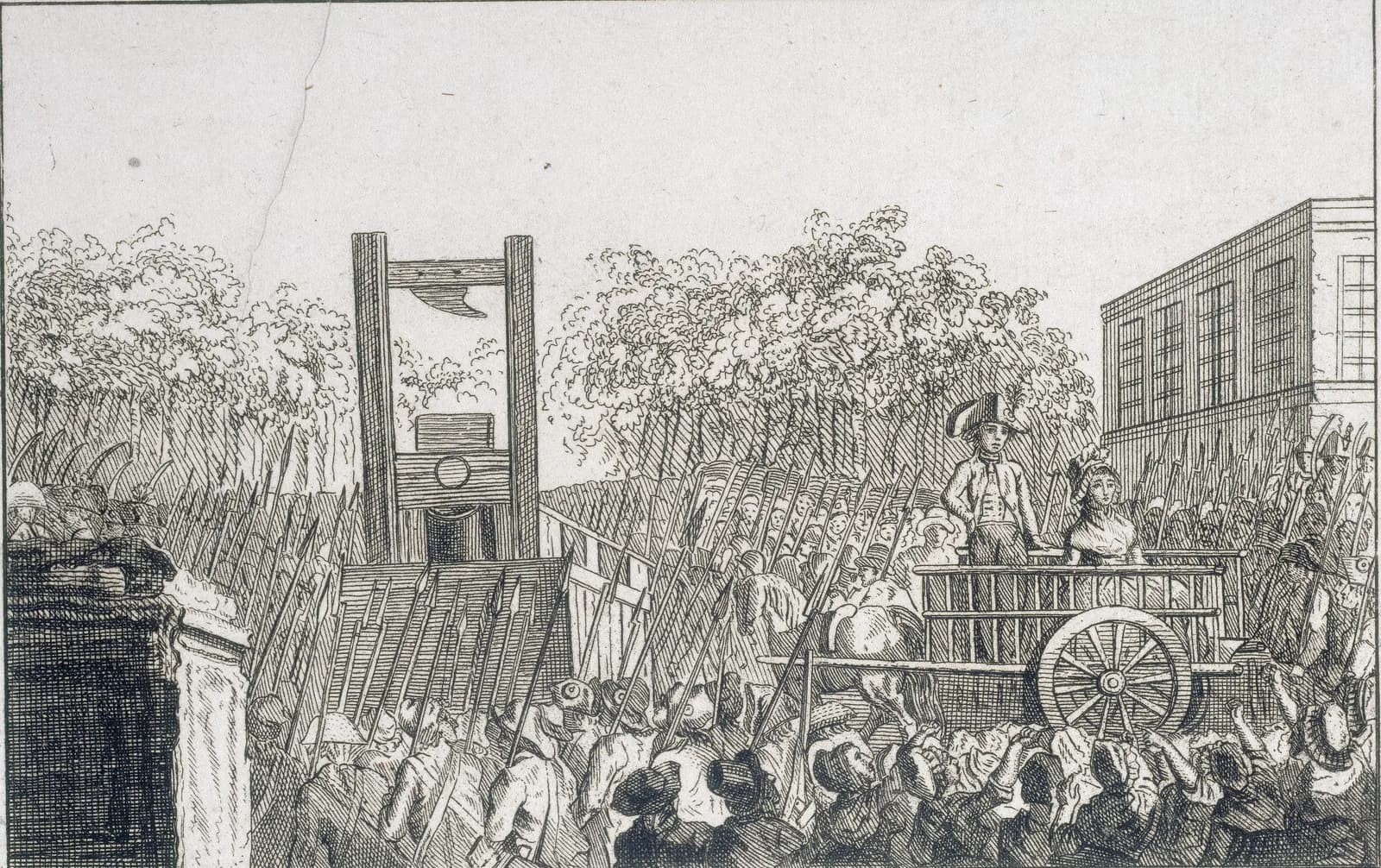
Spoilers for the whole of A Tale of Two Cities, including the last chapter and its final sentence.
Most readers meet the closing sentence long before they meet the book, on posters and in speeches, and assume Carton says it on the scaffold. Dickens set it up differently. The last day in the Conciergerie is its own doorway in the playable A Tale of Two Cities, where you are in the prison while a quiet act of courage plays out and changes the lives of the people left behind.
📜 Why is Darnay condemned a second time?
Because the Defarges produce a paper Doctor Manette hid in his Bastille cell. It names the Evrémonde twin brothers, Darnay’s father and uncle, for the ruin of a peasant family, and it curses them and their descendants “to the last of their race.” The jury votes him back to the Conciergerie with death inside twenty-four hours.
Darnay was freed by a cheering tribunal that same day, then arrested again at home by lamplight. One of the men, from Saint Antoine, names the accusers as the Citizen and Citizeness Defarge “and by one other,” and will say no more. The chapter that answers the question is called The Substance of the Shadow, and the answer is the doctor himself: the letter is dated the last night of 1767, written long before he had a son-in-law to protect.
And all the worse for the doomed man, that the denouncer was a well-known citizen, his own attached friend, the father of his wife.
Manette does not survive the verdict intact. He sets out that evening to plead with the men in power, nobody ever learns whether he reached any of them, and he comes back after midnight asking where his shoemaker’s bench has gone, the prisoner of the opening chapters once more.
🔐 How does Carton’s swap work?
Carton buys some small packets from a chemist the night before, with a warning to keep them separate, and uses what he knows about the spy Barsad to get a turnkey’s help. In the cell he makes Darnay put on his boots, cravat and coat, dictates a note, and holds the drug under his nose until he faints.
The note is addressed to no one and undated. It begins with “the words that passed between us, long ago.” The likeliest words are the ones Carton spoke to Lucie years earlier, when he told her he would embrace any sacrifice for her and for those dear to her. He then dresses in the clothes Darnay took off, ties back his own hair with Darnay’s ribbon, and calls Barsad in. Two men fetched by the spy carry the unconscious man out on a litter as the visitor who fainted, so that the count of fifty-two prisoners for the day still comes out right.
Outside, a coach with Lucie, her child, her father and Mr. Lorry passes the barrier on a set of papers. One of them reads Sydney Carton, Advocate, English, and belongs to the limp man in the corner. When Darnay starts to come round on the road, he believes the two of them are still together and asks Carton by name what he has in his hand.
🧶 Why does Madame Defarge die?
She goes to Lucie’s lodging armed with a loaded pistol and a sharpened dagger, meaning to catch Lucie in her grief and denounce her too, and finds Miss Pross alone in the emptied rooms. The two women wrestle at the door, the pistol goes off between them, and Madame Defarge falls dead. Miss Pross keeps her life but loses her hearing for good.
Her reason for hating the Evrémondes is in the same Bastille letter. She tells her husband that the injured peasant family it describes is her own family, and that the wounded boy’s sister was her sister. Whether that makes her a villain or a woman owed justice is argued in the essay on Madame Defarge, which keeps her motive to itself.
🪡 Who is the seamstress, and what does she ask?
She is a young prisoner from La Force, condemned for plots she never joined, who knew Darnay in jail. In the Conciergerie she recognises that the man beside her is someone else and whispers, “Are you dying for him?” He answers yes, for him and for his wife and child, and she asks to hold his hand in the cart.
At the foot of the scaffold she asks him one more thing: whether the wait for her cousin in the next world will feel long. He tells her there is no Time there, and no trouble there. She asks whether the moment has come, he says yes, and she goes up as number Twenty-Two. Carton is Twenty-Three, and he dies to the burial verse he heard at his father’s grave as a young man and repeated to himself on his walk through Paris the night before.
✒️ Who says “a far, far better thing”?
On the page, nobody says it aloud. The narrator reports that people thought Carton’s face looked sublime and prophetic, mentions a woman who once asked at the same scaffold to write down her thoughts, and then offers the words he would have spoken if he had said anything. The famous sentence is the last line of that imagined speech.
If he had given any utterance to his, and they were prophetic, they would have been these:
What follows is a page of visions: Barsad, Defarge and the judges going to the same machine, Paris rising out of the terror, Lucie with a child who bears his name. The standard plot summary calls this a final prophetic thought running through Carton’s mind, which is fair, as long as one remembers the conditional the narrator hangs it on. Carton doesn’t utter a single word of it in the Project Gutenberg text, and the phrase appears exactly once in the whole novel.
It is a far, far better thing that I do, than I have ever done; it is a far, far better rest that I go to than I have ever known.
The choice suits a man who spent the book unable to say what he felt to the people he felt it for. On the scaffold his dialogue shrinks to comfort for the seamstress and a single yes, and his best-known speech is one Dickens writes for him after the fact. How the resemblance between the two men is planted hundreds of pages earlier is traced in the essay on Carton and Darnay’s shared face.
Sources
- A Tale of Two Cities (Project Gutenberg text) — Project Gutenberg
- A Tale of Two Cities — Wikipedia
- Exécution à la guillotine de Charlotte Corday le 17 juillet 1793 (collection record) — Paris Musées
- Execution of Charlotte Corday, 1793 engraving (CC0) — Wikimedia Commons
Frequently asked questions
- Why was Sydney Carton executed?
- Because the Republic took him for Charles Darnay, the condemned Evrémonde. Apart from the seamstress and Barsad, the spy who arranged it, nobody at the scaffold sees through it. The Vengeance sits among the knitting-women believing she is about to watch Evrémonde die, holding Madame Defarge's knitting and keeping her usual chair empty, while a woman beside her remarks that Thérèse never missed one before.
- What is the famous ending quote from "A Tale of Two Cities"?
- It is the novel's last sentence, the one that begins "It is a far, far better thing that I do". It closes a run of imagined visions that each open with "I see", among them Lucie grown old and weeping for him on the anniversary of the day, and her son becoming one of the foremost judges, who brings a boy of Carton's name to that same place.
- What does the ending of A Tale of Two Cities mean?
- It finishes the resurrection theme the novel opens with. Book the First is titled Recalled to Life, after Manette's release from the Bastille, and even Jerry Cruncher's night work as a Resurrection-Man plays on the idea. Carton dies so that Darnay can live, and his last vision imagines his name made honourable again through a child.
- How does Madame Defarge die in A Tale of Two Cities?
- Her own pistol kills her while Miss Pross is holding her round the waist. Dickens credits the win to the vigorous tenacity of love, always so much stronger than hate. Afterwards Miss Pross locks the door on the body and, crossing a bridge on her way to meet Jerry Cruncher at the cathedral, drops the key into the river.
- Does Charles Darnay know what Carton did?
- Not by the last page. Before the two men Barsad fetches carry him out, Carton tucks the dictated note into Darnay's breast and orders that Mr. Lorry give him no restorative but air. The book leaves Darnay coming round in the coach on the road out of Paris, so the reader never sees the moment he finds the note and understands it.
Enjoyed this one?