Sydney Carton and Charles Darnay: A Tale of Two Cities’ Doppelganger Twist
A London jury acquits Charles Darnay because he looks like another man in the room, and that man is slouched at the defence table with his wig on.


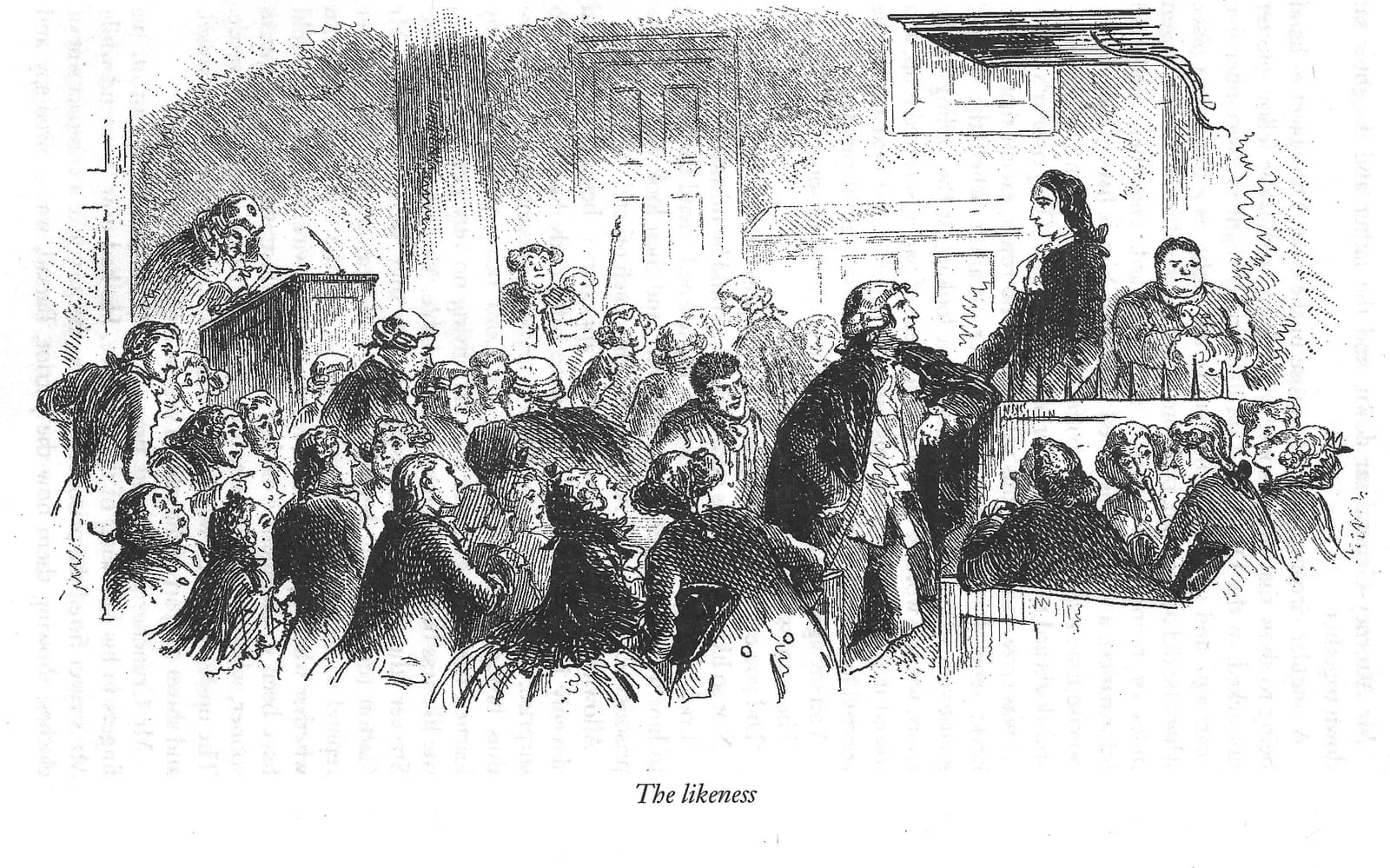
A book called A Tale of Two Cities opens with a sentence made of matched opposites and puts two men with the same face in the same courtroom by its third chapter. None of that is decoration. The resemblance is a working part of the plot, and it is the first thing the playable A Tale of Two Cities puts in front of you if you take the courtroom door.
⚖️ The resemblance, entered as evidence
Charles Darnay is on trial for his life at the Old Bailey, and the prosecution’s case rests on a witness who places him in a garrison town on a particular night. Under cross-examination the witness is certain. He is asked whether he has ever seen anybody very like the prisoner, and says not so like that he could be mistaken.
“Look well upon that gentleman, my learned friend there ... and then look well upon the prisoner. How say you? Are they very like each other?”
The gentleman indicated is one of the defence barristers, slouched at his own table, and the court is startled enough by the comparison that the judge is asked to have him take off his wig. With the wig gone the likeness “became much more remarkable”, and the judge asks drily whether they are to try the barrister for treason next (l.588–594). The identification collapses. Darnay leaves as “the acquitted prisoner” (l.646).
Dickens closes the chapter by putting the two of them side by side and making the reader do the arithmetic: they are “so like each other in feature, so unlike each other in manner”, standing together and both reflected in the glass above them (l.619). The mirror above the dock is about as subtle as a stage direction, and it is doing exactly what a stage direction does.
🥃 The lion and the jackal
The barrister is Sydney Carton, and the novel gives him the least flattering job title in Victorian fiction. Word had got about, the narrator says, that although he would never be a lion, he was “an amazingly good jackal” and rendered suit and service to the advocate Stryver in that humble capacity (l.708).
The chapter then shows the arrangement working. Stryver lies on a sofa with his hands in his waistband while Carton sits at the paper-strewn table with wet towels folded on his head, gets up periodically to re-steep them, and assembles the case in pieces the narrator calls meals, which the lion takes with care and caution and makes remarks upon (l.732–733). They finish at three in the morning, and in the courtroom the following day the case belongs entirely to Stryver, who delivers it to the jury like a suit of clothes he had tailored himself.
- The nickname is about ownership, not ability. A jackal does the hunting and the lion eats, which is a precise description of a junior who drafts everything and is credited with none of it.
- Carton supplies the diagnosis himself.“I am a disappointed drudge, sir. I care for no man on earth, and no man on earth cares for me” (l.698) — offered to Darnay, on the night of the acquittal, as an explanation for why he will not be thanked.
- The resemblance makes the contrast legible. Two men with one face, one of whom has a profession, a marriage prospect and a future, is a comparison Dickens can run without a word of commentary.
Footsteps in the Storm is a doorway in the playable A Tale of Two Cities: you are a guest in the quiet Soho house with Lucie, Darnay, Carton and Doctor Manette, and you can steer the evening toward comfort, toward the past, or toward the thing nobody in the room will say. Role-play A Tale of Two Cities →
🪞 How far the doubling goes
Once you have noticed the device you start finding it in the furniture, which is the usual sign that a writer is working deliberately rather than reaching for an effect. The doubles in this novel are structural, and several of them are visible in the table of contents before you read a word.
- Two chapters named against each other.Book the Second runs “The Fellow of Delicacy” straight into “The Fellow of no Delicacy”, one chapter per suitor, and the chapter before them is called “A Companion Picture”.
- Two trials. Darnay is tried for his life twice in this book, once in London and once in Paris, in front of two legal systems that the novel invites you to compare at every step.
- Two names for one man. Darnay travels under a surname that is not the one on his birth record, which means the doubling is inside him as well as between him and Carton.
- Two cities, obviously. London and Paris are run as a matched pair from the title down, and the novel’s own critical reputation has always turned on how the halves answer each other.
A doppelgänger in the older sense is an apparition of a living person, usually an omen. Dickens declines the supernatural version and takes the shape of it instead — one face, two lives, and the uncomfortable question of what separates them — and puts it to work as realist machinery, which is why the resemblance can be entered as courtroom evidence rather than treated as a portent.
🔓 What it sets up, and where this piece stops
The London trial is the first of two. Years later Darnay is arraigned before a revolutionary tribunal in Paris, and the name the court calls him by is the one he left France to escape: “Charles Evrémonde, called Darnay” (l.2402). Doctor Manette testifies, the crowd is with him, every juryman votes his way and the President declares him free (l.2434).
That is where this essay stops, on purpose. The resemblance established in Chapter III of Book the Second has not been used up by any of this, and Dickens has been careful to keep reminding you that it exists without ever spending it twice. Readers who arrive at this novel already knowing how it turns out tend to report that the foreknowledge made no difference to them, because the construction is the pleasure and it was built to be met a page at a time.
🍟 One unexpected thing the novel gave English
A single phrase in Book the First has outlived most of the plot in a way nobody planned. In the Hunger paragraph, among the dead-dog sausage and the bad bread of Saint Antoine, Dickens lists “husky chips of potato, fried with some reluctant drops of oil” (l.221).
The Oxford English Dictionary gives that line as its earliest recorded use of “chips” in the fried-potato sense, a citation repeated in the standard account of fish and chips. A novel about the Reign of Terror appears to have handed Britain the name of its national dish, in a sentence about people who did not have enough to eat. You can check the phrase yourself in the free Project Gutenberg text, six paragraphs into Chapter V of Book the First.
Sources
- A Tale of Two Cities (Project Gutenberg eBook #98) — Project Gutenberg
- A Tale of Two Cities — Wikipedia
- Doppelgänger — Wikipedia
- Fish and chips — Wikipedia
Frequently asked questions
- Who is Sydney Carton in A Tale of Two Cities?
- A barrister who does another barrister’s work. He first appears in the Old Bailey with his hands in his pockets staring at the ceiling of the court, and he is never once shown addressing a jury himself — the arrangement with Stryver is that Carton builds the case overnight and Stryver argues it in the morning. His one decisive act in that courtroom is to write “a word or two on a little piece of paper” (l.588) and toss it to the man who is arguing. The novel is precise about the waste, and never sentimental about it.
- What is the significance of Sydney Carton?
- He is the book’s instrument for measuring everyone else. Darnay, Stryver, Lucie and Doctor Manette are all defined partly by what they have that Carton does not, and the resemblance to Darnay makes the comparison physical rather than moral. The narrator is blunt about the cost: Carton is the “idlest and most unpromising of men”, seen going home “like a dissipated cat” (l.708), and every scene he appears in is built to be measured against somebody steadier.
- What is Sydney Carton's relationship with Charles Darnay?
- Strangers who look alike, and never anything closer. The novel offers no cousinship, no shared parentage and no explanation for the resemblance — which is deliberate, because an explanation would make it a plot mechanism rather than a coincidence the plot then exploits. After the Old Bailey they meet socially a handful of times, always slightly awkwardly.
- Why is Sydney Carton a jackal?
- Because the Temple decided he was. The narrator reports the gossip directly: Carton “would never be a lion, he was an amazingly good jackal” (l.708), and rendered suit and service to Stryver in that humble capacity. A jackal in Victorian legal slang was a junior who did the reading, the drafting and the night work while somebody louder took the brief into court.
- Did Sydney Carton love Lucie?
- He says so, once, and asks for nothing. In Book 2, Chapter XIII he tells her the last confidence of his life is reposed in her, states plainly that he expects no return and would not have accepted one, and asks only that she keep it to herself. He is not a rival to Darnay in any conventional sense, and Dickens never stages the conversation as a proposal.
Enjoyed this one?