“It Was the Best of Times”: What A Tale of Two Cities’ Opening Line Actually Means
Fourteen matched clauses escaped the book they belong to, and the closing clause — the one nobody prints — is where the argument actually lives.


Two clauses of a very long sentence have escaped the book they belong to. They get printed on tote bags, used as headlines about whatever year it currently is, and quoted by people who have never opened the playable A Tale of Two Cities or the novel behind it. Read to the end of its own sentence, the opening is doing something sharper than the tote bags suggest.
📜 The sentence, and the argument it makes
The famous part is the first eleven clauses. The part that decides what they mean is the clause that closes the sentence, and it is almost never reproduced with them.
“It was the best of times, it was the worst of times ... in short, the period was so far like the present period, that some of its noisiest authorities insisted on its being received, for good or for evil, in the superlative degree of comparison only.”
The subject of that closing clause is the period’s noisiest authorities rather than the period itself, and what they insist on is a grammatical habit: the superlative degree, best and worst, nothing in between. Dickens then sets the year at 1775 and starts listing the things England and France were confidently sure about, from a prophetic private in the Life Guards to a congress of British subjects in America whose messages, he notes drily, turned out to matter rather more than the ghost stories did.
So the paragraph is about the way an era talks about itself while it is happening. Every generation believes it is living through the most extreme version of everything, and Dickens opened a novel about the French Revolution by pointing out that his own 1859 audience believed exactly the same thing about themselves.
🕯️ “Recalled to life”, the first mystery
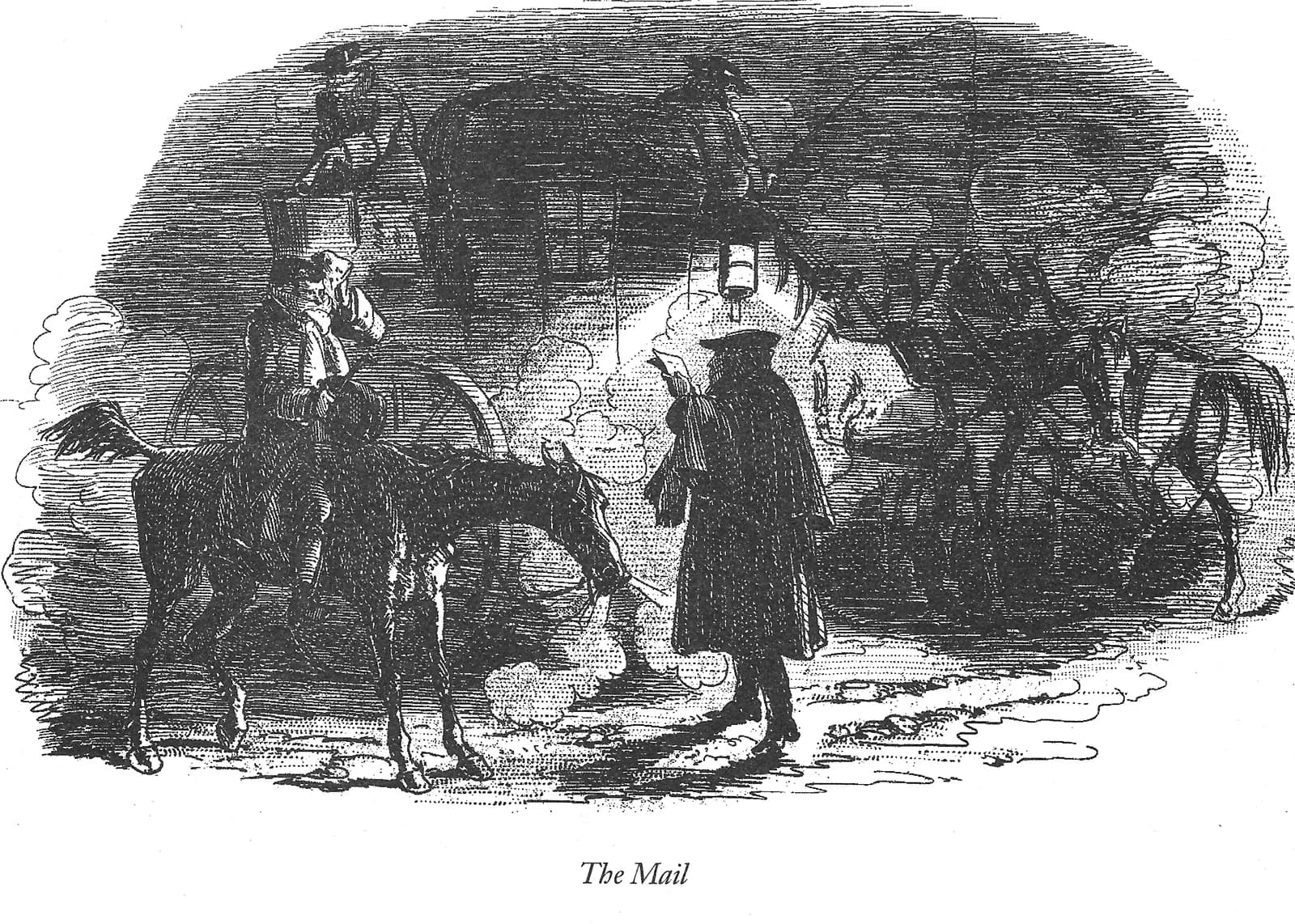
The second-best-known phrase in the opening Book is three words long and arrives as a message nobody explains. A bank clerk named Jarvis Lorry, travelling to Paris on the night mail, reads a note by the light of the coach lamp and gives the messenger a verbal answer to carry back.
- It starts as a coded reply.“Jerry, say that my answer was, RECALLED TO LIFE” (l.65). The messenger calls it a blazing strange answer, which is a fair summary of how the reader is meant to feel.
- It becomes a question put to a ghost.Dozing in the mail coach, Lorry rehearses the meeting in his head. He asks a spectre buried “almost eighteen years”, “You know that you are recalled to life?”, and is answered “They tell me so” (l.94). The exchange is imaginary, and it is where the phrase first acquires a person to be said to.
- It is also a working alias.Lorry tells the man’s daughter that his credentials and memoranda are “all comprehended in the one line, ‘Recalled to Life;’ which may mean anything” (l.202) — a phrase chosen because it gives away nothing to anyone reading over his shoulder.
The whole first Book is titled after it. What begins as a piece of bank tradecraft turns into the book’s governing idea, applied over and over to people who are taken out of one life and put down in another, and the phrase keeps its double meaning the whole way through.
The Midnight Mail is a doorway in the playable A Tale of Two Cities: you are the traveller on the freezing Dover road carrying a message that has to reach the coast before the morning ferry, and you can deliver the answer unopened, read it first, or press the passenger who gave it to you for what it means. Role-play A Tale of Two Cities →
🔁 The line people quote instead
Search for a famous sentence from this novel and the opening is not always what comes back. The closing narration supplies the other candidate, the “far, far better thing that I do” line, and it has had a strange afterlife: a live search for it returns a Q&A page arguing about whether the words are really the ones people remember, a science-fiction forum thread devoted entirely to identifying a story that misquotes it, and a results column where Dickens’s David Copperfield keeps surfacing beside it for no reason connected to either book.
This piece is not going to tell you who speaks that line or what is happening when it is spoken, because the sentence only works if you reach it in order. What is worth noticing is the pattern. Both of this novel’s most-quoted sentences travel without their context, and both get read as general-purpose wisdom about life rather than as specific claims made by a specific narrator at a specific point in a plot.
⚖️ Why it still gets read as balance
The balance reading survives because the sentence is built out of matched pairs, and a reader who stops at the fourth or fifth pair has every reason to think the pairs are the point. They are the rhythm, not the argument. The argument arrives in the clause about the noisiest authorities, which is where the antithesis gets handed to somebody specific and becomes a criticism of how they talk.
There is a second reason. The novel really does run on doubled things — two cities, two nations, two men who look alike, a wine cask that breaks in the street and stains the ground red long before anything worse does — so a reader who has finished the book can look back at the opening and see the doubling everywhere, which makes the balance reading feel confirmed. What Dickens set up in the first sentence was not a scale with two equal pans on it, but a warning about the confidence with which people describe the times they are living in.
He was, incidentally, quite capable of the same habit himself. He told his biographer he was reading Carlyle’s history of the Revolution “again, for the 500th time”, which is the superlative degree of comparison applied to his own reading habits by a man who had just written a paragraph mocking it. The novel he built out of that reading is free to read at Project Gutenberg, and the first page repays going slowly.
Sources
- A Tale of Two Cities (Project Gutenberg eBook #98) — Project Gutenberg
- The Life of Charles Dickens (Project Gutenberg eBook #25851) — John Forster, via Project Gutenberg
- A Tale of Two Cities — Wikipedia
- David Copperfield — Wikipedia
- Charles Dickens — Wikipedia
Frequently asked questions
- What is the most famous line from A Tale of Two Cities?
- “It was the best of times, it was the worst of times,” the first twelve words of a sentence that runs to a hundred and nineteen. It reached its first readers a week at a time, serialised through 1859 in Dickens’ own magazine All the Year Round before Chapman and Hall issued it as a book, which is why the paragraph is built to be read aloud and remembered.
- What does the opening line of A Tale of Two Cities mean?
- That the age being described insisted on hearing itself described in extremes. Dickens sets the chapter in 1775 and then lists what England and France were confidently sure of — a prophetic private in the Life Guards, the Cock-lane ghost, and messages from a congress of British subjects in America which, he notes, “have proved more important to the human race” than any of the ghost-rappings. The pairs are the rhythm; the claim about noisy authorities is the point.
- What does the phrase “recalled to life” mean in A Tale of Two Cities?
- Literally, that a man believed dead has been found alive in a Paris garret after eighteen years. Practically, it is a code: Jarvis Lorry tells Lucie Manette that his credentials, entries and memoranda are “all comprehended in the one line, ‘Recalled to Life;’ which may mean anything” (l.202), because anything more specific would be dangerous to carry across the Channel.
- What is the famous quote from A Tale of Two Cities?
- Two sentences compete. The opening line wins on recognition, and the closing narration’s “it is a far, far better thing that I do” wins on emotional weight — and on being got wrong. A live search for it returns forum threads devoted to identifying stories that misquote it, and quote-card pages that attribute it to the wrong Dickens novel entirely. Where it falls and who speaks it is worth meeting in the book.
- What is the main message of A Tale of Two Cities?
- That people can be brought back from what looks final — and that a society which has stopped believing this will do terrible things. The structure carries it: forty-five chapters in three Books titled “Recalled to Life”, “The Golden Thread” and “The Track of a Storm”, each naming a way of being pulled back into the world or held in it. The resurrection idea is the title of Book the First before it is a theme.
Enjoyed this one?