A Tale of Two Cities Characters Guide: Darnay, Carton, the Defarges, and Lucie
Three of the four leads are introduced before you are told anything solid about them, which is deliberate and makes a cast list unusually useful here.


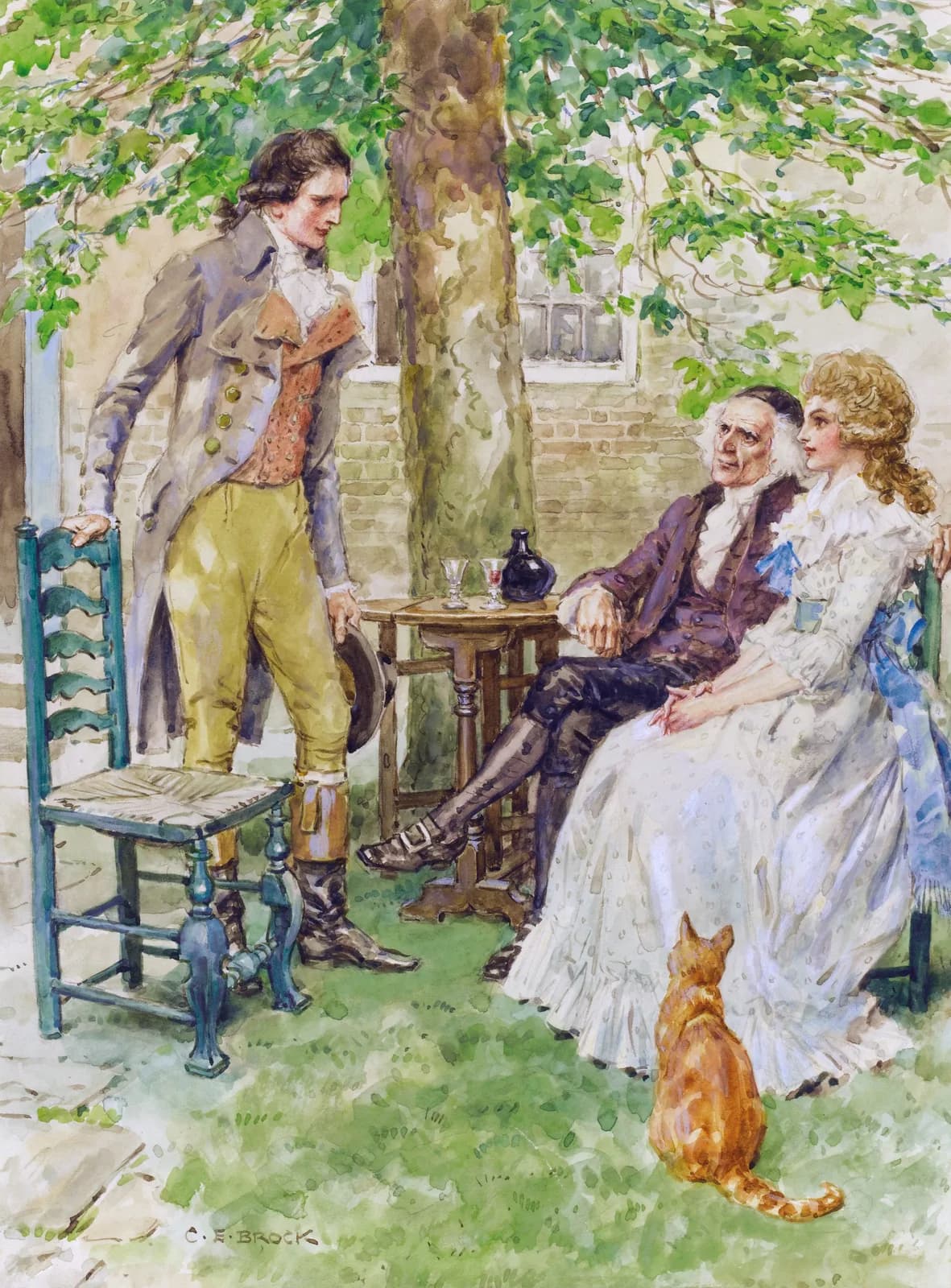
Four people carry this novel, and three of them are introduced before you are told anything solid about who they are. Dickens withholds names and histories on purpose, so a cast list read too early spoils the method and a cast list read too late is no use. What follows is the working version: who each person is, what they do, and where in the playable A Tale of Two Cities you first run into them.
🎭 Charles Darnay, and the name he left behind
Darnay arrives in the book standing in the dock at the Old Bailey, accused of treason and facing a sentence that the narrator describes in detail. He is acquitted, and the thing that breaks the prosecution is an accident of appearance: a witness who is certain he could not mistake the prisoner for anybody is asked to look at one of the barristers, who is then told to take off his wig (l.588–594). Jerry Cruncher leaves the court with the two men standing side by side, “so like each other in feature, so unlike each other in manner” (l.619).
The name he is tried under was never the name on his birth record. He was born Charles Evrémonde, nephew to a French Marquis, and in Book 2 he tells his uncle to his face that the property and the country are lost to him and that he renounces them both (l.1061). Years later a letter arrives at Tellson’s bank addressed “To Monsieur heretofore the Marquis St. Evrémonde, of France” and lands on the counter in front of him, which is how the reader finally learns that the English teacher and the French aristocrat are one person (l.2065). Doctor Manette has known since the morning of the wedding and has been asked to keep it inviolate; Darnay’s own wife, the narrator says flatly, has no suspicion of the fact (l.2066).
When he goes back to France the name goes with him. He is called before the revolutionary tribunal as “Charles Evrémonde, called Darnay” (l.2402), and at the end of that hearing every juryman votes his way and the President declares him free (l.2434). What happens after that is the rest of the novel, and this piece leaves it alone.
🥃 Sydney Carton, the jackal
Carton is the barrister whose wig comes off. He is the best legal mind in the room and the least employable man in it, and the narrator hands him the least flattering job description in the book.
“I am a disappointed drudge, sir. I care for no man on earth, and no man on earth cares for me.”
His working arrangement is with a loud, rising advocate called Stryver, and the arrangement is public knowledge in the Temple: Carton would never be a lion, people said, but he was “an amazingly good jackal” (l.708). He sits up all night with wet towels folded on his head, assembles the case, and watches Stryver deliver it in the morning. Why the nickname sticks, and what the resemblance to Darnay is doing in a book so interested in doubles, is the subject of its own essay.
🧶 Ernest and Thérèse Defarge, who keep the wine-shop
The Defarges run a wine-shop in Saint Antoine, the poorest quarter of Paris, and the shop is the district’s real town hall. Ernest Defarge was once Doctor Manette’s servant and has kept him hidden in a garret above the shop, while his wife sits behind the counter with her knitting and misses nothing that happens in the room.
- She is introduced by her arithmetic.A stout woman with a watchful eye that seldom seemed to look at anything, and a character from which you might predict that she “did not often make mistakes against herself in any of the reckonings over which she presided” (l.232).
- The knitting is a record.Her husband tells the other conspirators it would be easier for a man to erase himself from existence than to erase one letter of his name from “the knitted register of Madame Defarge” (l.1505). What the register is for, and whether keeping it makes her a villain, is argued in full elsewhere in this series.
- They are not interchangeable. Ernest Defarge has limits and hesitations that his wife does not share, and the distance between the two of them widens as the Revolution goes on, which is one of the quieter things the second half of the book is keeping track of.
The Old Bailey Spectacle is a doorway in the playable A Tale of Two Cities: you are in the public gallery as the treason trial opens, and you can push for a better view, watch the prisoner, or watch the barrister nobody else is looking at. Role-play A Tale of Two Cities →
🧵 Lucie Manette, the golden thread
Lucie is introduced as a seventeen-year-old who believes her father died before she was born and is told, in a Dover inn, that he has been found alive. Her function in the novel is stated outright rather than implied: she is “the golden thread that united him to a Past beyond his misery, and to a Present beyond his misery” (l.631), and Book the Second takes its title from the phrase.
Modern readers often find her the flattest of the four, and that is a fair complaint about how she is written rather than about what she does. What she does is hold a damaged man in the present tense by main force, night after night, for years — a job the book takes seriously enough to return to it in Chapter XXI, where she is still “ever busily winding the golden thread that bound them all together” (l.1875).
🏦 The people who hold it together
Four more names do most of the structural work, and a reader who confuses them loses the plot in Book 3 rather than Book 1.
- Doctor Alexandre Manette— Lucie’s father, released after eighteen years in the Bastille, who makes shoes when his mind slips. His standing as a former prisoner of the old regime becomes politically useful to his family in Paris.
- Jarvis Lorry— a Tellson’s bank man who calls himself a man of business and is the closest thing the Manettes have to a guardian. He is the one who carries the message the novel opens on.
- Miss Pross— Lucie’s red-haired, ferociously protective companion, introduced by flattening Mr. Lorry against a wall. She is the comic relief and, in the last third, considerably more than that.
- Mr. Stryver— Carton’s employer, a barrister who is described as too big for every room he enters and who decides at one point to confer himself on Lucie as a favour (l.1240–1246).
📖 Is this a reasonable place to start Dickens?
It is the shortest of his major novels and the most tightly plotted, which makes it a common recommendation for a first Dickens. It is also the one his own completionist readers most often rank near the bottom of his work, because the sentence-level comedy that carries most of his other books is largely absent and the cast is small by his standards. Both of those things are true at once, and which one matters more depends entirely on why you are reading.
The practical advice from people who have finished it is unglamorous and works: go slowly through Book 1 until the prose stops feeling like a foreign dialect, and consider running an audiobook alongside the page if English is not your first language. The full text is free at Project Gutenberg, and the first six chapters are the whole test.
Sources
- A Tale of Two Cities (Project Gutenberg eBook #98) — Project Gutenberg
- A Tale of Two Cities — Wikipedia
- Madame Defarge — Wikipedia
- Charles Dickens — Wikipedia
Frequently asked questions
- What is the character of Lucie Manette in “A Tale of Two Cities”?
- A young woman of “not more than seventeen” (l.146) when the book opens, raised in England believing her father dead, and told in a Dover inn that he is alive in Paris. Dickens uses her as the connective tissue of the plot rather than as a source of it: she is the one relationship every other major character has in common, and Book the Second takes its title from the metaphor he attaches to her.
- What does Madame Defarge represent?
- The Revolution’s memory, and then its momentum. Thérèse Defarge is built out of a real figure — the tricoteuses, the women who sat knitting through the Revolution’s public business — and Dickens gives her the job of remembering what the old regime did to people it never charged. Whether that makes her a villain is argued in this series’ essay on her, not settled here.
- Why does Lucie Manette marry Charles Darnay?
- Because he is the only one of three interested men who treats it as her decision. Stryver plans an announcement rather than a proposal and is talked out of it by a banker (Book 2, Ch. XII). Carton tells her he loves her while stating plainly that he expects and asks for nothing (Ch. XIII). Darnay goes to her father first, offers to explain who he really is, and waits.
- What is Charles Darnay's character like in A Tale of Two Cities?
- Principled, a little colourless, and consistent about it. He renounces a title and an estate on principle, earns his living in London teaching French language and literature, and returns to Revolutionary France on the strength of a letter from a servant whose life is in danger — a decision he defends to the tribunal by asking whether coming back to save a citizen’s life is criminal in the eyes of the Republic (l.2429).
- What is the best book to start with Charles Dickens for a beginner?
- Not usually this one, despite its being the shortest of the major novels. A Tale of Two Cities drops the crowded comic cast that carries Great Expectations, David Copperfield and A Christmas Carol, and readers coming to Dickens for the first time often find the humour they were promised missing. Start with A Christmas Carol for the voice, then come here for the plotting.
Enjoyed this one?