Is Madame Defarge the Villain of A Tale of Two Cities — or Its Conscience?
The novel never once applies the word villain to her, which leaves the sorting to the reader and makes the evidence worth laying out properly.


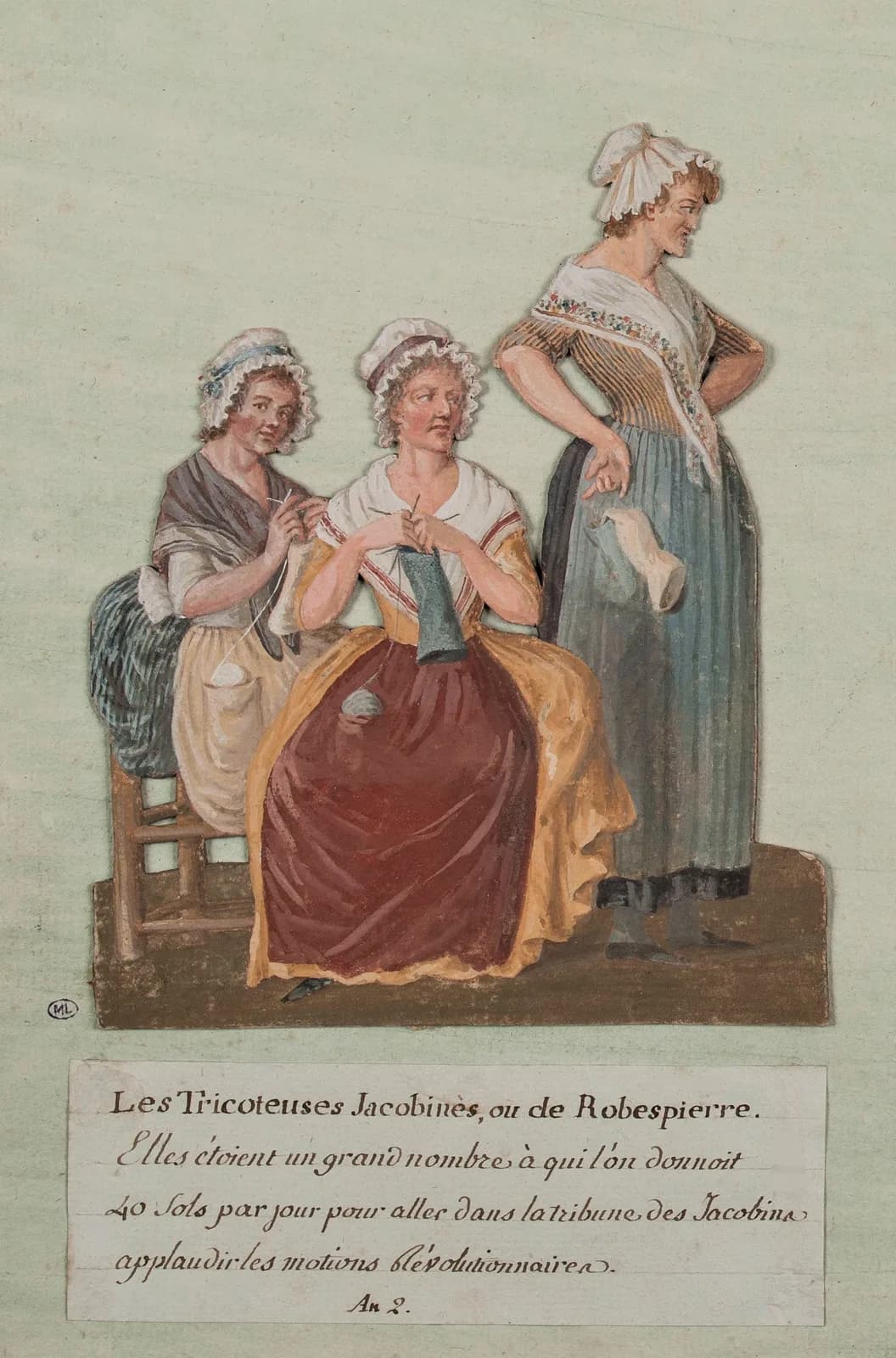
Madame Defarge is the most quoted villain in a novel whose actual villains are mostly offstage and mostly titled. She is also the character the playable A Tale of Two Cities puts you closest to when you choose the wine-shop. It is worth noticing that the novel never applies the word villain to her at all, and that when the word gets shouted in Saint Antoine it is the crowd, and Madame Defarge among them, shouting it at somebody else (l.1974, l.1977).
🧶 What the knitting is actually doing
The knitting gets treated as an eerie tic in adaptations, and in the novel it is a filing system. Chapter XV of Book the Second is called “Knitting” and spends its length explaining the mechanism to a room of conspirators who all go by the name Jacques.
“How say you, Jacques?” demanded Number One. “To be registered?” — “To be registered, as doomed to destruction,” returned Defarge.
One of the men asks the obvious security question: can the register be read back reliably, and can anyone else read it? Her husband’s answer is that she would not lose a syllable of it if she kept it in her memory alone, and that it would be easier for the weakest coward alive to erase himself from existence than to erase one letter of his name from “the knitted register of Madame Defarge” (l.1504–1505).
The chapter after that shows the system in use on a live target. A spy walks into the shop, she sizes him up, and the narrator gives you her thought in the middle of the small talk: stay long enough, and I shall knit ‘BARSAD’ before you go (l.1593). Earlier in the same chapter she has already ruled on somebody else — it is necessary to register him, she says, and he shall be registered to-morrow (l.1540, l.1548).
Two things follow from that. The first is that the register is evidence-shaped: names go in because of what their owners have done, one at a time, on a decision taken out loud. The second is that a woman sitting still in a shop doing an unremarkable domestic task is conducting surveillance in a district crawling with police spies, which is why nobody stops her.
🍞 What Saint Antoine is like before she starts
The novel introduces her quarter before it introduces her. A cask of wine breaks in the street and the whole district comes out to scoop it off the cobbles with their hands, and one man dips a finger in the lees and writes a single word on a wall: BLOOD (l.219). Dickens then runs a paragraph in which the word Hunger is the grammatical subject seven times over, hanging from washing lines, patched into clothes, stared down from cold chimneys, written on the baker’s empty shelves (l.221).
The man with the wine-stained finger is Gaspard, named two lines later when Defarge crosses the road to smear the word out (l.225–226). In Book 2 a nobleman’s carriage runs Gaspard’s small child down at a street fountain, and the Marquis inside it complains that people cannot take care of their children, throws a gold coin out of the window, and says he would ride over any of them very willingly (l.906–912, l.921). The scene is examined as history in a companion piece; what matters here is the detail Dickens puts at the end of it.
“He looked to the spot where Defarge the vendor of wine had stood, a moment before; but the wretched father was grovelling on his face on the pavement in that spot, and the figure that stood beside him was the figure of a dark stout woman, knitting.”
The Knitting of Names is a doorway in the playable A Tale of Two Cities: you are in the wine-shop while the register is being kept, and you can give a name, withhold one, or ask the woman behind the counter what she is making. Role-play A Tale of Two Cities →
⚖️ The case for reading her as the book’s conscience
Search the question and the top of the results is unusually sober for a villain query: an encyclopaedia entry, a digital-humanities project and a study site, with the fandom villain wiki pushed down the page. That is a reasonable reflection of the scholarship, which has spent decades arguing that she is the novel’s moral instrument rather than its monster.
- Her ledger is a response, not an initiative. Every entry in Chapter XV follows an account of something done to somebody by a man with a title, and the register exists because no court in France will hear those accounts.
- She is the only person keeping records at all. The old regime in this novel destroys its paperwork — people vanish into prisons under letters that name no crime — and the knitting is the counter-archive.
- Dickens gives her the arithmetic line first. Long before she is dangerous, she is introduced as somebody who does not make mistakes against herself in the reckonings she presides over (l.232), which is the sentence you would write about an auditor.
🔪 The case for reading her as its villain
The counter-case does not need the second half of the book to make itself. It is already visible in the chapters above: a register of people doomed to destruction has no appeal, no correction procedure and no category for the innocent relative, and the novel keeps putting ordinary people in front of it to see what happens.
Her husband is the control experiment. Ernest Defarge holds the same politics and has lived the same years in the same street, and he hesitates where she does not, which tells you that the difference between them is temperament rather than circumstance. The book is careful about this. It never argues that Saint Antoine’s suffering was exaggerated, and it never argues that the suffering licenses whatever comes next.
Why she wants revenge, at the level the first two Books will support, is the level this piece stops at: she is a woman from the poorest quarter of Paris in the 1780s, and the men she is counting are the men who own it. The novel goes on to give her reasons of her own that are not in the public record, and reading them in order is the only way they land.
🦇 Why Bane is knitting in The Dark Knight Rises
If the image feels familiar from somewhere other than Dickens, there is a specific reason. Christopher Nolan has said his draft of the 2012 film The Dark Knight Rises was inspired by this novel, and one of the quieter borrowings is a prop: Bane is shown finger knitting paracord, a deliberate nod to Madame Defarge that most of the audience will never consciously register.
The nod works because the original image is not a Dickens invention either. The tricoteuses — the women who sat knitting through the Revolution’s public business — were real enough to be painted from life, and Jean-Baptiste Lesueur’s gouache of them hangs in the Musée Carnavalet. Dickens took a figure his readers half knew from history books, gave her a filing system, and made her the one person in Saint Antoine who is always paying attention. The full text is free at Project Gutenberg if you want to check the stitches yourself.
Sources
- A Tale of Two Cities (Project Gutenberg eBook #98) — Project Gutenberg
- The Dark Knight Rises — Wikipedia
- Tricoteuses (Jean-Baptiste Lesueur, c. 1793) — Paris Musées, Musée Carnavalet
- Madame Defarge — Wikipedia
Frequently asked questions
- Who is the villain in A Tale of Two Cities?
- The book keeps two answers in play. Madame Defarge is the antagonist the plot runs through, but the harm that starts everything is done by the Evrémonde family and the system around them — the Marquis who runs a child down in the street holds the page for three chapters and shapes the twenty that follow. Dickens puts an individual in the foreground and a class behind her, and declines to pick.
- What is the significance of Madame Defarge?
- She is the point at which the Revolution stops being an abstraction and becomes a person with a list. She is also the reason the novel’s second half has a shape at all: she works with a pair of allies the book names The Vengeance and Jacques Three, and the three of them convert Saint Antoine’s grievances into specific proceedings against specific people.
- Why does Madame Defarge want revenge?
- At the level the first two Books will support: because she has spent her life in the poorest quarter of Paris under a regime that answers hunger with contempt. Dickens establishes it before she is dangerous — a wine cask breaks, the street drinks it off the stones, and a man writes BLOOD on a wall with a finger dipped in the lees. Dickens closes that chapter by looking ahead: “the time was to come, when that wine too would be spilled on the street-stones” (l.220). The novel gives her further reasons of her own, in their own place.
- What does Madame Defarge knitting symbolize?
- Fate, recorded rather than spun. The image reaches back to the classical Fates who measure and cut a life’s thread, and Dickens sharpens it into bureaucracy: the register is a document, kept in stitches and symbols of her own devising that nobody outside the conspiracy can decipher. The knitting is at once the most domestic activity in the book and the only reliable archive in Paris.
- Who is the real hero in A Tale of Two Cities?
- Readers nominate four different people and the book supports all four. Doctor Manette survives the thing that should have destroyed him; Lucie holds a family together; Miss Pross and Jarvis Lorry both do something quietly enormous in the last third. Sydney Carton is the popular answer, and why is the subject of this series’ essay on him rather than a line here.
Enjoyed this one?