How Historically Accurate Is A Tale of Two Cities?
Seventy years after the events, written by a man who never saw revolutionary Paris — and still the version most English speakers carry in their heads.


This is a novel written seventy years after the events it describes, by an Englishman who was born in 1812 and never saw revolutionary Paris. It is also the version of the French Revolution that more English speakers have in their heads than any history book has put there, which makes the question of what it gets right worth asking carefully. The playable A Tale of Two Cities drops you into the same streets, so it is worth knowing which parts of them are documented.
📚 Where Dickens got his history
One book did most of the work. Thomas Carlyle published The French Revolution: A History in three volumes in 1837, written in a present-tense, almost hallucinatory style that treats the Revolution as something happening to the reader rather than something filed away. Dickens carried it around with him compulsively and drew on it for his crowd scenes in particular, a debt traced in Simon Heffer’s biography of Carlyle and in John Burrow’s history of historians.
Dickens himself is the best witness to how hard he used it. In a letter his biographer John Forster preserved, he complains cheerfully about something Carlyle got wrong while admitting how often he had been back to the book.
“By the bye, I observe, reading that wonderful book the French Revolutionagain, for the 500th time, that Carlyle, who knows everything, don’t know what Mumbo Jumbo is.”
That inheritance explains the novel’s method as much as its facts. Carlyle wrote history as a crowd seen from inside it, with the mob as a single organism, and Dickens writes Saint Antoine the same way: the district is a character, the individuals surface out of it and sink back in.
🏰 The Bastille, as it was and as he stages it
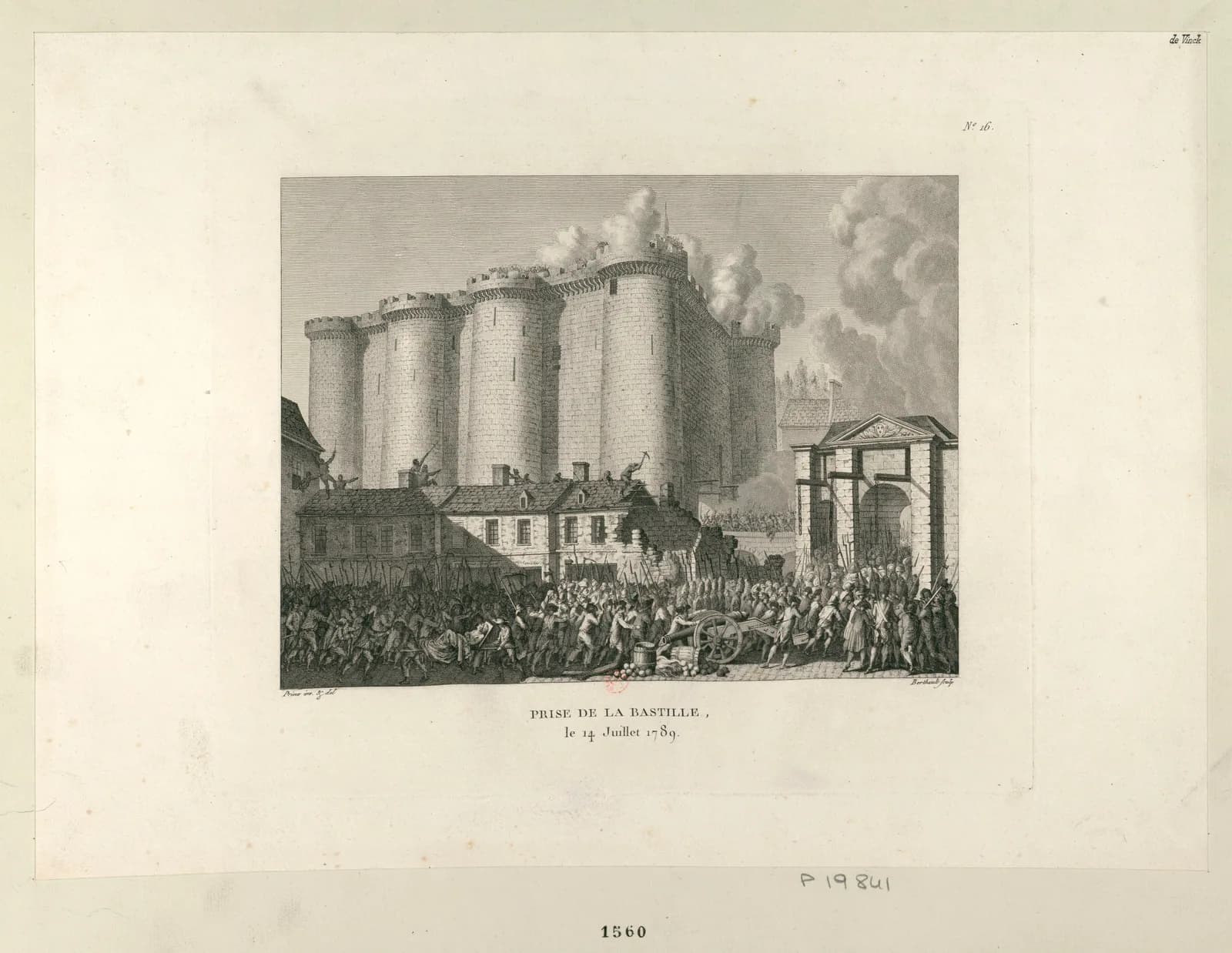
Defarge leads Saint Antoine to the fortress in Book the Second, with one of the flattest battle cries in English fiction — “Patriots and friends, we are ready! The Bastille!” (l.1908) — and the chapter carries him through the assault and out the other side to the governor’s fate (l.1948). The date is right and so is the direction of travel: the fortress stood at the edge of the Faubourg Saint-Antoine, and the crowd that took it came out of exactly the quarter Dickens has been describing since Chapter V.
The number the novel does not mention is the one that changes how the day reads. On 14 July 1789 the fortress held seven prisoners: four convicted forgers, two men who were mentally ill, and a count whose own family had had him locked up. World History Encyclopedia puts the same figure beside the same conclusion — the liberation was symbolic, because there was almost nobody inside to liberate.
Dickens needs the Bastille to be full, and he makes it full with one man. Doctor Manette’s eighteen years in a cell numbered One Hundred and Five, North Tower, does the work that seven forgotten forgers cannot, and the tribunal later calls him exactly what the record would have called him: “eighteen years a secret and unaccused prisoner in the Bastille” (l.2335). The invention is the prisoner rather than the prison, and the prison’s meaning in the book is the meaning it actually had in 1789.
The Wine-Shop Watch is a doorway in the playable A Tale of Two Cities: you are standing in Saint Antoine as the wine runs into the gutter and the temperature of the street starts to change, and you can drink, help, or keep count of who is watching whom. Role-play A Tale of Two Cities →
⚖️ The Terror’s real arithmetic
Book the Third runs on the revolutionary tribunal, and the novel’s picture of it — fast, crowded, joked about, unappealable — matches the record more closely than its reputation for melodrama suggests. Dickens writes that the guillotine became “the popular theme for jests”, the best cure for headache, a thing that kept the hair from going grey (l.2344–2345), which is the tone of a society metabolising something it cannot look at directly.
- The window is right. The Terror ran from September 1793 to July 1794, which is where the novel puts its Paris chapters and roughly how long it lets them last.
- The scale is documented. 16,594 official death sentences were handed down across France, about 2,600 of them in Paris — the same figure appears in the standard reference account and in Harrison W. Mark’s survey for World History Encyclopedia.
- The arrests dwarf the executions. At least 300,000 suspects were taken into custody nationwide, which is the part Dickens dramatises hardest: the fear in his Paris is about being denounced, not about being convicted.
- The procedure really did collapse. The Law of 22 Prairial, passed on 10 June 1794, removed the investigation and cross-examination stages from tribunal trials, and both sources connect it directly to the surge in executions that followed.
🍷 The part the novel gets most right
If one sequence earns the verdict, it is the wine-cask. A cask breaks outside the Defarges’ shop, the street drinks it off the stones, and a man writes BLOOD on a wall with a finger dipped in the lees (l.219). The paragraph that follows makes Hunger the grammatical subject seven times running, hanging from washing lines and written on the baker’s empty shelves (l.221).
Every serious account of the Revolution’s origins puts food prices and dearth near the centre of it, and Dickens gets there in Chapter V of his first Book, before any politics have been mentioned. He then supplies the other half of the equation in Book 2, when a nobleman’s carriage kills a child at a fountain and the nobleman complains about the carelessness of the poor and says he would ride over any of them very willingly (l.906–912, l.921). The scene is invented. The relationship it describes is not, and a reader who wants the argument at length can find it in this series’ essay on Madame Defarge.
⏳ What the novel compresses
The honest deduction from the verdict is about time. The novel opens in 1775 (l.15), returns in Book the Second to a windy March morning in 1780 (l.411), and ends deep in the Terror, which means it covers close to two decades while behaving like a thriller.
Dickens manages that by leaving out almost all the politics. There are no Estates-General, no Tennis Court Oath, no Declaration of the Rights of Man, no Robespierre, no Danton, no legislative factions at all. The Revolution in this book arrives as weather rather than as a sequence of decisions taken by named men in rooms, which is a defensible choice for a novel about a family and a poor choice for anyone using it as a substitute for a history.
So the verdict holds with one qualification. The conditions, the institutions and the arithmetic are close to the record; the causation is missing, because Dickens is interested in what the Revolution felt like to be caught in rather than in how it was argued into existence. Read the novel free at Project Gutenberg and Carlyle beside it, and you can watch the borrowing happen in the crowd scenes.
Sources
- A Tale of Two Cities (Project Gutenberg eBook #98) — Project Gutenberg
- The French Revolution: A History (Project Gutenberg eBook #1301) — Thomas Carlyle, via Project Gutenberg
- The French Revolution: A History — Wikipedia
- The Life of Charles Dickens (Project Gutenberg eBook #25851) — John Forster, via Project Gutenberg
- Storming of the Bastille — Wikipedia
- Reign of Terror — Wikipedia
- Reign of Terror (Harrison W. Mark, 1 November 2022) — World History Encyclopedia
- French Revolution (Harrison W. Mark, 12 January 2023) — World History Encyclopedia
Frequently asked questions
- How historically accurate is A Tale of Two Cities?
- Accurate about conditions, vague about causes. The hunger, the aristocratic impunity, the tribunal’s procedure and the scale of the arrests all match the record. What is missing is the political machinery: no Estates-General, no Declaration of the Rights of Man, no Robespierre or Danton anywhere in the cast. The Revolution arrives in this book as weather rather than as decisions taken by named men in rooms.
- What is the historical significance of the Reign of Terror?
- It set the pattern every later revolutionary government has been measured against: emergency powers, a special court, and mass preventive arrest justified by external war. It ended with the fall of Robespierre in July 1794, which is why the period has a name and a closing date at all. Roughly 16,594 official death sentences were recorded across France during it.
- What grade reading level is A Tale of Two Cities?
- Harder than its page count suggests, and the difficulty is historical rather than lexical. The sentences are long — the novel opens with one that runs past a hundred words without reaching a full stop — and the story assumes a reader already knows roughly what happened in France between 1775 and the Terror, which most first-time readers do not. Published grade levels for it disagree with each other, because a Lexile measure and a Flesch-Kincaid score are measuring different things, so this piece quotes neither.
- What inspired Charles Dickens to write A Tale of Two Cities?
- Carlyle’s history, read to pieces. Dickens told his biographer he was going through The French Revolution “again, for the 500th time”, and Carlyle’s three volumes — published in 1837 and covering 1789 to 1795 — supplied both the events and the method of writing crowds as a single organism. The novel’s debt is heaviest exactly where its reputation is strongest, in the street scenes.
- How long does it take to read A Tale of Two Cities?
- Less time than any other major Dickens novel, because it is the shortest of them. It helps to read it the way its first audience did: in weekly pieces, with the three Books as natural stopping points. Book the First runs six chapters, Book the Second twenty-four, and Book the Third fifteen, and the pace increases sharply at each break.
Enjoyed this one?