Every era invents its own Cleopatra — Shakespeare named why in 1607 (2026)
You already have a Cleopatra in your head — Elizabeth Taylor's eyeliner, or the Netflix casting fight. Almost nobody's read the 1607 play all of it keeps remaking, and Shakespeare named the whole pattern in two words: infinite variety — a line about how every era re-makes her, not about her face.


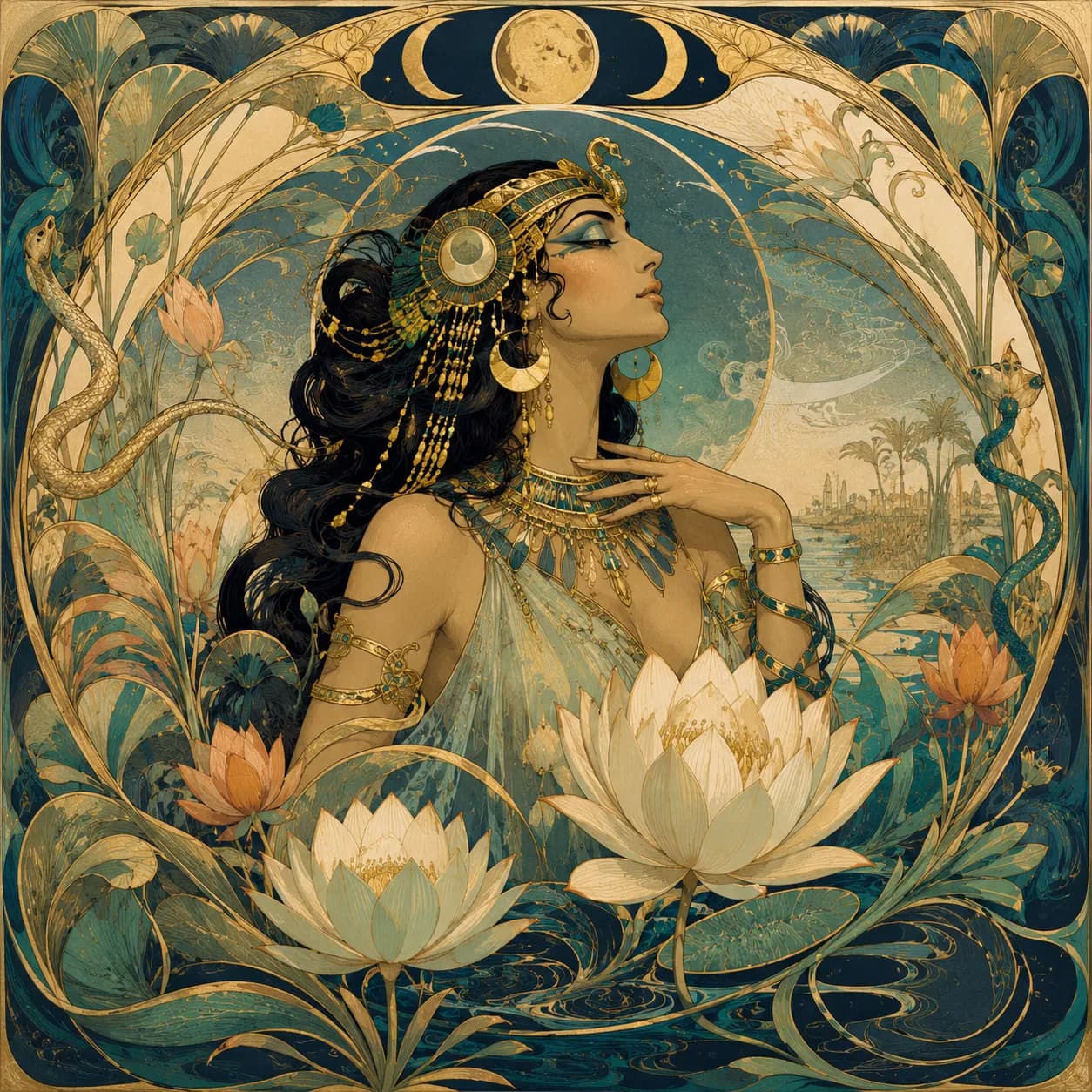
You already have a Cleopatra in your head. For a lot of people it's Elizabeth Taylor's kohl-lined eyes in the four-hour 1963 film. For others it's the Netflix casting fight that made the news a couple of years ago, or a paperback cover, or a Halloween costume. Almost none of those people have opened the 1607 play all of it keeps re-making — and here's the strange part: Shakespeare saw the whole thing coming and named it in two words.
The words are infinite variety, and they're usually read as a compliment about a beautiful woman. They're not. Read in context, the line is a diagnosis of us — of why every generation has to build its own Cleopatra from scratch, and why the one you happen to carry says more about your era than about hers.
- “Age cannot wither her, nor custom stale / Her infinite variety.” — Enobarbus, Act 2, the play's most-quoted and most-tattooed line.
- It's not about her looks. It's about reception — how each era looks at her again and remakes her in its own image.
- Every generation casts a new one. Elizabeth Taylor, Sophie Okonedo, Julia Bullock, a Netflix docuseries that drew a formal protest from Egypt — the remaking never stops.
- The Cleopatra you picture is a mirror. Whoever you cast in your head is quietly telling you which fights your era is having.
| The usual read | What the play is doing |
|---|---|
| A compliment about how she looks | A diagnosis of how every era re-reads her |
| “She never gets old or boring” | “Every generation has to make her new” |
| About her face | About our need for a mirror |
| Enobarbus praising a queen | Shakespeare naming a 400-year pattern |
🎭 “Age cannot wither her, nor custom stale her infinite variety” — what it really means
The line comes from Act 2 of Antony and Cleopatra, and it isn't Cleopatra saying it about herself — it's Enobarbus, a blunt Roman soldier on Antony's side, trying to describe her to men who've never met her. He reaches for the biggest thing he can say: “Age cannot wither her, nor custom stale / Her infinite variety.” Age won't wear her down, and familiarity won't make her boring — because there's always another version of her arriving.
On the podcast, my co-host Sharon reads the line and then flips the way most people hear it. It was never about a pretty face:
Here's the line everybody keeps. Age cannot wither her, nor custom stale her infinite variety. And Leo, it was never about a pretty face, or a queen. It's a promise that a person can be big enough that every era has to remake her. That's the diagnosis.
That's the move the tattoos and wedding readings miss. “Infinite variety” isn't a line about beauty aging well; it's a line about a person too large for any single portrait to hold. Which is why the play doesn't end the argument about who Cleopatra was. It starts it.
🎬 Every era makes a new Cleopatra — and Shakespeare saw it coming
Look at the last century and the pattern is almost comic in how reliable it is. Elizabeth Taylor turned her into a four-hour 1963 epic that nearly bankrupted the studio. Sophie Okonedo played her at Britain's National Theatre. The American composer John Adams built a whole opera around her, with Julia Bullock in the role. Here's Sharon running the through-line:
Basically. And it doesn't stop there, you know. Elizabeth Taylor did the four hour movie in the sixties, nearly bankrupted the studio. And lately the composer John Adams built a whole opera around her.
Then there's the loudest version of the fight. In 2023 Netflix cast a Black actress as Cleopatra in its docuseries Queen Cleopatra, and Egypt's government filed a formal protest calling it “a falsification of Egyptian history”; the show landed a 2% audience score on Rotten Tomatoes. Whatever you make of the casting, notice what the fight is actually about — not the play, but which era gets to own her image.
Brand new. And a few years back, Netflix put out Queen Cleopatra. They cast a Black actress in the lead, and Egypt's government filed a formal protest.
The remarkable thing is that Shakespeare didn't just create a character who gets re-cast every generation. He put the pattern insidethe play, in one phrase, handed to a minor soldier who can't stop marvelling at her:
He named the whole pattern in the play. In one phrase, in a speech by Enobarbus, Antony's closest general. Two words that pretty much own it. Infinite variety.
🪞 “Infinite variety” isn't about her looks. It's about us.
Here is the reframe the episode is built on: the line describes a way of seeing, not a face. Critics writing about the modern controversies land in the same place — Cleopatra has become “a figure of fantasy rather than reality, someone upon whom people can project their own ideas.” That's not a flaw in how we remember her. It's the whole mechanism, and Shakespeare named it four hundred years before the streaming fight.
That's kind of the misread. It's not about her looks at all, but a diagnosis of how every era looks at her, all over again.
There's an edge to the line, too. Enobarbus isn't just admiring her — he's admitting she can't be pinned down, which is a slightly unsettling thing to say about anyone. The moment you think you've got the real her, another version walks in.
He did, really. And Enobarbus almost makes it a dare. Every time you think you've pinned her down, she's already something else.
This is also why the play refuses to sit still as a genre — part tragedy, part romance, part political thriller. Readers notice it, too: the top reviews on Goodreads keep circling the same word — that she's the most complex, contradictory figure Shakespeare ever wrote, and that the contradiction is the point, not a bug.
🍽️ The Cleopatra you carry says something about you
Once you hear the reframe, you start seeing “infinite variety” people everywhere — and not just famous ones. The aunt two relatives describe as completely different women at the same holiday table. The boss everyone in the office reads differently. On the episode, Leo — that's me — pushed past the movie stars to the version I actually carry: a woman named Sherene I sat next to at a wedding when I was ten.
She comforted a kid crying in the hallway, the exact voice my grandmother always had. A minute later she walked a nervous grandpa through his toast, word by word, patient as anything. Then she roasted her own husband so hard he laughed till he cried. Ten year old me watched all of that in one night. Every one of them real, every one of them hers.
Five different women in one night, and every one of them true. That's the Cleopatra thing scaled down to a folding chair at a reception — a person too big to be caught by any one description of them. And the useful turn is inward: the version of someone you insist is the “real” them usually says more about what you need to see than about who they are.
Age cannot wither her. So the next time you catch yourself arguing which version of someone is really them, at a family dinner, at work, in the group chat, you're standing right inside the play. Every time.
Every era gets the Cleopatra it needs — and the one you carry in your head is quietly telling you which era made you.
So the next time an adaptation sparks a fight, or two people at dinner describe the same person as if they'd met different humans, remember what Enobarbus already knew. The argument isn't really about her. It's about the era doing the arguing — and the Cleopatra you reach for first is the one that fits the fights you're living. Age cannot wither her, because we keep rebuilding her. Same as you, probably.
Sources
- Antony and Cleopatra (1607 text) — Project Gutenberg
- Netflix's 'Queen Cleopatra' Controversy, Explained — Forbes
- Is Netflix's Queen Cleopatra cultural appreciation or cultural appropriation? — The Conversation
- Antony and Cleopatra (John Adams opera) — Wikipedia
- Cleopatra (1963 film) — Wikipedia
- Antony and Cleopatra — reader reviews — Goodreads
Frequently asked questions
- What does "Age cannot wither her, nor custom stale her infinite variety" mean?
- In Shakespeare's Antony and Cleopatra (about 1607), the soldier Enobarbus describes Cleopatra with the line "Age cannot wither her, nor custom stale her infinite variety." It means she never grows dull or predictable — there is always another version of her arriving. Read closely it is less a compliment about her looks than a description of how endlessly she can be re-imagined, which is why every generation reinvents her.
- Is "infinite variety" a compliment about Cleopatra's beauty?
- It is usually taken that way, but in context the line is about reception, not beauty. Enobarbus is marveling that Cleopatra cannot be pinned down — every time you think you have grasped the real her, another version appears. Modern critics make the same point about the historical Cleopatra: she has become a figure people project their own ideas onto, which is exactly what "infinite variety" names.
- Who has played Cleopatra over the years?
- Dozens of performers across a century. Elizabeth Taylor played her in the four-hour 1963 film epic; Sophie Okonedo played her at Britain's National Theatre; Julia Bullock sang the role in John Adams's opera; Adele James played her in Netflix's 2023 docuseries Queen Cleopatra. Each version reflects its own era — which is the whole point of Shakespeare's "infinite variety."
- Why was Netflix's Queen Cleopatra so controversial?
- Netflix's 2023 docuseries Queen Cleopatra cast a Black actress, Adele James, in the title role. Egypt's Ministry of Tourism and Antiquities objected, with an official calling it "a falsification of Egyptian history," and the show drew a 2% audience score on Rotten Tomatoes. The fight was less about Shakespeare's play than about who gets to claim Cleopatra's image — the modern version of the reinvention pattern.
- Did Shakespeare invent the phrase "infinite variety"?
- Yes. The exact phrase "infinite variety" first appears in Antony and Cleopatra, in Enobarbus's Act 2 speech, and passed into English from there. It is one of several everyday expressions this single play gave the language — proof that even people who have never read it end up quoting it without realizing.
- Why is Antony and Cleopatra still relevant today?
- Because the play is really about how we keep re-inventing a person, not just about ancient Rome and Egypt. Every era casts its own Cleopatra — Taylor's, the Netflix fight, a new opera — and Shakespeare named that pattern four centuries early. It also works as a mirror: the version of any larger-than-life person you carry says something about the fights your own era is having.
Enjoyed this one?