How do you love someone who's picking wrong? Antony and Cleopatra's answer is Enobarbus (2026)
It's eleven at night and the group chat has spent six months watching a friend pick wrong. Antony and Cleopatra has a character for exactly this: Enobarbus, who loves his friend, says his piece, leaves when he has to — and dies of grief. The distance and the love are both allowed to be real.


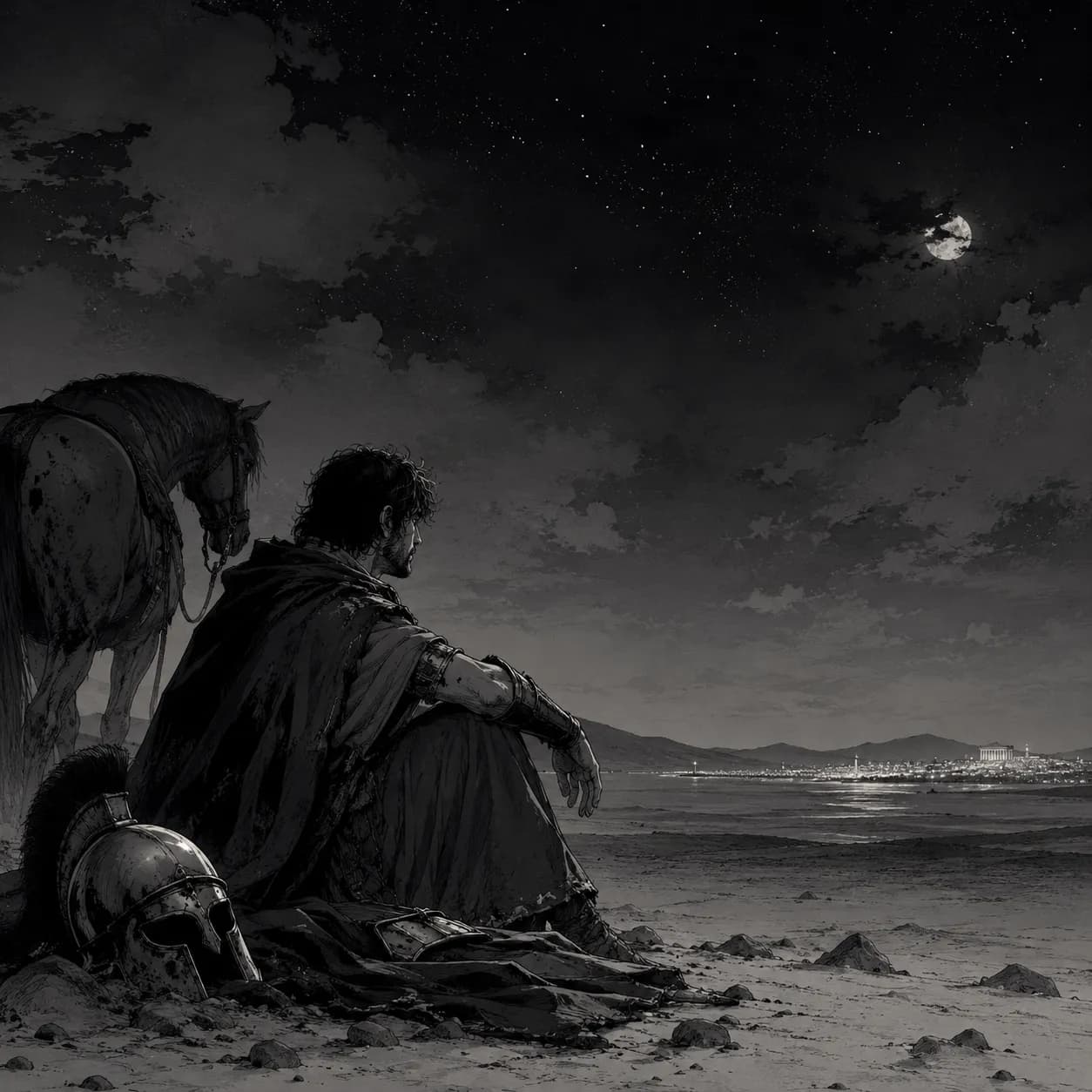
It's eleven at night. The group chat has spent six months carrying one of your closest friends through a genuinely bad decision — the same three friends, the same disbelief, night after night, nobody saying anything new. And then, one night, somebody just quietly mutes the whole thread and goes to bed. Not because they stopped caring. Because they couldn't watch anymore.
There's a character in a four-hundred-year-old play who had that exact night. He's a Roman soldier, the oldest friend of a man throwing away a war for the wrong reasons, and he does the thing you're not supposed to admire: he leaves. Then Shakespeare does something strange with him — he doesn't reward the smart move, and he doesn't punish it either. He shows you what it actually costs to love someone who's picking wrong. His name is Enobarbus, and almost nobody outside a Shakespeare class remembers it. That's fine. The shape is the part you already know.
- Enobarbus is Antony's oldest friend — the clear-eyed one who watches Antony throw a war away for Cleopatra, says his piece, and is waved off every time.
- He leaves when he can't stay. When it's certain Antony will lose, he deserts, quietly, to the winning side — the smart, survivable move.
- The kindness is what breaks him. Antony answers the desertion not with rage but by sending his friend's belongings after him, “with / His bounty overplus.” Enobarbus dies of grief before dawn.
- The takeaway isn't “stay loyal.” It's that you can leave the situation and still love the person — the distance and the love are both allowed to be real at once.
| What we tell ourselves love means | What Enobarbus actually does |
|---|---|
| Stay no matter what, or you never really loved them | Stay as long as you can stand it — then leave when it's wrecking you too |
| Leaving proves you stopped caring | You can leave the situation and keep loving the person |
| Say your piece until they finally listen | Say your piece, accept they won't, and stop re-litigating it |
| The distance cancels out the love | The distance and the love are both real at once |
🪖 Who is Enobarbus, and why his story matters
Enobarbus is Antony's oldest and most trusted friend in Shakespeare's Antony and Cleopatra, and he spends the play doing the hardest job in any friendship: watching someone he loves make a slow-motion mistake with his eyes wide open. He stands by Antony through everything and watches him throw the whole war away for Cleopatra, says his piece more than once, and gets waved off every time. Readers have long treated him as the play's third lead — the voice of reason and, in the words of the top reader review on Goodreads, the man whose “disillusioned betrayal, and his subsequent death from what can best be described as a broken heart” is one of the three things the play is really about.
Here's Sharon, my co-host, on the part that makes him unforgettable:
Well, here's the gutting move. Shakespeare won't take the sensible one's side, not for a second, because leaving is only half the story.
That's the trap the play springs. We're braced for a story about loyalty versus self-preservation — stay and go down with him, or save yourself and carry the guilt. Enobarbus does the sensible thing. When it's finally clear Antony is going to lose, he walks over to the winning side. And Shakespeare refuses to let that be the end of it, because the leaving was never the hard part.
🎁 The kindness that kills him: Antony's “bounty overplus”
Enobarbus dies not because Antony punishes his desertion, but because Antony forgives it. When Antony learns his oldest friend has gone over to Caesar, his response isn't rage — it's generosity. He orders everything Enobarbus left behind sent after him across the battle lines, “all thy treasure, with / His bounty overplus” — the belongings, plus a bonus on top of what was already his. Sharon lays out how it lands:
Not with rage, not even anger. He answers with kindness. He orders every single thing Enobarbus left behind sent after him, with a generous bonus on top of what was already his.
It is the most devastating gesture in the play precisely because it is so kind. A cruel Antony would have let Enobarbus keep the clean, defensible story he told himself on the way out. Instead Antony hands him proof, across a war line, that the man he abandoned still loved him — and that kindness leaves Enobarbus nothing to stand on. He goes out into the dark alone and says the line Sharon reads verbatim:
He walks out into the night, alone, and says out loud, I am alone the villain of the earth. That's the line, verbatim.
In the play the full line is “I am alone the villain of the earth, / And feel I am so most” (Act 4). And then he is simply gone — no sword, no wound, no enemy. Shakespeare kills him with grief. His last words are still addressed to the friend he left, “Forgive me in thine own particular” — forgive me, you, personally — and then he dies.
He can't. He's dead before dawn, of grief. His very last words, still to Antony, are, forgive me in thine own particular, meaning, forgive me, you, personally. Then he's gone.
🧭 The Enobarbus rule: you can leave and still love them
Shakespeare's answer to how do you love someone who's choosing badlyis not a moral — it's a set of permissions. You give them what you can, you leave when you have to, and you never pretend you stopped loving them. Sharon states it plainly on the episode:
Right, and that's Shakespeare's answer, if you're the friend watching someone pick wrong. You give what you can, you leave when you have to, and you never pretend to stop loving them.
Notice what the play refuses to do. It never scores the desertion as cowardice, and it never scores the loyalty as foolishness. It just shows you both, and it shows you that the two of them live in the same chest at the same time. The leaving didn't cancel the love; that's exactly why the kindness could still reach him. The reason “just cut them off” and “never give up on them” both feel wrong is that each one is trying to resolve a thing that isn't supposed to resolve.
You can mute the group chat and still cry a little on their birthday. The distance and the love are both allowed to be real at once.
💬 Loving a friend who's picking wrong, in real life
The reason this play still lands is that almost everyone has stood on one side of it — the friend who left, or the friend who was left. On the episode, Leo — that's me — took the seat of the one who was picking wrong, and got loved through it anyway:
Okay, Sharon, my turn. And mine's the opposite side. Few years back, I was the one picking wrong, chasing a job everyone I trusted said was a mistake. My best friend didn't argue, she just kept sending me the recipe podcasts we used to swap. When I finally quit, I looked back and she'd sent forty. Not one told you so. Just, Wednesday, here's a chowder.
That's Enobarbus's loyalty minus the leaving — a friend who sat down next to a bad choice with a chowder recipe and refused to make it about being right. And Sharon took the other seat, the Enobarbus one: the friend who watched, said what she could, and finally went quiet because she couldn't keep watching.
Mine's the other side. Years back, my closest college friend was sinking into a bad relationship, and I could see it. I said what I could. Then I stopped inviting her out because I couldn't watch. On my birthday, she sent me a small bouquet. Her card had two words. Still here. And I sat in my kitchen crying, because she had every right to be gone. And she wasn't.
Two words on a card, instead of a whole speech — kindness reaching clean across a distance somebody chose. That's Antony's move, four hundred years on, and it's the reason the friendship, not the famous romance, is the part of this play that won't leave you. As Leo put it, there isn't a right answer, and that's the point:
Because there isn't one, really. And maybe that's why the friendship is the part that actually stays, long after the two lovers get flattened into a movie rerun and a Halloween costume.
So if you're the one who muted the thread, or the one who sent the birthday text anyway, you're not being disloyal and you're not being a pushover. You're doing the thing Shakespeare wrote a whole tragedy to say out loud: you can leave, and you can love them, and neither one has to win.
This is Part 3 of our four-part walk through Antony and Cleopatra. If you want the other side of the story — the man Enobarbus couldn't save, and why Shakespeare wrote him as awake, not seduced — that's its own episode.
Sources
- Antony and Cleopatra (First Folio text) — Project Gutenberg
- Antony and Cleopatra — Folger Shakespeare Library
- Antony and Cleopatra — reader reviews — Goodreads
- Antony and Cleopatra — Wikipedia
Frequently asked questions
- Who is Enobarbus in Antony and Cleopatra?
- Enobarbus is Antony's closest friend and most trusted officer in Shakespeare's Antony and Cleopatra — a blunt, clear-eyed Roman soldier who acts as the play's voice of reason. He watches Antony ruin himself for Cleopatra, warns him repeatedly, and is often read as the play's third lead alongside the two lovers.
- Why does Enobarbus leave Antony?
- Enobarbus deserts Antony because he can see Antony is going to lose the war and won't go down with a doomed cause. He stays loyal as long as he can bear it and says his piece more than once, only crossing to Octavius Caesar's winning side once Antony's defeat looks certain. It's a survival move, not a loss of love.
- How does Enobarbus die in Antony and Cleopatra?
- Enobarbus dies of grief, with no wound and no enemy. After he deserts, Antony sends his abandoned treasure after him 'with his bounty overplus' — a generous, forgiving gesture. The kindness overwhelms Enobarbus with guilt; he goes out alone into the night, calls himself 'the villain of the earth,' and dies of a broken heart before morning.
- What does 'I am alone the villain of the earth' mean?
- It's Enobarbus's line in Act 4 of Antony and Cleopatra, spoken after Antony forgives his desertion with a gift of treasure. It means he feels he is the single most contemptible person alive — the only real traitor — because he abandoned a friend who repaid him with generosity instead of anger. That self-condemnation is what kills him.
- What is 'his bounty overplus' in Antony and Cleopatra?
- 'His bounty overplus' is the phrase Shakespeare uses when Antony sends the deserting Enobarbus all his belongings plus extra — a bonus on top of what was already his ('overplus' means surplus or excess). It is Antony's act of forgiveness reaching across the battle lines, and its very kindness is what breaks Enobarbus's heart.
- How do you love a friend who is making a bad decision?
- Antony and Cleopatra's answer, through Enobarbus, is that you don't have to choose between staying loyal and protecting yourself. You say your piece, you give what you can, you step back when watching becomes unbearable — and you never pretend you stopped caring. The distance and the love are allowed to be real at the same time.
Enjoyed this one?