“To dream the impossible dream” isn't Cervantes — the famous Don Quixote lines he never wrote (2026)
The three most famous 'Don Quixote' lines — 'to dream the impossible dream,' 'tilting at windmills,' and 'facts are the enemy of truth' — and not one was written by Cervantes. Two come from a single 1965 Broadway musical, the third from a 1644 satire. Here's where the lines we live by actually came from, and why we keep them anyway.


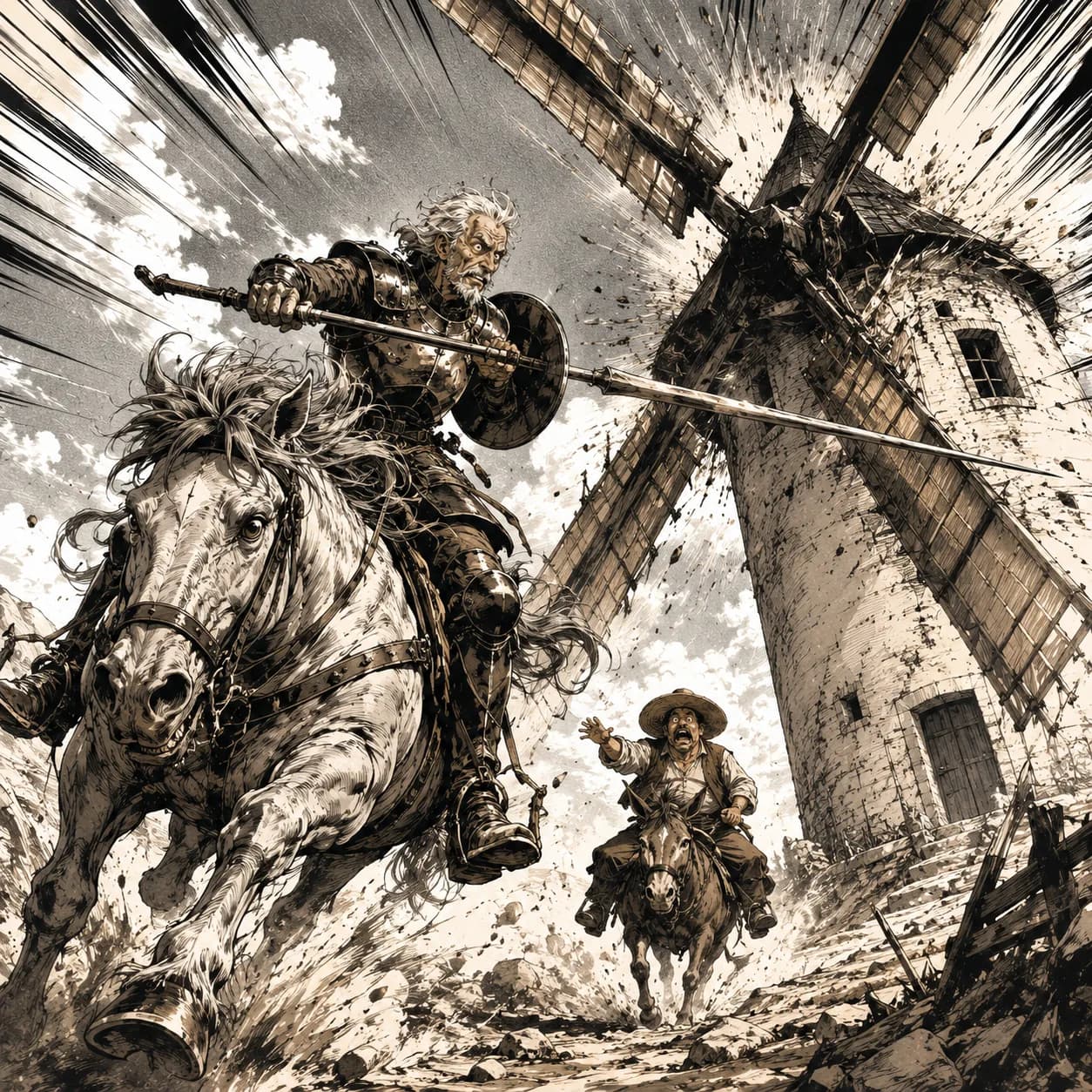
Quick test. Name the three most famous things Don Quixote ever said: “to dream the impossible dream,” “tilting at windmills,” and “facts are the enemy of truth.” How many did Miguel de Cervantes actually write? Zero. Two of the three come from a single 1965 Broadway musical, the third from a 1644 satire — and somehow we file all of them under a novelist who died in 1616.
- “To dream the impossible dream” — not Cervantes.It's the title song of the 1965 Broadway musical Man of La Mancha, lyrics by Joe Darion — written three and a half centuries after Cervantes died.
- “Tilting at windmills” — not in the book. The windmill scene is in the book (Part 1, chapter 8), but the four-word phrase was coined by the English satirist John Cleveland in 1644.
- “Facts are the enemy of truth” — not Cervantes either. Playwright Dale Wasserman wrote it for that same 1965 musical — a spoken line in his script, not a song and not a sentence from the novel.
- So where does that leave Cervantes?Two of the three most famous “Don Quixote” lines come from one 1965 musical; the third from a 1644 satire. None of them are his.
| What people think | Where it actually came from |
|---|---|
| “To dream the impossible dream” is Cervantes | A 1965 Broadway lyric (Joe Darion, Man of La Mancha) |
| “Tilting at windmills” is a phrase from the book | Coined by satirist John Cleveland in 1644, decades after Cervantes died |
| “Facts are the enemy of truth” is Cervantes | Written by Dale Wasserman for the same 1965 musical |
| The windmill fight isn't really in the novel | The scene is in the book (Part 1, ch. 8) — only the four-word phrase isn't |
🪶 Three famous lines, and Cervantes wrote none of them
The three lines almost everyone can quote from Don Quixote all came from somewhere other than Cervantes — three different writers, across three different centuries, none of them the man whose name they travel under. Leo lays the trap in the first ten seconds of the episode.
Three lines everybody quotes as Don Quixote. To dream the impossible dream, tilting at windmills, facts are the enemy of truth. Heads up, Sharon, Cervantes wrote none of them. Every one came in from somewhere else, long after he was dead.
That's the strange thing about a book this famous: the more a line gets quoted, the less anyone checks where it came from. Run each of the three past the actual sources and a clear pattern shows up — and two of the three lead back to the exact same place.
🎭 “The impossible dream” is a 1965 Broadway lyric
The single most-quoted “Don Quixote” line is a show tune. “To dream the impossible dream” is the lyric of “The Impossible Dream (The Quest),” written for the 1965 musical Man of La Mancha — not a sentence Cervantes ever wrote.
To dream the impossible dream is a song lyric, it's from the nineteen sixty five musical, Man of La Mancha. So the single most quoted line from a four hundred year old novel is a Broadway show tune, written three and a half centuries after Cervantes died.
The song's lyrics are by Joe Darion, with music by Mitch Leigh, for a musical whose book was written by Dale Wasserman. It became an anthem — covered by everyone from Frank Sinatra to Elvis — which is exactly how a 1965 lyric ends up sounding like the soul of a 1605 novel. The musical itself is now older than Cervantes's book was when the show first opened.
🌬️ “Tilting at windmills” was coined in 1644
The windmill scene is genuinely in the book; the phrase we wrap around it is not. Don Quixote really does charge the windmills in Part 1, chapter 8 — but the four-word idiom “tilting at windmills” came from a different writer, decades later.
Same pattern, really. Take tilting at windmills, that phrase isn't in the book either. An English satirist coined it in sixteen forty four, decades after Cervantes was gone, as a dig at people who fight imaginary enemies.
That satirist was John Cleveland, who in 1644 jeered at “the Quixotes of this Age” who “fight with the Wind-mills of their owne Heads”; the modern phrase settled into English in the 1800s. In the novel, Sancho tells him plainly the giants are only windmills, and Quixote charges anyway (Ormsby's 1885 translation, Part 1, chapter 8). The picture is Cervantes's. The caption everyone quotes was added forty years after he died.
📜 “Facts are the enemy of truth” is from the same musical
The line that sounds most like Cervantes is the one he had the least to do with. “Facts are the enemy of truth” was written by Dale Wasserman for Man of La Mancha — the very same 1965 musical, this time a spoken line rather than a song.
That one he had the least to do with, honestly. Here's the twist, it's from that very same nineteen sixty five musical, just a spoken line this time, not a song. The line that feels the most like Cervantes is something a Broadway playwright wrote.
The aphorism is reliably attributed to Dale Wasserman, Man of La Mancha — it's a line from his script, not a translation of any one Cervantes sentence. Which means the two most quotable “Don Quixote” lines in English, the dreamy one and the wise one, were both handed to him by the same 1965 show. Leo does the arithmetic.
So two of the three came out of one Broadway musical, and the third from a sixteen forty four satire. Three different writers, not one of them Cervantes, and every one of them mistaken for him.
🤝 Why we keep the lines anyway
Here's the part the correction usually skips: we don't hang on to these lines because they're accurate. We keep them because of who handed them to us — and that turns out to be the very thing the book is about.
And that's the part, I think, nobody checks. We keep a line for who handed it to us, or who we were standing next to when we said it. Being right was never what made it ours. The handing over was.
And then the loop closes. What we've done to Cervantes is what Don Quixote did to his chivalry novels: loved a story so much we believed our preferred version over the real one. The book saw its own readers coming, four centuries early — which is why the misattribution isn't really a mistake so much as the most fitting possible tribute. The episode ends on the series bookend — Sharon, then Leo — traded gently, the way you'd say it about a friend.
Some of it was made up.
And some of it was windmills.
So the next time someone quotes “the impossible dream” as Cervantes, you'll know it's 1965, the windmill phrase is 1644, and the wise-sounding aphorism is a playwright's spoken line from the same show. The lines we live by are rarely the ones that are perfectly sourced — they're the ones somebody we trusted handed us. If you want the novel underneath the myth, start with the man whose books dried up his brain and the friend who rode next to him anyway.Treasure Islandhas its own famous line nobody can find in Stevenson's actual text either.A Tale of Two Citieshas the opposite problem: the line everyone quotes really is Dickens's, and almost nobody quotes the end of it.The War of the Worlds has the same trouble with a single word: the one everybody uses for its walking machines turns up eight times in the whole novel.
Sources
- Don Quixote (John Ormsby translation, 1885) — Project Gutenberg
- The Impossible Dream (The Quest) — Wikipedia
- Man of La Mancha — Wikipedia
- “Facts are the enemy of truth” — Dale Wasserman, Man of La Mancha — Goodreads
- Tilting at windmills — meaning and origin — Phrases.org.uk
Frequently asked questions
- Did Cervantes write 'to dream the impossible dream'?
- No. 'To dream the impossible dream' is the lyric of 'The Impossible Dream (The Quest),' a song from the 1965 Broadway musical Man of La Mancha, with lyrics by Joe Darion and music by Mitch Leigh. Miguel de Cervantes died in 1616 — three and a half centuries before the song existed — and the line appears nowhere in his 1605/1615 novel. It is probably the single most-misattributed 'Don Quixote' quote in English.
- Is 'tilting at windmills' in Don Quixote?
- The scene is; the phrase isn't. Don Quixote really does charge a row of windmills he mistakes for giants in Part 1, chapter 8 of Cervantes's novel. But the four-word idiom 'tilting at windmills' never appears in the book. It traces to the English satirist John Cleveland, who in 1644 mocked 'the Quixotes of this Age' who 'fight with the Wind-mills of their owne Heads'; the modern wording settled into English in the 1800s.
- Who wrote 'facts are the enemy of truth'?
- Playwright Dale Wasserman wrote 'facts are the enemy of truth' for the 1965 stage musical Man of La Mancha — it's a spoken line in his script, not a line from Cervantes and not a song lyric. It's widely pinned online as a Don Quixote quote, but it isn't in the novel; Wasserman built it from the musical's larger theme rather than translating any single Cervantes sentence.
- What is Man of La Mancha?
- Man of La Mancha is a 1965 Broadway musical loosely based on Cervantes's Don Quixote, with a book by Dale Wasserman, lyrics by Joe Darion, and music by Mitch Leigh. It introduced 'The Impossible Dream (The Quest),' and a 1972 film version followed. Most people who 'know' Don Quixote actually know the musical — its songs and lines are now older than Cervantes's novel was when the show first opened.
- Are any famous Don Quixote quotes actually from the book?
- Yes. The windmills exchange is genuine: in John Ormsby's 1885 translation Sancho warns that 'what we see there are not giants but windmills,' and Quixote insists 'those are giants.' The novel's famous opening — 'In a village of La Mancha, the name of which I have no desire to call to mind' — is real too. The lines people quote as inspirational ('the impossible dream,' 'facts are the enemy of truth'), though, are later additions, not Cervantes.
- Why are so many 'Don Quixote' quotes misattributed?
- Because the version most people meet is the 1965 musical, not the 1605 novel — and a punchy lyric travels faster than a thousand-page book. There's also a fitting irony: Don Quixote is about a man who loved his chivalry stories so much he believed his own version over the real one. Readers have done the same to Cervantes, keeping the lines that feel like him over the ones he actually wrote.
Enjoyed this one?