Don Quixote's brain 'dried up' from reading too much — the original brain-rot story (2026)
The famous knight charging windmills is a 1965 musical. The book Cervantes wrote in 1605 opens with a man whose brain 'dried up' from reading too many fantasy novels — and the friends who burn his library to save him. It's the original story of letting what you consume rewire what you see: brain rot, doom-scrolling, the algorithmic feed, four hundred years early.


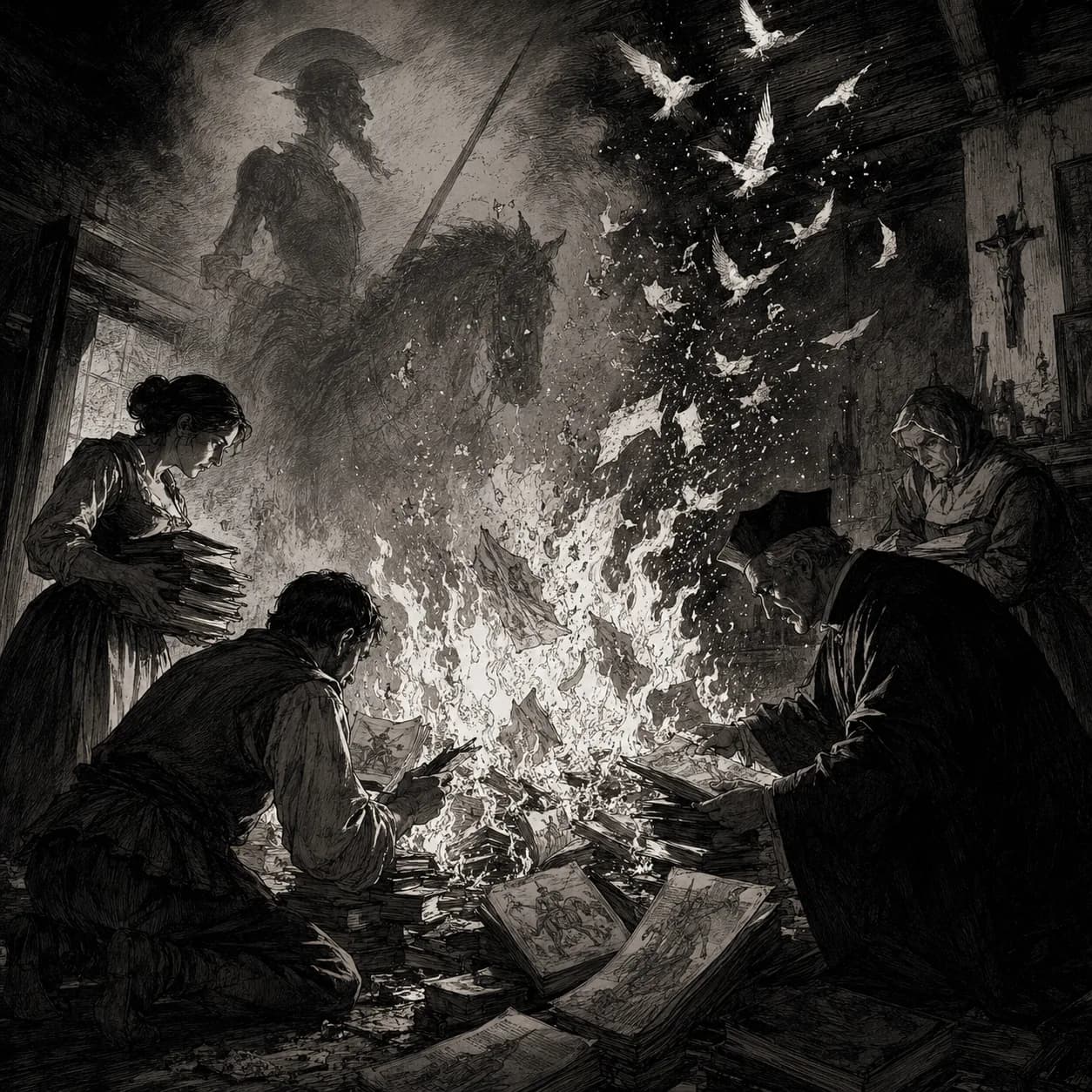
Picture the most famous knight in literature: lance up, charging the windmills, an inspirational anthem swelling behind him. The noble dreamer. Now open the actual 1605 book. It starts with a middle-aged man who read so many fantasy novels that his brain — in Cervantes' own words — dried up, and the people who love him burning his library to save his life. Don Quixote isn't the story of a dreamer. It's the first story about letting what you consume rewire what you see — brain rot, doom-scrolling, the algorithmic feed, four hundred years early.
- His brain “dried up.”Chapter 1 says that what with little sleep and much reading his “brains got so dry that he lost his wits.”
- It's a comedy, not an anthem.The inspirational “noble dreamer” is the 1965 musical Man of La Mancha; the 1605 book is slapstick.
- His friends stage an intervention. In chapter 6 his niece, his housekeeper, and the village priest burn most of his library to save him.
- It's the original brain-rot story.A man reshaped by the thing he can't stop consuming — 420 years before doom-scrolling had a name.
| The cultural Don Quixote | The 1605 book |
|---|---|
| A noble dreamer with a swelling soundtrack | A man whose brain 'dried up' from too many novels |
| An inspirational quest to dream the impossible | A slapstick comedy about losing your grip on reality |
| He charges windmills as a heroic stand | He charges windmills because he can't tell them from giants |
| A timeless hero | A cautionary tale about what you let rewire you |
🛡️ The dreamer is a 1965 musical, not the book
The inspirational Don Quixote everyone pictures — the one who dreams the impossible dream — comes from a 1965 Broadway musical, not from Cervantes. The book Cervantes published in 1605 is a comedy, a satire of the chivalry novels that were popular at the time, and its first readers laughed at it.
Yeah, that picture is everywhere. The cultural Don Quixote is the nineteen sixty five Broadway musical, Man of La Mancha. The book Cervantes wrote is a slapstick comedy.
That gap matters, because the version we inherited flatters the disease. The musical turns a man who read himself out of reality into a hero for refusing to see things as they are. Cervantes did the opposite: he opened the book by telling you exactly what was wrong with his hero, on the first page, before the adventures even start.
📚 His brain literally dried up
Cervantes opens the novel by diagnosing his hero: too little sleep and too much of one kind of reading left his brain dried out and his wits gone. In John Ormsby's 1885 translation it lands almost like a medical note — the cause first, then the symptom.
It's almost a medical note, honestly, Leo. What with little sleep and much reading, his brains got so dry that he lost his wits. That's the opening. He leads with the diagnosis.
And the man who wrote that line knew what being wrecked felt like. Cervantes had been a soldier and then a captive — Barbary pirates held him for ransom in Algiers for about five years — and he drafted Part 1 in or just after a Spanish prison. The funniest book in the language was written by someone who had genuinely been through it.
So we've been telling ourselves this is the noble dreamer story, and Cervantes opens with the guy reading himself into a fog. And Cervantes himself knew real suffering. He drafted part one in a Spanish prison, after years held captive for ransom by Barbary pirates in Algiers.
🔥 His friends burned his library
When Don Quixote's madness turns dangerous, his family doesn't lecture him — they burn the books. Part 1, chapter 6 is, in effect, an intervention staged three centuries before the word existed, and Cervantes plays it as comedy: the priest sorting the library can't help saving a few titles he secretly loves from the fire.
Honestly, it plays like an intervention, centuries before the word existed. His niece, the housekeeper, and the priest burn most of his library while he sleeps. They're not punishing him, they're taking what broke him. And the priest quietly slips a few he loves back from the fire. The rescue can't quite let go.
It's a startlingly modern idea for 1605: that the cure for someone consumed by what they read might be to take the books away — and that doing so might not work. Critics have come to read the whole novel this way, as a story about the dangers of reading badly — about media consuming the reader, rather than the other way around.
📱 You can't burn a feed
The modern version of chapter 6 is the relative who disappeared into a feed — and the reason it stings is that you can burn a library, but you can't burn a feed. Cervantes' book has had a strange second life as a story for exactly this: Salman Rushdie's 2019 novel Quichotte rewrites Don Quixote as a man so soaked in reality TV that the line between truth and lies goes smudged and indistinct.
For me, it's the holiday dinner now, and Quixote's books are a feed. There's the relative six months deep in one channel, in a voice that isn't quite theirs. The table goes quiet, and you feel that ache of the algorithm getting there first. But you can't burn a feed, so the rescue gets quieter. You save them a seat next year, you keep the door open.
You can burn a library. You can't burn a feed.
Which brings it back to the one image everybody thinks they already know. The windmills aren't a heroic last stand; they're the brain-dried-up symptom in motion — a man so sure the fantasy is real that, thrown from his horse, he calmly explains an enchanter must have turned the giants into windmills.
And that's the whole book in one image. Somebody you love, dusting off, still telling you it was giants.
That's the part the inspirational poster leaves out. Don Quixote isn't admirable for not seeing the windmills — he's heartbreaking because he can't. Four centuries later you can name the feed, you can see the diagnosis coming, and you still pull up to dinner ready to try again. If you want the rest of what we get wrong about him, meet the friend who rode beside him the whole way and the most famous line he never actually wrote. Some of it really was giants, to him. And some of it was windmills.The Count of Monte Cristo has its own reader who takes a story too literally, with far bloodier results.
Sources
- Don Quixote (John Ormsby translation, 1885) — Project Gutenberg
- Guide to the classics: Don Quixote, the world's first modern novel — The Conversation
- Don Quixote or the Dangers of Reading Badly — Ploughshares
- Channeling Cervantes: On Salman Rushdie's Quichotte — Los Angeles Review of Books
- Miguel de Cervantes — Wikipedia
Frequently asked questions
- Did reading too many books make Don Quixote go mad?
- Yes — that is the premise of Cervantes' 1605 novel. Don Quixote is a country gentleman who reads so many chivalry romances, sleeping little and reading day and night, that (in John Ormsby's 1885 translation) 'his brains got so dry that he lost his wits.' He then believes the fantasy world is real and rides off to be a knight. The book frames it almost as a medical diagnosis of media over-consumption.
- What kind of books drove Don Quixote mad?
- Chivalric romances — the pulpy knight-errant adventures that were the bestselling genre of Cervantes's day (Amadís of Gaul and its many imitators). Don Quixote sells off farmland to buy every one he can find and reads them day and night until, in Ormsby's translation, 'his brains got so dry that he lost his wits' and he sets out to become a knight himself. It's a satire of binge-reading one escapist genre — the 1605 image we'd now call 'brain rot.'
- Is Don Quixote a comedy or a tragedy?
- Cervantes wrote it as a comedy — a slapstick satire of the chivalry novels popular in his day, and his contemporaries read it as a funny book. The noble, inspirational 'dreamer' version most people know comes largely from the 1965 Broadway musical Man of La Mancha, not from the novel. The book does turn poignant by its end, but its core mode is comic.
- Why do Don Quixote's friends burn his books?
- In Part 1, chapter 6, Don Quixote's niece, his housekeeper, and the village priest go through his library and burn most of it while he sleeps, blaming the chivalry romances for driving him mad. It reads like an intervention centuries before the term existed — and the priest cannot help quietly saving a few books he secretly loves from the fire.
- How is Don Quixote relevant to social media and doom-scrolling?
- Don Quixote is an early story about media reshaping a person's sense of reality — a man so immersed in one kind of content that he can no longer see the world as it is. Modern writers, including Salman Rushdie in his 2019 novel Quichotte, have explicitly mapped that idea onto reality TV, fake news, and doom-scrolling. The 1605 problem and the algorithmic-feed problem are the same shape.
- Did Cervantes write Don Quixote in prison?
- Cervantes drafted much of Part 1 in or just after a stint in the Royal Prison of Seville, around 1597. Earlier in life he had been a soldier and then a captive: Barbary pirates held him for ransom in Algiers for about five years, from 1575 to 1580. The funniest book in the Spanish language was written by someone who had genuinely been through hardship.
Enjoyed this one?