Why Sancho Panza is the real hero of Don Quixote — the friend who knew it was windmills and rode along anyway (2026)
Everyone remembers the windmills. Almost no one remembers that Don Quixote is a thousand-page book about a friendship — and that the friend, Sancho Panza, could see they were windmills the whole time. He knew his best friend was deluded, and he saddled up and rode beside him anyway. Here's the loyal-friendship reading of Cervantes' comedy, and the modern friend it describes.


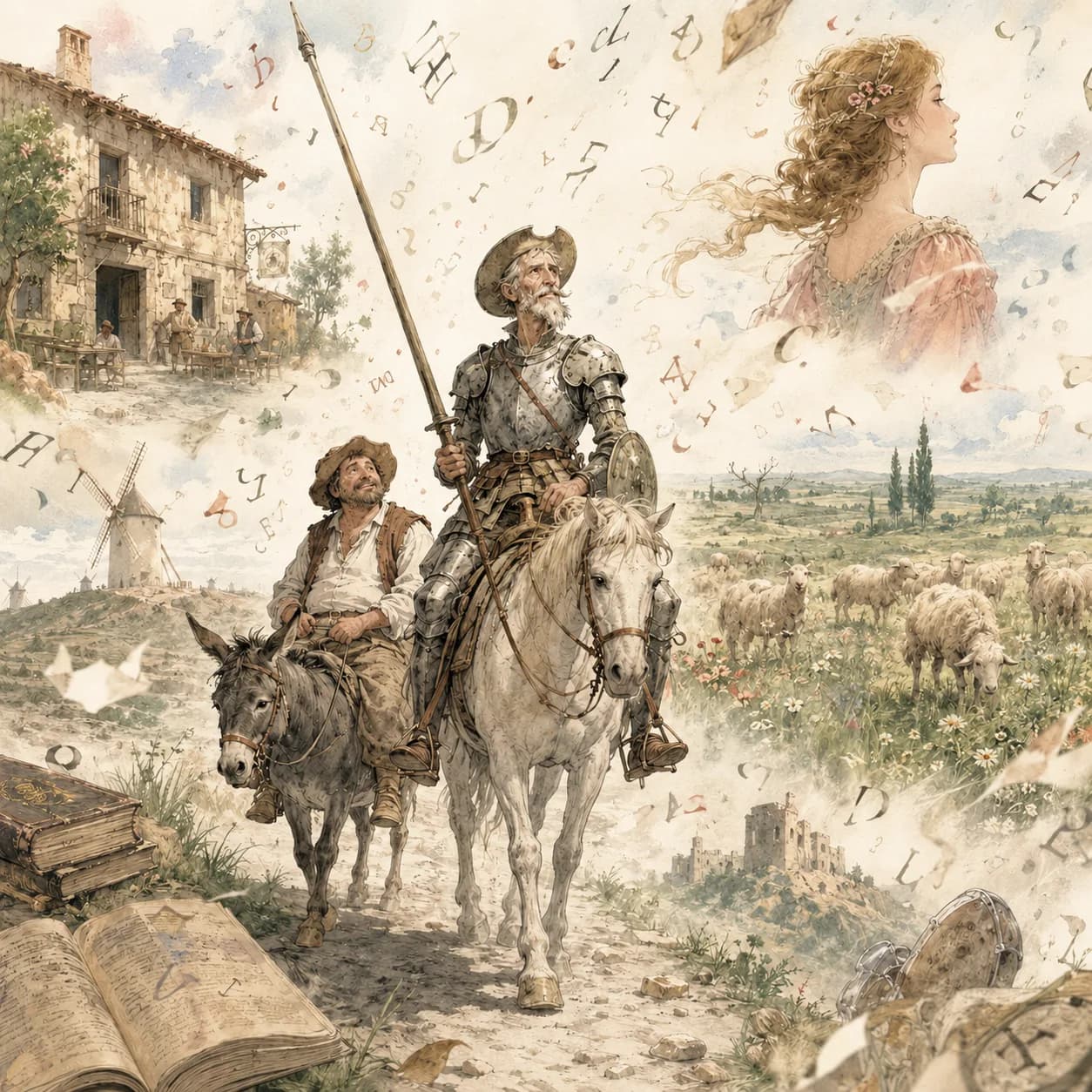
Everyone can picture the windmills: a deranged old knight lowering his lance at a row of mills he's decided are giants. What almost nobody pictures is the man next to him — the pragmatic farmer on the donkey who can see perfectly well they're windmills, says so out loud, and rides off down the road beside his friend anyway. That man is Sancho Panza, and the book the world remembers as “the windmills” is really a thousand-page portrait of him: the friend who doesn't share your dream but shows up for it.
- Sancho knew.He tells Don Quixote plainly that they're windmills, not giants — and saddles up and rides along regardless.
- The windmills are one chapter. The friendship is the whole book — roughly a thousand pages of two mismatched men on the road, side by side.
- The ending isn't a charge. Don Quixote dies sane in bed, and Sancho is at the bedside begging him to stay mad so they can ride out again.
- Loyalty over agreement.Sancho never converts him, and the book's quiet point is that converting him was never what the friendship was for.
| What everyone remembers | What Cervantes actually wrote |
|---|---|
| A noble knight charging a windmill | A friend telling him it's a windmill — and riding along anyway |
| A heroic solo quest | A thousand pages of two people on the road, side by side |
| He dies tilting at windmills | He dies sane in bed, and Sancho begs him to stay mad |
| A story about a dreamer | A story about the friend who showed up for the dream |
🤝 It's a friendship book, not a windmill book
Don Quixote is remembered as an adventure, but structurally it's a friendship — the windmill scene is a single chapter, and the rest of the book is two opposites on the road together. Cervantes published it in two parts, in 1605 and 1615, and it runs to roughly a thousand pages; the lance-and- windmill image you carry is one famous beat near the start of a very long story. It's why the book is so often called the world's first modern novel: the engine isn't the quest, it's the relationship.
The friendship is the spine, you know. The windmill scene is one chapter. The other thousand pages are just the two of them on the road, side by side.
Don Quixote and Sancho are a study in opposites — the gaunt idealist and the round, hungry realist — and across the book they temper and complete each other. Take the windmills away and you still have the book. Take Sancho away and you have nothing.
🌬️ What Sancho actually said at the windmills
At the famous windmills in Part 1, chapter 8, Sancho doesn't egg his friend on — he tells him the plain truth: those are not giants but windmills, and the “arms” are just sails turned by the wind. He is, in other words, completely right, and he knows it.
Sancho explains the physics. He says, look, your worship, what we see there are not giants but windmills, and what seem to be their arms are the sails that, turned by the wind, make the millstone go. And Quixote, like it's obvious: it is easy to see that you are not used to this business of adventures.
That's the whole dynamic in one exchange. Sancho states reality; Quixote pats him on the head for not understanding adventures; Quixote charges, gets flattened, blames a wicked enchanter for turning his giants into mills, picks himself up, and rides on to the next disaster. And the realist who just told him the truth doesn't peel off home. He rides right next to him.
Which is kind of what every real friendship is. Nobody converts anybody. You just stay in the conversation, or you don't.
🕯️ The ending nobody remembers
Don Quixote does not die tilting at windmills — he dies sane, in bed, having renounced his madness and reclaimed his real name, the man Alonso Quixano the Good. The most famous comedy ever written ends on a quiet, sad deathbed in Part 2, chapter 74 — and the friend who spent the whole book insisting the giants were only windmills does the exact opposite of what you'd expect.
Sancho weeps and climbs up beside him. Don't go, he pleads, please don't go. Out in some field, somewhere, we'll go find the woman he loves, just like he always dreamed. He's been the realist the entire book, and the moment Quixote agrees with reality, Sancho begs him to keep believing.
It's the gut-punch most people who can name the windmills have never heard about. The pragmatist — the one who was right the whole time — is the only person in the room who can't let the dream die.
Wow. That's the part that wrecks me. Not the madness, but Sancho being the one who can't let it go. After a thousand pages together, he's the only one in the room not ready.
The friend who says “they're windmills” — and saddles up anyway.
🫂 How to be a Sancho
Being a Sancho doesn't mean pretending the windmills are giants — it means riding next to the person who believes they are, without needing to win the argument first. Sancho is the friend who keeps you honest, the one whose worldview is the opposite of yours and who would never, ever leave.
The friend you've been worried about doesn't always need fixing. Sometimes they just need a Sancho. Not a fix, a Sancho. And sometimes, you know, you're the one who needs one, more than you'd admit.
You already know this person, or you've been them. It's the friend who thinks your plan is nuts and helps you move the couch anyway. The relative whose new conviction you quietly doubt, who still gets the ride to the airport. Nobody converts anybody. You just stay in the conversation — or you don't — and the staying is the whole thing.
Next time you catch yourself ready to talk a friend out of something — the doomed plan, the wedding everyone has opinions about, the faith or feed that went a different way than yours — remember that Cervantes wrote a thousand pages and only one of them is the windmill. The rest is a man riding next to his friend. And it began, four hundred years ago, with a brain dried up from too many books — which is how Quixote got on the road in the first place.
Some of it was windmills. Sancho knew that the whole time, and he rode along anyway — which is the part the lance-and-helmet image always leaves out, the same way the most famous Don Quixote line turns out not to be in the book at all. The giants were never the point. The friend riding beside you was.Water Margin runs its own found-family loyalty story, with a hundred and eight friends instead of one.
Sources
- Don Quixote (1885 Ormsby translation) — Project Gutenberg
- Don Quixote, Volume 2, Chapter 74 (Ormsby translation) — Literature.org
- Guide to the classics: Don Quixote, the world's first modern novel — The Conversation
- Sancho Panza (fictional character) — Encyclopaedia Britannica
Frequently asked questions
- Is Don Quixote really about friendship?
- Yes. Don Quixote is remembered for the windmill scene, but that scene is a single chapter — the bulk of Cervantes' roughly thousand-page novel is the relationship between Don Quixote and his squire, Sancho Panza, two opposites traveling the roads of La Mancha side by side. Many readers come away thinking of it less as an adventure than as the greatest portrait of loyal friendship in fiction.
- Did Sancho Panza know the windmills were not giants?
- Yes. Sancho was never deluded. At the famous windmills in Part 1, chapter 8, he tells Don Quixote plainly that what he sees are windmills, not giants, and that the 'arms' are just sails turned by the wind. Don Quixote charges anyway and is thrown from his horse. Sancho can see reality clearly the entire book; he simply chooses to stay and ride along.
- Why does Sancho follow Don Quixote if he knows he's mad?
- Out of loyalty and love, not belief. Sancho is the realist of the pair — he sees the windmills, the inns Quixote mistakes for castles, and the peasant girl Quixote calls a noble lady. He follows anyway because the friendship matters more to him than being right. It's the model of the friend who doesn't share your dream but shows up for it regardless.
- How does Don Quixote die at the end?
- Not tilting at windmills, as cultural memory suggests. In the final chapter (Part 2, chapter 74) Don Quixote recovers his sanity, renounces his knightly delusion, and dies quietly in bed, reclaiming his real name, Alonso Quixano the Good. The book the world remembers as a comic adventure actually ends on a calm, sad deathbed scene.
- What does Sancho do at Don Quixote's deathbed?
- He weeps and begs his friend not to give up the dream. In a reversal of their whole relationship, the man who spent a thousand pages insisting the giants were only windmills pleads with the now-sane Quixote to stay 'mad' so they can ride out on more adventures together. The pragmatist, at the end, is the one who can't let the dream go.
- What does it mean to 'be a Sancho' to someone?
- It means staying beside a friend whose choices or beliefs you don't share, without trying to fix or convert them. As the Saylia episode puts it, being a Sancho isn't believing the windmills are giants — it's riding next to the person who does. In modern terms, it's the friend who thinks your plan is nuts and still shows up to help you move the couch.
Enjoyed this one?