Sancho Panza's Real Proverbs: What He Actually Says in Don Quixote
Cervantes wrote hundreds of quotable lines and gave nearly all of them to an illiterate farmer. Sancho speaks in proverbs, in strings, whether or not they fit, until his master starts swearing about it. Then Sancho points out that his master does it too, and he is right.


The most quoted lines attributed to Don Quixote are mostly from a 1965 musical, which another essay on this hub deals with. This one is about the opposite problem. Cervantes wrote hundreds of quotable lines and put nearly all of them in the mouth of an illiterate farmer, and almost nobody quotes those.
Sancho Panza speaks in proverbs. Not occasionally: constantly, in strings, whether or not they fit, until his master starts swearing at him about it. It is the longest-running joke in the novel and it turns into something else by the end. You can hear it first-hand in the playable Don Quixote, which has a doorway for the day Sancho sits as a judge.
🗣️ The proverbs are a running joke, and Cervantes says so
The narrator sets the rule early in Part Two. Sancho, he says, is getting cleverer, but whenever he reaches for fine language he ends up “toppling over from the summit of his simplicity into the abyss of his ignorance.” And then the diagnosis.
“Where he showed his culture and his memory to the greatest advantage was in dragging in proverbs, no matter whether they had any bearing or not upon the subject in hand.”
That is a joke with a structure. A man with no schooling has an enormous stored memory and no filing system for it, so the right saying and the wrong saying arrive with equal confidence. Cervantes then runs the gag for another sixty chapters and lets it accumulate meaning.
Not everybody in the book finds it tiresome. The Duchess, the best-educated character in Part Two, tells Don Quixote to leave him alone: Sancho’s proverbs, she says, “are not therefore less to be esteemed for the conciseness of the maxims,” and she likes them better than sayings that are better placed.
😤 Even Don Quixote begs him to stop
The best sequence is Part Two, chapter 43, on the night before Sancho leaves to govern his island. Don Quixote is giving him advice on how to behave, and one item on the list is to use fewer proverbs. Sancho agrees immediately and then produces four in one sentence, ending with “in a house where there’s plenty, supper is soon cooked.” His master’s patience lasts about an hour of story-time.
“Oh, God’s curse upon thee, Sancho! sixty thousand devils fly away with thee and thy proverbs! For the last hour thou hast been stringing them together and inflicting the pangs of torture on me with every one of them.”
Sancho’s defence is the best thing he says in the chapter, and it is an argument about property. “Why the devil should you be vexed if I make use of what is my own?” he asks. “I have got nothing else, nor any other stock in trade except proverbs and more proverbs.” A man who owns a donkey and a set of sayings is being told to stop using half of what he owns.
The complaint recurs on a schedule. Chapter 19: nobody can understand him but Judas. Chapter 43: the sixty thousand devils, plus the verdict that Sancho is “a sack full of proverbs and sauciness.” Chapter 67: a request for moderation. Chapter 71, near the very end and with nothing left to argue about: “For God’s sake, Sancho, no more proverbs.”
🪞 Then Sancho catches him doing it
In chapter 67 Don Quixote reaches for a saying about preaching in the desert, immediately follows it with a second one, and Sancho, who has been listening to this for two volumes, points at him.
“Said the frying-pan to the kettle, Get away, blackbreech. You chide me for uttering proverbs, and you string them in couples yourself.”
Don Quixote’s reply is that he brings them in to the purpose, “and when I quote them they fit like a ring to the finger,” whereas Sancho drags them in by the head and shoulders. It is a real distinction and it does not save him. One chapter later Sancho tries again, more cheerfully: the proverbs “drop in pairs from your worship’s mouth faster than from mine; only there is this difference between mine and yours, that yours are well-timed and mine are untimely; but anyhow, they are all proverbs.”
There is a checkable receipt for this. In chapter 43 Sancho uses “there’s a remedy for everything except death.” In chapter 64, twenty-one chapters later, Don Quixote uses the same line, word for word, and nobody in the scene mentions it.
⚖️ The governor’s cleverest judgment
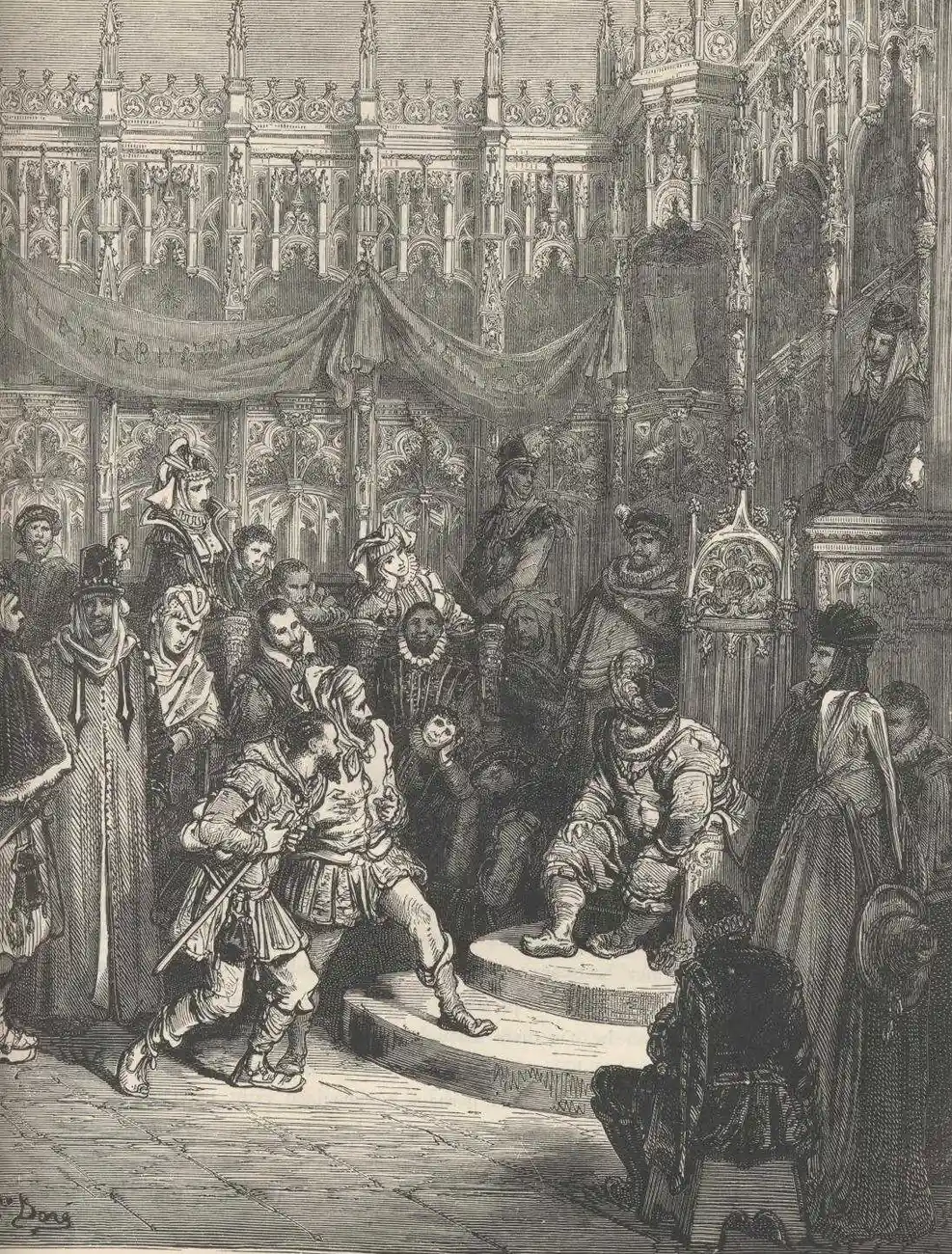
Sancho gets his island in Part Two, chapter 45, and it is a hoax: a market town lent to him by a duke for entertainment. He does not know that. What he does is sit down and start judging cases, and the first one is genuinely good.
An old man says he lent ten crowns to another old man, who will not repay. The debtor offers to swear he already handed the money back. As he raises his hand to take the oath he passes his walking stick to the creditor to hold, swears truthfully that he gave the money into the other man’s hand, then takes his stick back. Sancho watches this, sits in silence with a finger on his nose, then calls the man back and asks for the stick.
“He ordered the cane to be broken in two, there, in the presence of all. It was done, and in the middle of it they found ten gold-crowns.”
The bystanders call him another Solomon. Cervantes then does something better than leaving the compliment standing. Asked how he worked it out, Sancho explains the reasoning correctly, and then admits he had heard the village curate describe a case exactly like it. His memory, elsewhere in the book a liability, has done the work again. The court recorder is left in the position everybody in this novel eventually occupies: he “could not make up his mind whether he was to look upon him and set him down as a fool or as a man of sense.”
The other two cases that day are worth naming honestly. A tailor and a farmer argue over five caps made from one piece of cloth, and Sancho rules that the tailor loses his labour, the farmer loses his cloth, and the caps go to the prisoners in the town gaol. Between them sits a case in which a woman accuses a cattle dealer, a “poor pig dealer” by his own account, of rape, and Sancho decides against her by a test with a purse. It is a scene most modern readers find hard to take, and dressing it up as another clever verdict would be dishonest. It is in the chapter, and it is not one of the good ones.
His governorship ends in chapter 53, after a staged night attack, and he walks out on it. The exit speech is the best writing Cervantes ever gave him.
“A reaping-hook fits my hand better than a governor’s sceptre... naked I was born, naked I find myself, I neither lose nor gain.”
📝 Real Sancho lines, with the chapter attached
These are all from Ormsby’s 1885 translation, which is free at Project Gutenberg, and every one of them is checkable in about thirty seconds. Modern translations word them differently, so the sense is what carries over.
- “Each of us is as God made him, aye, and often worse.” Part 2, chapter 4.
- “A sparrow in the hand is better than a vulture on the wing.” Part 2, chapter 12.
- “Whether the pitcher hits the stone, or the stone the pitcher, it’s a bad business for the pitcher.” Part 2, chapter 43.
- “There’s a remedy for everything except death.” Part 2, chapter 43, and borrowed by his master in chapter 64.
- “Naked I was born, naked I find myself, I neither lose nor gain.” Part 2, chapter 53.
- “Good luck betide him that invented sleep, the cloak that covers over all a man’s thoughts.” Part 2, chapter 68.
The last one is worth reading whole. It runs on for a paragraph, calling sleep the food that removes hunger, the fire that warms the cold, and “the universal coin wherewith everything is bought, the weight and balance that makes the shepherd equal with the king and the fool with the wise man.” A squire who cannot read has just written the best lyric passage in a four-hundred-thousand-word novel, and a page later he is trampled by a drove of six hundred pigs. That is the joke the whole book runs on, and the essay on Sancho as the real hero takes it from there.
Sources
- Don Quixote, translated by John Ormsby (1885) — Project Gutenberg
- Sancho Panza — Encyclopaedia Britannica
Frequently asked questions
- What are some real Sancho Panza quotes from the book?
- Three worth keeping, all in Ormsby: each of us is as God made him, aye, and often worse (Part Two, chapter 4); praying to God and plying the hammer (chapter 71); a sparrow in the hand is better than a vulture on the wing (chapter 12). The last is a repeat. He first used it in Part One, chapter 31.
- Why does Sancho Panza use so many proverbs?
- He tells his master in Part Two, chapter 43 that he owns nothing else. The habit is also a sequel invention. Count the word proverb in Ormsby's text and it appears six times in the fifty-two chapters of Part One and fifty times in the seventy-four of Part Two. Cervantes built the running joke after his character was already famous.
- Does Don Quixote use proverbs too?
- Constantly, and there is a dated receipt for it. In Part Two, chapter 62, standing in a Barcelona printing house, he dismisses the fake sequel with a farmer's proverb: its Martinmas will come to it as it does to every pig. Five chapters later he asks Sancho to use fewer of them.
- What was Sancho's smartest decision as governor?
- The case of the cane, in Part Two, chapter 45, on an island the book actually names. It is Barataria, a walled village of about a thousand people, and the text offers two reasons for the name: the village may have been called Baratario, or it is named for the joke that gave him the job. The majordomo later makes him account for ten days of government.
- Are any of the famous inspirational Don Quixote lines real?
- The best known ones are not Cervantes. To dream the impossible dream comes from the 1965 musical, and the phrase tilting at windmills is not in the novel at all. The book is stingier than its reputation: the word windmill appears ten times in four hundred thousand words, and the giants are charged in a single chapter, Part One, chapter 8.
Enjoyed this one?