Who's Who in Don Quixote: the Duke and Duchess, Sansón Carrasco, Rocinante and the Rest
Everyone can name two characters in Don Quixote and a third who never appears. The other thirty are why the second half works: aristocrats who have read the book about him, a graduate who beats him in single combat, and two animals, one of whom was never actually named.


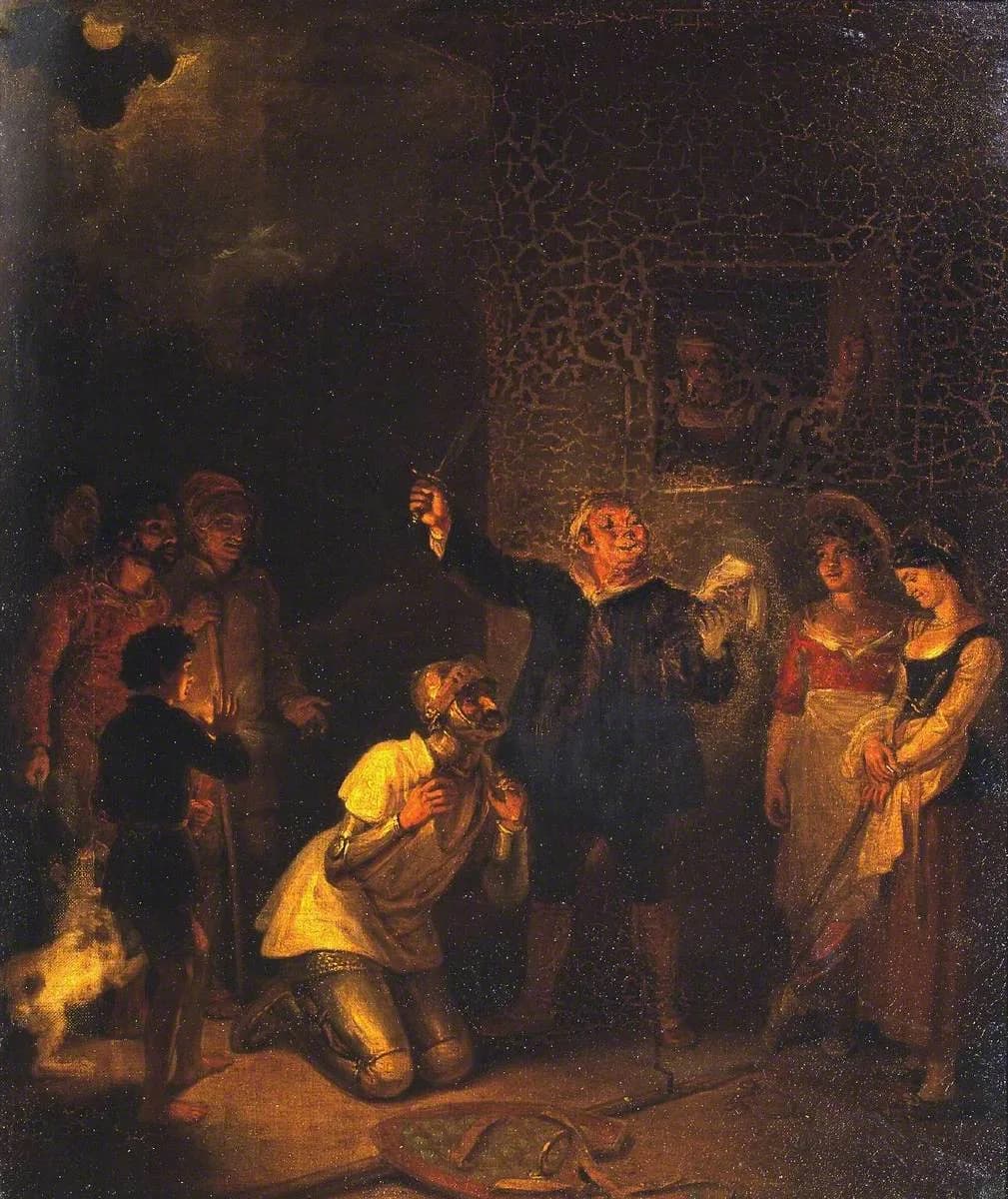
Almost everyone can name two characters in Don Quixote, and most people can name a third who never appears on stage. The other thirty or so are the reason the second half of the novel works, and one of them is the person who actually ends the story.
This is a guide to those people: the aristocrats who turn the book into a prank, the young neighbour who beats the knight in single combat, the four members of a household who burn his library, and the two animals who carry all of it. All of them can be met in the playable Don Quixote, which has a doorway for the Duke’s masquerade.
📕 In Part Two, the cast has read Part One
The single fact that organises everybody below is that Cervantes published his two halves ten years apart, and used the gap. In Part Two, the people Don Quixote meets have read the book about him. Samson Carrasco arrives in chapter 3 to tell him he is in print. The Duke and Duchess set their whole practical joke up in advance because, as the narrator says outright, they “had read the First Part of this history, and from it were aware of Don Quixote’s crazy turn.”
This changes what a supporting character is. In Part One they are obstacles he misreads: innkeepers, goatherds, galley slaves. In Part Two they are an audience, and most of them are performing back at him. He is no longer the only person in the book pretending.
👑 The Duke and Duchess, and what the narrator thinks of them
They are never given names. They meet Sancho and Don Quixote out hunting, recognise them from the book, and take them home for what turns into the longest single sequence in the novel. It runs from chapter 30 to chapter 57 of Part Two, with a return visit near the end, and it contains a fake enchanted princess, a wooden flying horse the guests are told is crossing the sky blindfolded, a hoax funeral, and an entire fake island for Sancho to govern with a staff and a doctor under orders to starve him.
Modern readers often find these chapters the hardest part of the novel, and they are right to. Cervantes agrees with them. Forty chapters after they arrive, the narrator reports Cide Hamete’s own verdict on the hosts.
“He considers the concocters of the joke as crazy as the victims of it, and that the duke and duchess were not two fingers’ breadth removed from being something like fools themselves when they took such pains to make game of a pair of fools.”
That sentence is the reason the Duke and Duchess are worth knowing about rather than skipping. They are rich, idle, and better read than anybody else in the book, and Cervantes uses them to point out that laughing at Don Quixote is itself a form of the disease. The Duchess is the sharper of the two and the only aristocrat in the novel who genuinely enjoys Sancho’s company. Altisidora, one of her maids, spends several chapters pretending to be in love with a man in his fifties as part of the same joke.
🎓 Samson Carrasco, the neighbour who ends it
Carrasco is introduced in Part Two, chapter 3 as a young man of “somewhere about four-and-twenty years of age,” sallow, sharp-witted, and, in Ormsby’s phrase, “a very great wag.” He has a degree from Salamanca and mentions it constantly. He arrives with the news that Don Quixote is a printed character, and he stays because he has decided to cure him.
His method is to beat him. He disguises himself as the Knight of the Mirrors, challenges him, and plans to impose a condition of going home. It goes wrong: Don Quixote wins, and Carrasco is left on the ground with broken ribs and a changed motive.
“It is not any wish that he may recover his senses that will make me hunt him out now, but a wish for the sore pain I am in with my ribs won’t let me entertain more charitable thoughts.”
He comes back in chapter 64, on the beach at Barcelona, as the Knight of the White Moon, and this time he wins. The condition he imposes is a year at home, and he explains afterwards that the hope is rest will do what argument could not. Whether he is a friend performing surgery or a humiliated graduate finishing a grudge is left for the reader. The text gives evidence for both.
- Samson Carrasco. Twenty-four, Salamanca-educated, fights him twice in disguise, and wins the fight that ends the book.
- The Duke and Duchess. Unnamed, rich, well read, and judged by the narrator to be as foolish as their victim.
- Cide Hamete Benengeli.The invented Moorish historian Cervantes credits with the whole story, and the source of most of the book’s asides about its own truthfulness.
- Ginés de Pasamonte.A galley slave freed in Part One who steals Sancho’s donkey, and returns in Part Two disguised as Master Pedro the puppeteer.
- Teresa Panza.Sancho’s wife, who gets two chapters of her own in Part Two and talks him out of nothing.
🔥 A curate, a barber, a niece and a housekeeper
Four people share a house with Don Quixote and try to manage him, and all four are named or numbered in the first chapters. The curate is Licentiate Pero Pérez. The barber is Master Nicholas. The niece is under twenty and the housekeeper is past forty, and both of them are given lines that are funnier than the men’s.
They are the ones who go through the library deciding what burns, a scene that belongs to its own essay on this hub. What matters for a cast guide is that the curate and the barber never stop. They follow him into the mountains in disguise, invent a princess to lure him home, and eventually carry him back in a cage on an ox-cart. The most persistent characters in the novel are two middle-aged villagers running an intervention.
Sancho’s family produces the novel’s best-known continuity error, and Cervantes turned it into a joke on his plagiarist. In Part One, chapter 7, Sancho names his wife twice in one conversation, seven lines apart, first as Juana Gutierrez and then as Mari Gutierrez. She is Teresa Panza for the whole of Part Two. And in chapter 59 Don Quixote picks up the unauthorised sequel and condemns its author for calling her Mari Gutierrez, “when she is called nothing of the sort.” He is objecting to a mistake his own author made first. The unauthorised sequel has an essay to itself here.
🐴 Four days to name the horse. The donkey never got one.
Rocinante is named in the first chapter, and Cervantes times it. “Four days were spent in thinking what name to give him,” because a famous knight’s horse cannot go unnamed. The word is built out of rocín, a worn-out nag, and the sense of “formerly”: the foremost nag in the world, and previously just a nag. Don Quixote then spends eight days more choosing his own name. He gives the horse half the deliberation he gives himself, which is the most flattering thing anybody does for an animal in this novel.
Sancho’s donkey is a different case, and most character lists get it wrong. English readers know the animal as Dapple, and the name appears 118 times in Ormsby’s translation. Search the Spanish and there is no name there at all. The word is rucio, which appears 119 times and is never once capitalised. Usually it carries an article,el rucio, the grey one. Sancho settles the matter himself when he calls it a colour: rucio es el color de mi jumento, grey is the colour of my donkey. Ormsby capitalised a description and English has treated it as a name ever since.
The donkey earns it anyway. He is stolen by Ginés de Pasamonte in Part One and returned later, Sancho grieves for him out loud, and by Part Two he is the only member of the party with no ambitions. Counted in Ormsby’s text, the grey turns up 118 times against Rocinante’s 208. The knight gets a horse he named over four days and a squire’s grey he never bothered to name, and the grey outlasts almost everyone.
Dulcinea, who is neither in this list nor quite absent from the book, has her own essay here, and Sancho’s own way of talking is covered separately. Every name and count above comes from Ormsby’s 1885 translation, free at Project Gutenberg, checked against the Spanish text where the point was a word.
Sources
- Don Quixote, translated by John Ormsby (1885) — Project Gutenberg
- Don Quijote de la Mancha (Spanish text) — Project Gutenberg
- Limbus Company — Wikipedia
Frequently asked questions
- Who are the Duke and Duchess in Don Quixote?
- An unnamed aristocratic couple in Part Two who recognise Don Quixote from Part One and take him home for the novel's longest sequence, staging hoaxes at his expense. The cruellest is staffed with a named professional. The doctor posted to starve Sancho on his island is Doctor Pedro Recio de Aguero, of Tirteafuera. Sancho, in a rage, renames him Pedro Recio de Malaguero.
- Who defeats Don Quixote at the end of the book?
- Samson Carrasco, a twenty-four-year-old graduate from his own village, fighting in disguise as the Knight of the White Moon at Barcelona in Part Two, chapter 64. The first attempt, as the Knight of the Mirrors, failed and exposed the plot: his squire wears a pasteboard nose, and in chapter 14 Sancho recognises him as Tom Cecial, his own neighbour.
- What are the names of Don Quixote's horse and Sancho's donkey?
- The horse is Rocinante, named over four days. The donkey has no name: English readers know it as Dapple, but the Spanish is rucio, the grey one, never capitalised. Chapter 1 describes the horse before it names him, with more quartos than a real and more blemishes than the steed of Gonela, and still, in his master's eyes, better than Alexander's Bucephalus.
- What is Sancho Panza's wife called?
- She has four names. In Part One, chapter 7 Sancho calls her Juana Gutierrez and then Mari Gutierrez seven lines apart. She is Teresa Panza through Part Two, and in chapter 6 the narrator calls her Teresa Cascajo. Their daughter, who keeps one name throughout, is Sanchica.
- Is the Don Quixote in the game Limbus Company the same character?
- Only by name, and the twist runs the other way. Wikipedia's article on Project Moon's 2023 game records that the character called Don Quixote is textually Sancho, using the knight's name as an alias. It is one source and no games press coverage could be found, so treat the detail as unconfirmed beyond that.
Enjoyed this one?