The Fake Don Quixote Sequel: How Cervantes Answered Avellaneda Inside Part Two
In 1614 somebody else published the second part of Don Quixote, with a prologue calling Cervantes old, crippled and jealous. He was sixty-seven and had eighteen months to live. He could not sue, so he wrote the plagiarist into the book and had a notary take a statement.


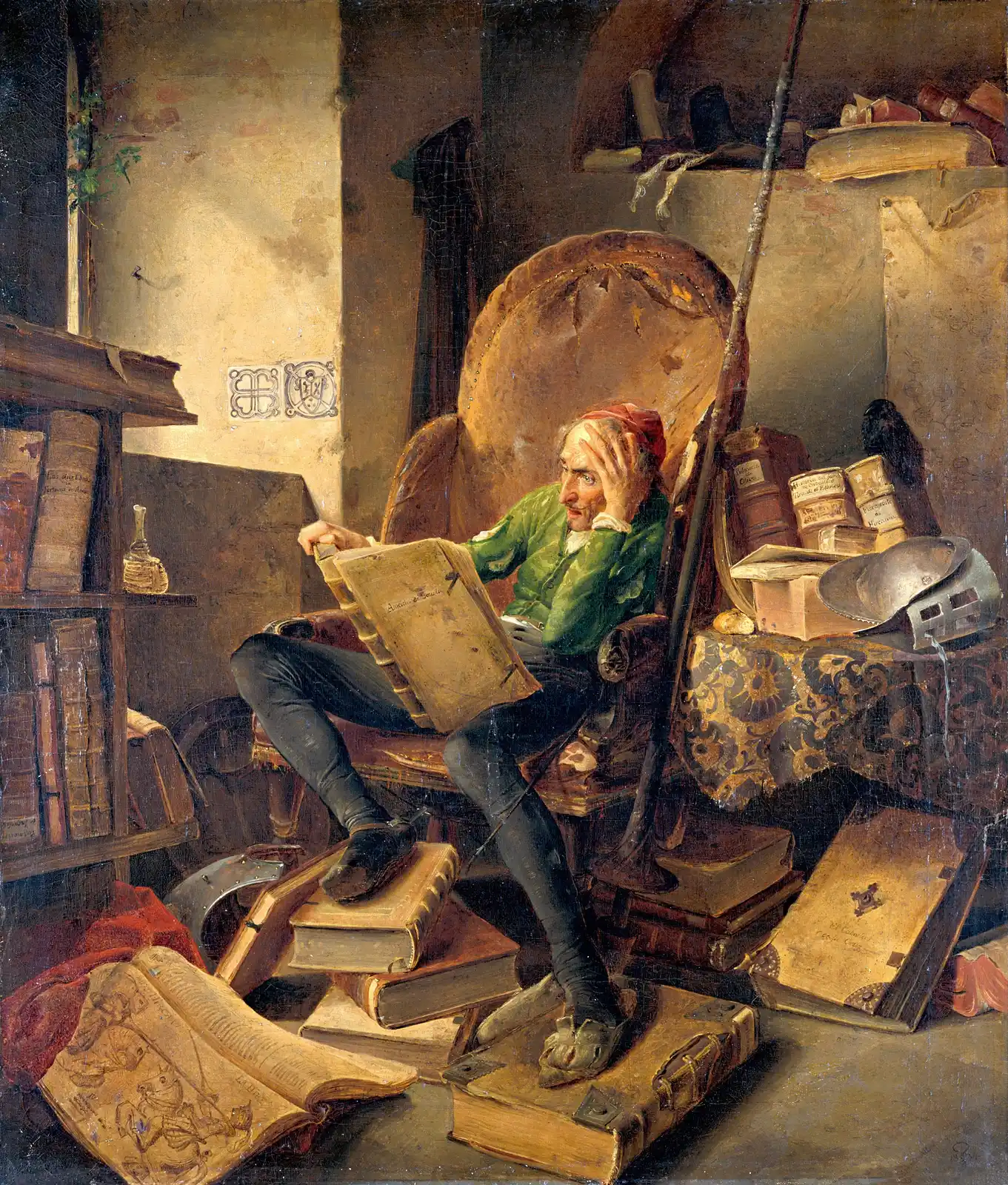
In 1614 a stranger published the second part of Don Quixote. Cervantes had not written it. He had been promising a continuation for nine years and had not delivered one, and somebody else got there first with a full sequel and a prologue that called Cervantes old, crippled and jealous. The title page named a licentiate from Tordesillas whom nobody has ever traced.
Cervantes was sixty-seven and had about eighteen months to live. What he did about it is the reason his novel finishes at all, and the reason literary critics keep calling a four-hundred-year-old comic novel modern. He did not go to court. He wrote the plagiarist into the book. You can walk the same road he sends his knight down in the playable Don Quixote.
📖 Somebody else published Part Two first
Part One appeared in 1605 and was a hit across Europe. Cervantes ended it with a vague promise of more and then spent a decade on other work. The volume that turned up in 1614 carried the name of a “Licentiate Alonso Fernández de Avellaneda, of Tordesillas” and, on its title page, the city of Tarragona. Both are probably inventions. No such licentiate has ever been traced and the actual printer is unknown.
John Ormsby, whose 1885 translation is the one quoted throughout this hub, reconstructed the moment it reached Cervantes: around October or November 1614, “a small octave lately printed at Tarragona” was put into his hand. Ormsby’s judgment of the book itself is short. He calls the author “at best, a poor plagiarist” and predicts that “dull and dirty” will remain the verdict of most readers.
The identity question has never closed. Wikipedia’s article on Avellaneda says flatly that there is no consensus. The most argued candidate is Jerónimo de Pasamonte, a real Aragonese soldier who fought at Lepanto and wrote an autobiography, proposed by Martín de Riquer and defended at length by Alfonso Martín Jiménez of the University of Valladolid. It is worth knowing why that name is tempting. A galley slave called Ginés de Pasamonte appears in Part One, is freed by Don Quixote, robs him, and comes back in Part Two disguised as Master Pedro the puppeteer. The theory is that Cervantes had already put his enemy in the book.
🗡️ What the fake prologue said, in Cervantes’ own words
The safest account of the insults is the one written by the man they were aimed at. Cervantes opens the preface to his own Part Two by telling the reader not to expect a fight, and then loses that argument with himself over the next paragraph.
“What I cannot help taking amiss is that he charges me with being old and one-handed, as if it had been in my power to keep time from passing over me, or as if the loss of my hand had been brought about in some tavern, and not on the grandest occasion the past or present has seen, or the future can hope to see.”
The grandest occasion is Lepanto, where Cervantes was shot three times and lost the use of his left hand. His reply is that a soldier’s scars “are stars that direct others to the heaven of honour” and that “it is not with grey hairs that one writes, but with the understanding.” He also objects to being called envious. Three charges, named by the target: age, the hand, envy. Secondary accounts add poverty and friendlessness. Cervantes does not, so this piece does not either.
He gets one joke in. He refuses to name Avellaneda and calls him instead the man “who was, they say, begotten at Tordesillas and born at Tarragona,” which turns the two invented place names on the fake title page into a slur about parentage.
⚖️ There was no lawsuit, because there was nothing to sue with
The version of this story that circulates online usually has Cervantes taking legal action. He did not, and the interesting part is that he could not. What a Spanish author held in 1614 was a privilegio, a royal licence to print a specific text in a specific kingdom for a fixed term. It stopped a rival printer running off copies of your book. It said nothing at all about somebody writing their own continuation of your story with your characters in it. The Statute of Anne, the first recognisable copyright law, arrived in 1710, in England.
Ormsby, writing three centuries later, reached the same conclusion and was blunter about it: “In fact Cervantes had no case, or a very bad one, as far as the mere continuation was concerned.” The end of Part One had all but invited a sequel. The grievance was the prologue, and there was no court for that.
✍️ So the revenge went inside the book
Part Two had already reached chapter 59 of its 74 when the fake caught up with him. Cervantes did not restart it. He absorbed the intruder into the plot in four moves, each of which can be found by chapter.
- Chapter 59.At an inn, two gentlemen are reading the false book. Don Quixote and Sancho hear themselves described. Sancho, called a glutton and a drunkard in it, objects that the Sancho in that history “must be different persons” from himself.
- Chapter 59, again.Told the fake Quixote attends jousts at Saragossa, the real one immediately cancels his own trip: “For that very reason I will not set foot in Saragossa.” He goes to Barcelona instead, and the plot of the last fifteen chapters exists because a rival author printed the wrong city.
- Chapter 62.Touring a Barcelona printing house, he finds workmen correcting proofs of the fake sequel and walks out with, in the narrator’s phrase, a certain amount of displeasure in his looks.
- Chapter 72.He meets Don Álvaro Tarfe, a character lifted straight out of Avellaneda’s book, and does something no novel had done before.
The chapter 72 scene is the one worth the price of admission. Don Quixote asks the traveller his name, recognises it from the false history, and asks whether he resembles the other Don Quixote. Álvaro Tarfe answers, “No indeed, not a bit.” Then Don Quixote asks him to put it in writing, and the machinery of a small Spanish town obliges.
“The alcalde of the village came by chance into the inn together with a notary, and Don Quixote laid a petition before him... The alcalde finally put it in legal form, and the declaration was made with all the formalities required in such cases.”
A fictional character, borrowed without permission from the book that stole him, swears before a magistrate that the hero of that book is an impostor. Cervantes then undercuts his own triumph in the next sentence, noting that the pair were delighted “as if a declaration of the sort was of any great importance to them.” He got the legal remedy he could not have in life, inside a fiction, and then made a joke about how little it was worth.
The last page finishes the job. Cide Hamete, the invented historian, is made to hang up his pen and warn off anyone who touches it, in language that stops being playful halfway through.
“For me alone was Don Quixote born, and I for him; it was his to act, mine to write; we two together make but one, notwithstanding and in spite of that pretended Tordesillesque writer.”
🏆 Why people call it the first modern novel
The phrase is repeated so often that it deserves a name attached to it. Harold Bloom says it. Carlos Fuentes said the modern world begins when Don Quixote leaves his village in 1605. The Conversation’s guide to the book, written by two academics at the University of Melbourne, carries the claim in its headline. It is a critical consensus, not a fact, and it is worth stating as one.
The Avellaneda affair is a large part of why. Part Two is a novel whose characters have read the novel about them, argue with its errors, meet people out of its unauthorised sequel, and visit the print shop where that sequel is being manufactured. That is not a modern technique borrowed by an old book. It is where the technique starts.
Honest rivals exist and are worth naming. Murasaki Shikibu’s The Tale of Genji, from eleventh-century Japan, is called the first novel on the strength of its psychological interiority, a case Ivan Morris made. Tirant lo Blanc, Catalan, 1490, has Mario Vargas Llosa calling it the first total novel. Cervantes himself put the case for it, through the curate, in the scene where they burn the library: “by right of its style it is the best book in the world. Here knights eat and sleep, and die in their beds, and make their wills before dying.” That is a definition of realism, written in 1605. And Ian Watt argued the case for Robinson Crusoe, 1719, as the first novel of ordinary daily life.
As for the popular vote: in 2002 the Norwegian Book Clubs asked one hundred writers from fifty-four countries to name the best books ever written, and Don Quixotewas set above the other ninety-nine. Ormsby’s last word on Avellaneda is the fairest one. Without the fake sequel, he wrote, the novel “would have come to us a mere torso instead of a complete work.” The plagiarist finished the book. The full text is free at Project Gutenberg, and the translation guide on this hub covers the paid editions.
Sources
- Don Quixote, translated by John Ormsby (1885) — Project Gutenberg
- Alonso Fernández de Avellaneda — Wikipedia
- How Don Quixote handled an unauthorized sequel — Plagiarism Today
- Spanish privilege, 1605 — Primary Sources on Copyright
- Guide to the classics: Don Quixote, the world's first modern novel — The Conversation
- Bokklubben World Library — Wikipedia
- Tirant lo Blanch — Wikipedia
- The Tale of Genji — Wikipedia
Frequently asked questions
- What was the fake Don Quixote sequel?
- A full-length second part published in 1614 under a name nobody has traced, a year before Cervantes finished his own. Its prologue attacked him personally, and that is what he resented. He answered by rerouting his knight: in Part Two, chapter 60 Don Quixote takes the road to Barcelona without touching upon Saragossa, to prove the new historian a liar.
- Who was Avellaneda?
- Nobody knows; the most argued candidate is Jerónimo de Pasamonte, and Cervantes never names him. He does stage the discovery. In Part Two, chapter 59 Don Quixote overhears two travellers in the next room of an inn discussing the fake sequel, answers them through the wall, and judges its author Aragonese because sometimes he writes without articles.
- Did Cervantes sue Avellaneda?
- No, and there was nothing to sue with. The novel prices what was actually protected: in Part Two, chapter 62 a self-publishing author at a Barcelona press expects a thousand ducats from two thousand copies at six reals apiece. A privilegio covered that edition, in one kingdom, for a term. It said nothing about somebody continuing your story.
- What happens in Part Two, chapter 72?
- Don Quixote meets Don Álvaro Tarfe, a character lifted out of Avellaneda's book, and gets him to swear before a magistrate that they have never met. The name reaches him by accident: a servant addresses his master by it as the party arrives at the inn. Tarfe then volunteers that he took the other Don Quixote to jousts at Saragossa.
- Why is Don Quixote called the first modern novel?
- It is a critical consensus rather than a fact, and the names are attachable: Harold Bloom, Carlos Fuentes, and academics writing for a general audience. What earns it is scenes like Part Two, chapter 70, where Altisidora describes devils playing tennis at the gate of hell with books for balls, one of them ordering the unauthorised sequel into the depths, told to the character it is about.
Enjoyed this one?