Is Don Quixote Worth Reading? Yes, and Which Translation to Pick: Grossman, Ormsby or Rutherford
Most people who bounce off Don Quixote bounce off it in a bookshop. A dozen English versions are in print and the spines do not tell you which one is funny. Here is which to buy, how long the book actually runs, and the pages the author himself expected you to skim.


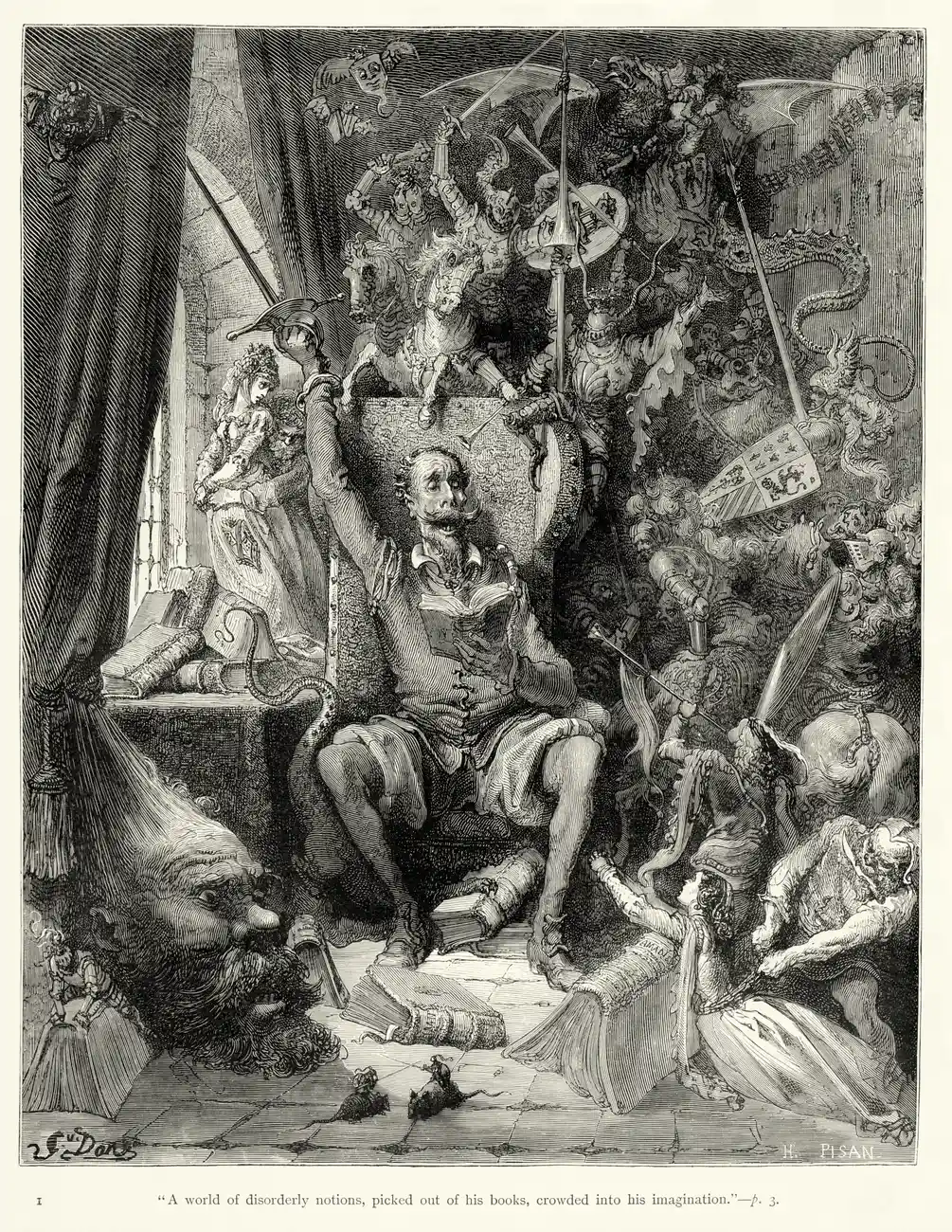
Most people who bounce off Don Quixote bounce off it in a bookshop, not on page one. There are a dozen English versions in print, four centuries of them, and the spines do not tell you which one is going to be funny. So the practical questions come first: which translation, how long, one book or two, and is the thing actually a comedy.
Short version. Buy Edith Grossman if you want the modern default, John Rutherford if you want the funniest English, and download John Ormsby free if you want to start tonight. The rest of this piece is the reasoning, and a first-time reader’s route through a book that is two books. If you would rather walk into it than read about it, the playable Don Quixote opens on the scene where his friends go through his library deciding what to burn.
📚 Four centuries of English Don Quixotes
The first English translation, by Thomas Shelton, appeared in 1612, seven years after the Spanish Part One and three years before Cervantes finished Part Two. Since then the book has been re-Englished roughly once a generation, and the versions disagree with each other about what kind of book it is. That is the useful thing to know before you buy one.
| Translation | What you get |
|---|---|
| Edith Grossman, 2003 (Ecco) | The modern default. Harold Bloom, in his introduction to this edition, called her the Glenn Gould of translators. Fluent, conversational, readable at speed. Some Cervantes scholars think it is too free with the text. |
| John Rutherford, 2000 (Penguin) | The funniest one. British idiom, comic timing preserved over literal fidelity. Won the Society of Authors’ 2002 Premio Valle-Inclán for translation from Spanish. |
| John Ormsby, 1885 | Free, public domain, complete with notes. Literal to a fault, which is exactly why it is the version quoted throughout this hub. Victorian in its vocabulary. |
| J. M. Cohen, 1950 (Penguin) | The Penguin before Rutherford, in print for fifty years. Plain and faithful. Some readers find it flat next to the newer two. |
| Burton Raffel, 1996 | Aimed squarely at making Cervantes easy for a modern reader. Shorter sentences than any of the others. |
| Thomas Shelton, 1612 and 1620 | The first in any language, done while Cervantes was still alive. A historical document rather than a reading edition. |
The one to avoid is easy to name, because the man who replaced it named it. Peter Motteux’s version, first published in 1700 and reissued in 1712, circulated for two hundred years and turned the novel into a joke book. Ormsby, translating in 1885, devoted several paragraphs of his introduction to it.
“To attempt to improve the humour of ‘Don Quixote’ by an infusion of cockney flippancy and facetiousness, as Motteux’s operators did, is not merely an impertinence like larding a sirloin of prize beef, but an absolute falsification of the spirit of the book…”
Motteux editions still turn up in cheap paperbacks and free ebook bundles because the copyright expired centuries ago. If a very cheap edition does not name its translator, that is usually what it is. Ormsby is equally free and much better, which is why Project Gutenberg is a better free source than a marketplace listing.
🗓️ One novel, published ten years apart
Cervantes published Part One in 1605 and Part Two in 1615. Every modern edition prints them together as one book, and they read as one book, but the gap is the single most interesting structural fact about the novel. In those ten years Part One became famous, and Part Two is written by a man who knows it. His characters know it too. In Part Two the people Don Quixote meets have read about him.
Part of what happened in the gap was a stranger writing a fake Part Two first, in 1614, which Cervantes then answered inside his own. That story has its own essay on this hub. For a first reader the practical consequence is simple: do not treat Part Two as a sequel you can skip. It is the better half.
📏 How long it actually is
Counted from the Gutenberg text of Ormsby’s English, with chapter headings and plate captions stripped out, the novel runs to about 400,000 words across 126 chapters: 52 in Part One and 74 in Part Two. That is long by any measure. It is also 126 separate short pieces, most of them under three thousand words, which makes it a much easier book to read in twenty-minute stretches than its brick-like paperback suggests.
The prose itself is not difficult. Here is the first sentence, in Ormsby, unaltered.
“In a village of La Mancha, the name of which I have no desire to call to mind, there lived not long since one of those gentlemen that keep a lance in the lance-rack, an old buckler, a lean hack, and a greyhound for coursing.”
🎭 It is a comedy that turns sad, not a sad book
People arrive at Don Quixote expecting a noble old dreamer and a wistful tone, mostly because of a 1965 musical whose most famous lines are not in the novel at all. Those lines get their own essay here. What is actually on the page for most of its length is slapstick, and fairly brutal slapstick at that. Sancho gets tossed in a blanket. A herd of six hundred pigs runs over both of them while they sleep. Don Quixote attacks a puppet theatre and destroys the cast.
The sadness is real, but it is concentrated, and it arrives late. The last few chapters change the temperature of the whole book, and the argument about what they mean belongs to the essay on Sancho, which is where the ending is discussed properly. A first-time reader should know only this much: the funny book is the real book, and the grief at the end lands because you spent a very long time laughing first.
🧭 How to actually get through it
Cervantes worried about this himself, and left instructions in the text. At the opening of Part Two, chapter 44, the narrator reports a complaint from Cide Hamete, the fictional Moorish historian credited with the story: he had padded Part One with self-contained novellas, and he had noticed that readers skipped them.
“He also thought, he says, that many, engrossed by the interest attaching to the exploits of Don Quixote, would take none in the novels, and pass them over hastily or impatiently…”
So he cut them. Part Two contains no interpolated novels at all. That is the author, in 1615, giving you permission to skim the long inset tale called The Ill-advised Curiosity in Part One, chapters 33 to 35, on a first pass. Come back for it later if you want. Nothing in the main story depends on it.
- Read Part One first, obviously, but read Part Two. Everyone who loves this book loves the second half more.
- Skim the inset novella in chapters 33 to 35 if it stalls you. Cervantes expected you to.
- Take the chapter headings as jokes. They are written by the narrator and they lie, on purpose.
- Twenty minutes a night works. The chapters are short and almost every one is a self-contained scene.
✅ So which one should you pick
If you buy one book, buy Grossman. It is the version most editions, courses and reading groups now assume, and Bloom’s introduction is a real essay rather than a jacket note. If you want the version that makes people laugh out loud on public transport, buy Rutherford. If you want to start in the next two minutes and pay nothing, take Ormsby from Project Gutenberg, which is the text every quotation on this hub comes from, chapter numbers and all.
One warning that applies to all of them. The curate in Part One, chapter 6 praises a rival romance for a reason that sounds oddly modern: in it, he says, knights “eat and sleep, and die in their beds, and make their wills before dying.” Cervantes was already thinking about realism as a technique in 1605. Whichever translation you pick, that is the joke you are reading for, and a version that flattens the comedy into whimsy is not saving you any time.
Sources
- Don Quixote, translated by John Ormsby (1885) — Project Gutenberg
- John Ormsby (translator) — Wikipedia
- Edith Grossman — Wikipedia
- Hamilton Cain on Edith Grossman's translation of Don Quixote — National Book Critics Circle
- Premio Valle-Inclán — Wikipedia
- Thomas Shelton (translator) — Wikipedia
- Peter Anthony Motteux — Wikipedia
- J. M. Cohen — Wikipedia
Frequently asked questions
- Which Don Quixote translation is considered the best?
- There is no single winner, but there is a sensible default. Edith Grossman's 2003 version is the one most editions and courses now assume; John Rutherford's 2000 Penguin won the Premio Valle-Inclan. The novel is itself a translation joke. In Part 1, chapter 9 the narrator hires a Morisco to render Cide Hamete's Arabic manuscript, and pays him two arrobas of raisins and two bushels of wheat.
- Is Don Quixote one book or two?
- One novel published in two instalments, ten years apart. Part One appeared in 1605 and Part Two in 1615, and every modern edition prints them together. The halves are not the same size. Part One runs about 197,000 words across 52 chapters; Part Two about 207,000 across 74, so the shorter chapters carry the longer book.
- How long does Don Quixote take to read?
- Counted from the Gutenberg text of Ormsby's translation with headings stripped out, it runs about 400,000 words across 126 chapters. The last one, chapter 74, in which he recovers his wits and dies, is 2,570 words. Most chapters are that size, so twenty minutes a night gets you through in about three months.
- Is it acceptable to skip parts of Don Quixote?
- Cervantes thought so. At the start of Part Two, chapter 44, the narrator reports that readers had skipped the self-contained novellas inserted into Part One, so he left them out of Part Two entirely. That is permission to skim The Ill-advised Curiosity in Part One, chapters 33 to 35, which runs to about 19,000 words, a tenth of Part One.
- Is Don Quixote really the best-selling book of all time?
- The figure everyone cites, around 500 million copies, has no audited source. Wikipedia's own list of best-selling books excludes numbers of that kind, because pre-modern print runs rest on estimates rather than sales records. The novel gives its own figure, and it is a joke: in Part Two, chapter 3, Sanson Carrasco tells Don Quixote there are more than twelve thousand volumes of his history in print.
Enjoyed this one?