Is Don Quixote Mad, or Performing? What the Helmet of Mambrino Scene Actually Shows
A barber rides home in the rain with a shaving basin on his head. Don Quixote takes it, puts it on, and complains that half the helmet is missing. A man who cannot tell a basin from a helmet does not notice that the helmet is the wrong shape.


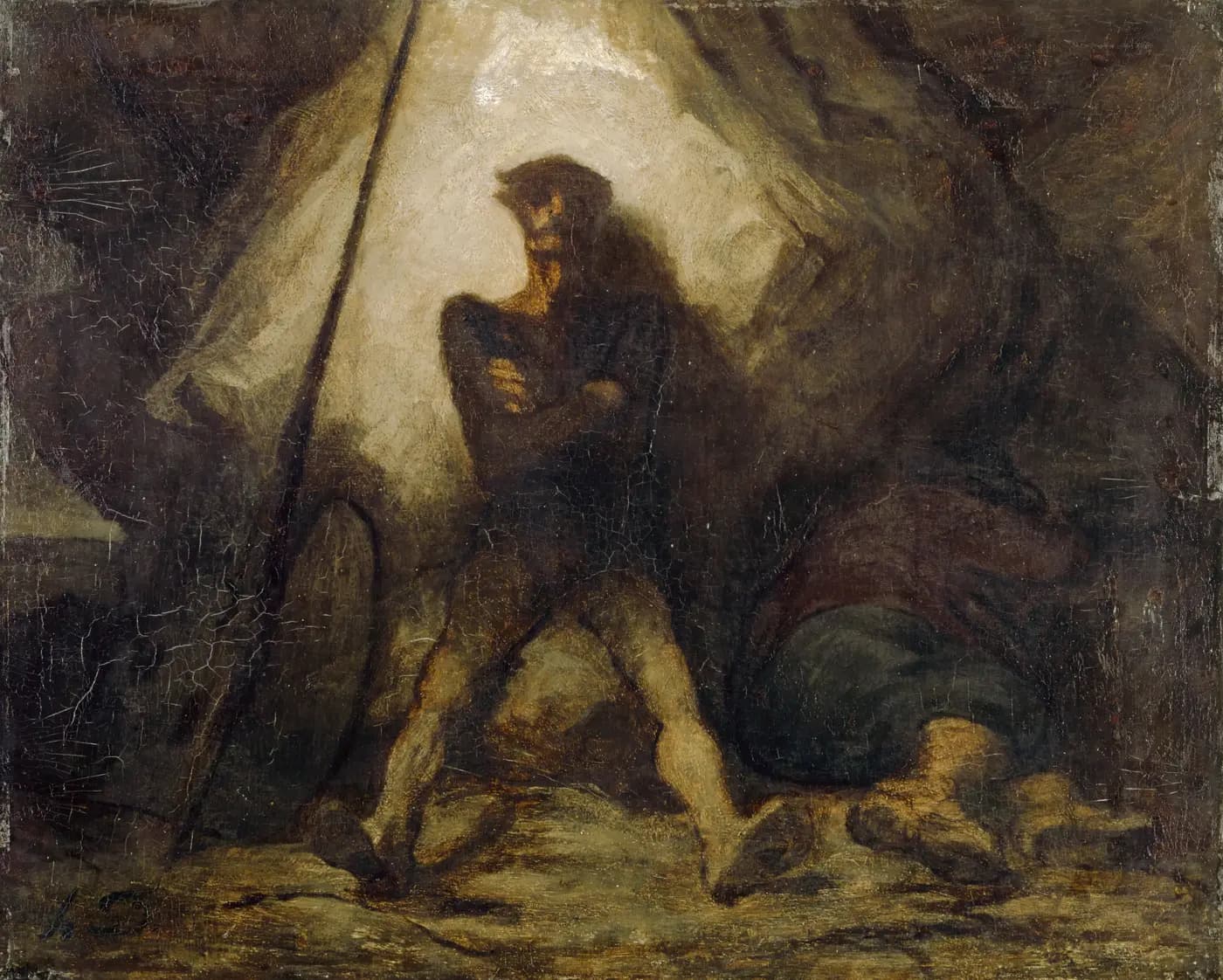
A barber is riding home in the rain with a brass shaving basin on his head to keep his hat dry. Don Quixote charges him, takes the basin, puts it on, turns it round looking for the fit, and delivers a verdict that has been quietly bothering readers for four hundred years. The helmet, he says, must have been made for a very large head. And then he adds that half of it is missing.
A man who cannot tell a basin from a helmet does not notice that the helmet is the wrong shape. The scene is the clearest place in the novel to ask what is actually wrong with him, and the answer the text keeps giving is more interesting than either of the easy ones. You can walk into that exact scene in the playable Don Quixote, where Mambrino’s Helmet is one of the doorways.
🪖 The basin is a basin, and he half says so
Cervantes stages the scene twice over. First Don Quixote describes what he sees: a knight on a dappled grey steed wearing a golden helmet. Sancho, standing next to him, is asked to confirm it.
“What I see and make out is only a man on a grey ass like my own, who has something that shines on his head.”
Then the narrator, in his own voice, explains the whole thing in a paragraph of flat domestic detail. There are two villages. The smaller has no barber. A man in it needed bleeding and another needed shaving. It began to rain and the barber put the basin on his head to protect a probably-new hat. Cervantes does not leave the reader inside the delusion for even one page.
What follows is the part that does not fit a simple madness. Don Quixote puts the basin on, cannot make it sit, and reasons out loud.
“Clearly the pagan to whose measure this famous head-piece was first forged must have had a very large head; but the worst of it is half of it is wanting.”
He then constructs an explanation for the missing half: someone who did not know what it was melted down one part for the gold and made the rest into something basin-shaped. He finishes by saying that to him, knowing what it is, “its transformation makes no difference.” That is not the sentence of a man who cannot see the object. It is the sentence of a man doing maintenance on a story.
🎯 He tells Sancho he is not mad in earnest yet
Four chapters later, in the Sierra Morena, Don Quixote announces a penance, and cannot decide whose. Amadis of Gaul wept and prayed. Roland tore up trees, killed shepherds and burned huts. Don Quixote weighs the two out loud and tells Sancho he will “follow Roland rather than Amadis in my penance.” Sancho points out, reasonably, that those knights had reasons. Nobody has rejected Don Quixote. Nothing has happened. The reply is the single most quotable sentence in this argument.
“There is the point, and that is the beauty of this business of mine; no thanks to a knight-errant for going mad when he has cause; the thing is to turn crazy without any provocation…”
He is describing a performance and grading it. A few lines later he goes further and draws a line between where he is now and somewhere else he could end up. He tells Sancho that he is mad and must stay mad until Sancho returns with an answer from Dulcinea, and that if the answer is the wrong one he “shall become mad in earnest.” The phrase only means something if the current state is a different thing.
A chapter later he settles the question alone on top of a rock, and Cervantes lets us watch him do it. He is weighing, in his own words, whether to imitate “the outrageous madness of Roland, or the melancholy madness of Amadis.” He rules Roland out on a technicality. Roland went mad because Angelica betrayed him, and Dulcinea has done nothing, so he cannot imitate Roland in his madness “unless I can imitate him in the cause of it.” He settles on Amadis, who got the same fame for weeping, and then goes looking for something to use as a rosary. That is a man selecting a madness on the merits.
The same chapter carries his other explanation, the one he falls back on whenever the world contradicts him: enchanters follow knights-errant about, changing how things look. What looks like a basin to Sancho is a helmet to him because a friendly sage disguised it so that nobody would steal it. The theory is airtight and unfalsifiable, and he built it himself.
🎭 He wrecks the puppet show, then settles the bill
The strongest evidence is in Part Two. At an inn, a travelling showman called Master Pedro performs a puppet play about a knight rescuing his wife from the Moors. Don Quixote, watching, draws his sword and destroys the puppets to save her. Everyone present sees a man attack a box of dolls.
What he does next is the interesting part. He explains that enchanters put the figures before his eyes and made them look real, and then he offers to pay.
“I am willing to condemn myself in costs for this error of mine, though it did not proceed from malice; let Master Pedro see what he wants for the spoiled figures, for I agree to pay it at once in good and current money of Castile.”
The innkeeper and Sancho are appointed appraisers. Master Pedro picks the pieces off the floor and prices them. King Marsilio of Saragossa, beheaded, comes to four reals and a half. Don Quixote listens to the itemised invoice, in a legal frame he supplies himself, and pays. He can hold the enchantment and the arithmetic in the same head at the same time, and the arithmetic is correct.
- The vigil, Part 1 chapter 3. The inn has no chapel, so the innkeeper suggests the yard, and the armour is laid on a water trough. He accepts the substitution.
- The basin, Part 1 chapter 21. He notices the helmet is half a helmet and invents a reason.
- The penance, Part 1 chapters 25 and 26. He states that going mad without a cause is the more impressive version, then sits on a rock and picks which madman to copy.
- The puppets, Part 2 chapter 26. He pays for the damage, priced piece by piece, in cash.
🗳️ The inn takes a vote, and Sancho invents a word
Late in Part One the barber turns up at the inn and asks for his basin back. What follows is a set-piece in which everyone who knows Don Quixote decides to humour him, and a group of strangers who do not know him watch in disbelief. One of the strangers finally loses patience.
“All the people in the world will not make me believe that this is not a barber’s basin and that a jackass’s pack-saddle.”
In the middle of that argument Sancho does something Cervantes lets him do exactly once. He fuses the two words. Ormsby renders it “basin-helmet”; the Spanish is baciyelmo, from bacía and yelmo, and a search of both texts finds the word one single time in each. Sancho, who is not clever in the way the educated characters are clever, has invented the exact term for an object that is genuinely both things depending on who is holding it. Nobody in the scene notices.
🩺 The people who have tried to diagnose him
Vladimir Nabokov, whose Harvard lectures on the novel were published in 1983, took the hardest line available. Writing in the Claremont Review of Books, the critic quoting him records the verdict that both parts “form a veritable encyclopedia of cruelty” and that the book is “one of the most bitter and barbarous books ever penned.” On that reading the madness is real, the laughter is at a sick man, and the performance argument is a way of making a brutal book comfortable.
Physicians have taken the question literally for at least sixty years. The Annales Médico-Psychologiquesran a paper on Cervantes and psychiatry in 1964. The Spanish Royal Academy of Medicine’s Anales published two studies in 2005 alone, one of which notes the long habit among doctors of diagnosing the knight as a monomaniac. Australasian Psychiatry returned to him in 2014. Four centuries on, a fictional gentleman from La Mancha still gets written up in medical journals, and they do not agree with each other.
The performance reading, by contrast, does not need a critic to carry it, and this piece has not found one worth quoting. It only needs the sentences above, in order.
⚖️ Why Cervantes leaves it open
Because the ambiguity is doing the work. If Don Quixote is simply ill, the novel is four hundred thousand words of hitting a sick man with sticks, which is Nabokov’s objection. If he is simply pretending, nothing costs him anything and the ending has no weight. The book stays readable because he is somewhere in between, and because the people around him keep having to decide how to treat a man in that position.
Cervantes says as much through minor characters. When two gentlemen spend an evening with him in Part Two, chapter 59, they go to bed “amazed to see the medley he made of his good sense and his craziness.” Medley is the word. The reason his brain went the way it did is a separate essay on this hub, and what happens at the very end belongs to the one about Sancho. Both are worth reading after this one. All the quotations above come from Ormsby’s translation, free at Project Gutenberg.
Sources
- Don Quixote, translated by John Ormsby (1885) — Project Gutenberg
- Don Quijote de la Mancha (Spanish text) — Project Gutenberg
- Laughing with Don Quixote — Claremont Review of Books
- Discreet follies. Variations on Don Quixote's folly (PMID 16173694) — Anales de la Real Academia Nacional de Medicina
- Two scripts of madness (PMID 24191296) — Australasian Psychiatry
Frequently asked questions
- Was Don Quixote actually mad?
- Cervantes never settles it, and the text is built so that it cannot be settled. He hallucinates armies and castles, and he also notices that his golden helmet is half a helmet, tells Sancho he is not yet mad in earnest, and pays a puppeteer for the damage he does. Chapter 1 gives one hard fact about him: he was bordering on fifty.
- What is Mambrino's helmet in Don Quixote?
- A barber's brass shaving basin. In Part 1, chapter 21 a village barber puts it on his head to keep the rain off his hat, and Don Quixote charges him for it, believing it to be the golden helmet of a Moorish king out of the chivalry romances. The name sticks: Mambrino appears fifteen times in the novel, and the object is a basin in every one of them.
- What does baciyelmo mean?
- It is a word Sancho invents in Part 1, chapter 44, fusing bacia, a basin, with yelmo, a helmet. Ormsby renders it basin-helmet, and it occurs exactly once in each text. The argument is settled off the page: later in Part One the barber is paid eight reals for the basin and signs a receipt. The word basin appears forty times in the novel.
- Have psychiatrists ever diagnosed Don Quixote?
- Repeatedly, and they disagree. The Annales Medico-Psychologiques ran a paper on Cervantes and psychiatry in 1964. The Spanish Royal Academy of Medicine's Anales published two studies in 2005. Australasian Psychiatry returned to the question in 2014. The novel supplies its own diagnosis in chapter 74: the doctor's opinion was that melancholy and depression were bringing him to his end.
- Does Don Quixote know Dulcinea is a farm girl?
- He says so directly to Sancho in Part 1, chapter 25, and argues that it makes no difference, because a knight's lady is a role rather than a person. The novel is blunter still. Aldonza Lorenzo is a very good-looking farm-girl he was once in love with, who, so far as is known, never knew it nor gave a thought to the matter.
Enjoyed this one?