Mina vs Lucy: Why Dracula Rewards One Woman and Stakes the Other
Dracula has two young women in it and does opposite things to them. The novel states its own criterion out loud in chapter XVIII, in the mouth of its wisest character, and then spends four hundred pages applying it. The critical name for what Stoker is reacting to is the New Woman.


Dracula has two young women in it and does two opposite things to them. One is drained, killed, buried, dug up, and destroyed by the men who loved her. The other survives, is thanked, and is the woman the last page of the novel is about. Readers have argued for a century about whether that is a moral or an accident, and the case is easier to judge once you notice that the book states its own criterion out loud, in chapter XVIII, in the mouth of its wisest character.
- Mina gets the compliment. Van Helsing calls her brain the brain a gifted man should have.
- Then she gets sent home.The same speech ends with “it is no part for a woman”.
- Lucy asks for one thing. To be allowed to marry three men, in a joke she immediately retracts.
- The novel takes the joke seriously. Four men give her blood, and one of them counts it as a marriage.
Lucy’s illness, as a story of a decline nobody names in time, is a companion post’s subject and is not re-told here. If you would rather be in the room where the men decide what to do about her, the playable Dracula opens the transfusion as one of its doorways.
⚖️ The short answer: the compliment and the door
Mina has just given Dr. Seward the idea that saves the investigation. Seward tells him about it on the drive back from the station. The professor’s response is the most quoted sentence anyone says about her, and almost nobody quotes the rest of the paragraph.
“Ah, that wonderful Madam Mina! She has man’s brain—a brain that a man should have were he much gifted—and a woman’s heart.”
Three sentences later, in the same speech, he decides that after tonight she must have nothing more to do with the affair, because the men are pledged to destroy the monster and it is no part for a woman. His reasons are her nerves, her dreams, and the fact that she is young and not long married. The compliment and the exclusion are one continuous thought. He is not contradicting himself; he is applying a rule.
The rule is that a woman’s ability is admirable exactly as far as it serves. Mina is the most useful person in the book, and the reward for usefulness is being told to go to bed. Everything that happens to her afterwards, including the worst thing, happens because she was excluded from the room where the men were making plans.
👒 The New Woman, and Mina’s joke about her
The phrase did not come from critics reading Dracula a century later. It was already current while Stoker was writing. Sarah Grand’s essay “The New Aspect of the Woman Question” appeared in the North American Review in March 1894 and is generally credited with putting the term into circulation, and by the mid-1890s the New Woman meant an educated, financially independent woman who did not treat marriage as the whole of her future.
Stoker puts the phrase in Mina’s own mouth, twice, in chapter VIII, in scare quotes, while she is on holiday in Whitby. She jokes that she and Lucy would have shocked the New Woman with the size of their tea. A few lines later she predicts that the New Woman will not condescend to accept a proposal in future and will do the proposing herself, and adds that she will make a nice job of it too.
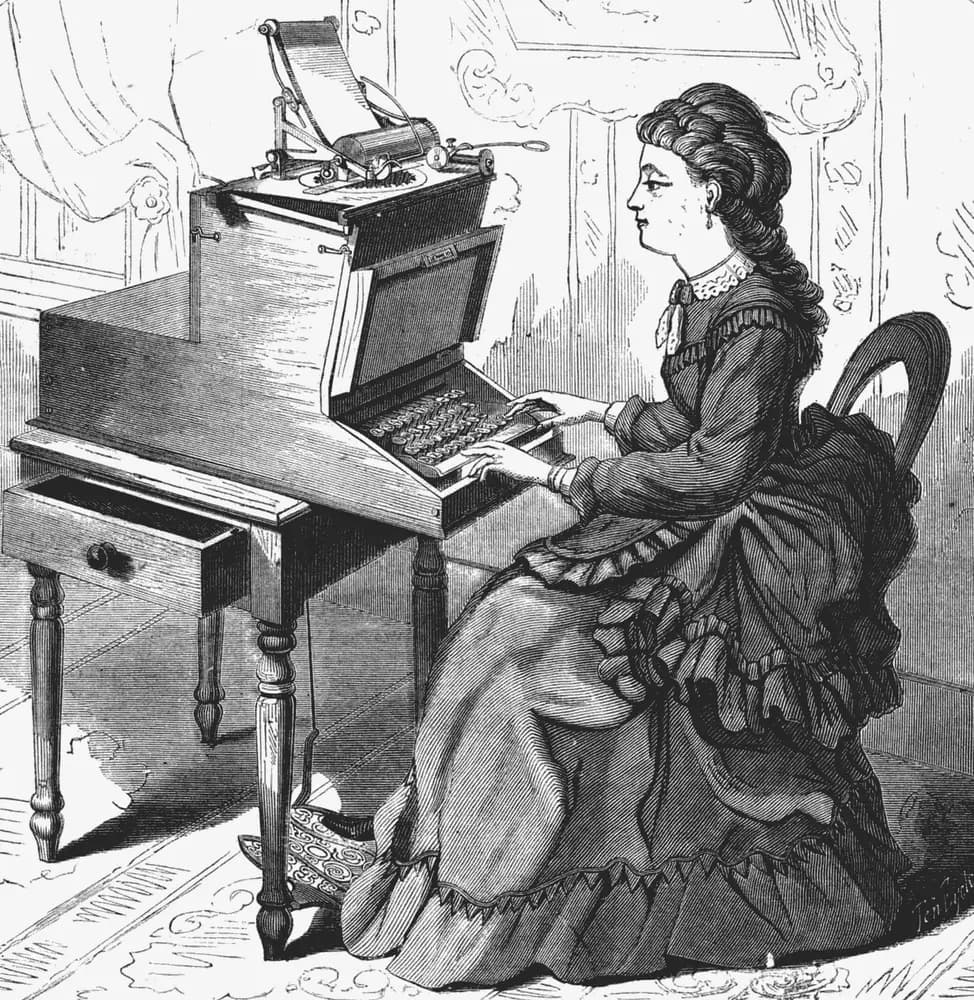
This is Stoker having it both ways in a single paragraph, and it is exactly what Carol A. Senf identified in her 1982 essay “Dracula: Stoker’s Response to the New Woman” in Victorian Studies. Mina teases the figure and is the figure. She is a working woman: an assistant schoolmistress who taught herself shorthand and typewriting, which in the 1890s was the fastest-opening professional door women had. American stenographers and typists went from about 40 per cent female in 1880 to over 75 per cent by 1900. By 1901, 99 per cent of typists in Scotland were women. Mina reads as an eccentric only if you do not know the numbers. She was one of thousands.
⌨️ The skill that makes her indispensable
There is a small scene in chapter XIV that gives the whole game away. Van Helsing asks to read Mina’s journal. She hands him the shorthand original, as a joke, because she has already guessed what he wants. He opens it, his face falls, and he stands up and bows.
“Oh, you so clever woman!… Alas! I know not the shorthand.”
She then produces the typewritten copy she had already made for him. The most advanced scientist of his day cannot read the notes of an assistant schoolmistress, and she is the one who apologises, and says she was almost ashamed of her little joke.
What her machines do to the plot is a separate argument on this hub. What matters here is the shape of the exchange. She anticipates the need, meets it before it is stated, makes a joke small enough to be forgiven, and takes the blame for making it. That is the behaviour the book rewards, and Lucy never learns it.
🌹 What Lucy asks for, and what she gets
Lucy, who tells Mina she will be twenty in September, receives three proposals in a single day in chapter V and is genuinely distressed about turning two of them down. She writes to Mina about it and lets one sentence escape.
“Why can’t they let a girl marry three men, or as many as want her, and save all this trouble? But this is heresy, and I must not say it.”
She retracts it in the same breath, which is what makes it worth noticing. She knows the thought is not allowed. She has it anyway, and she writes it down, which is more than Mina ever does.
The novel then does something no summary quite prepares you for: it grants the wish and turns it into the punishment. Four men give Lucy their blood, in an era when nobody yet knew that blood came in incompatible types. Arthur says afterwards that the transfusion made him feel they had been really married, that she was his wife in the sight of God. Van Helsing, alone with Seward in a carriage, laughs until he cries at the arithmetic: if that is true then what about the other three, and this so sweet maid is a polyandrist. The joke Lucy was not allowed to make is made about her, at her funeral, by the men who drained her.
And when they see her again in chapter XVI, the description is not about blood at all.
“Lucy Westenra, but yet how changed. The sweetness was turned to adamantine, heartless cruelty, and the purity to voluptuous wantonness.”
Purity and wantonness are not medical categories. That sentence is about a woman who has stopped being respectable, written by a man who is horrified and cannot look away. Mina is never described in those words, at any point, including the chapters in which she has drunk the Count’s blood.
🤔 So which reading is right?
Both are defensible and the argument is still live. On one side, the book gives its most capable brain, its best judgement and its final pages to a woman, at a time when it did not have to. Mina is the only character who holds the whole picture, and the men lose ground every time they decide to protect her from it. Read that way, Dracula is more generous to women than nearly anything else on the shelf beside it.
On the other, the generosity has a condition attached. Mina’s gifts are praised in a man’s vocabulary, deployed in a man’s service, and withdrawn the moment they might make her a participant rather than a resource. Lucy, who wants something on her own account and says so once, is written into a body the novel can call wanton and then destroy in front of four men, one of whom does the destroying.
The honest verdict is that Stoker did not settle it either. He wrote a heroine who is a New Woman and a villainess who is punished for appetite, published them in the same book in 1897, and left the arrangement for readers to argue about, which is what has happened continuously since. The full text is free at Project Gutenberg and the rest of the cast, including the two men nobody remembers, is set out here.
Sources
- Dracula (1897 text) — Project Gutenberg
- Bram Stoker: Modern Criticism (Senf on the New Woman) — Victorian Fiction Research Guides
- New Woman — Wikipedia
- Typewriters, women, and the advancement of workplace equality — National Museums Scotland
Frequently asked questions
- What does “man's brain, woman's heart” mean in Dracula?
- Van Helsing says it about Mina in chapter XVIII, meaning that her intelligence equals a gifted man's while her sympathy stays womanly, and he uses the same speech to bar her from the hunt. The bar does not hold. By chapter XXIII the men need her back, because the Count's blood has made her hypnotisable and she is the only instrument they have for finding him.
- Why does Lucy die and Mina survive in Dracula?
- The men do broadly the same things for both women and get opposite results, so the novel draws the difference in the women themselves. It also draws it on Mina's body. In chapter XXII the Sacred Wafer sears her forehead, and the mark stays until the last page, where Quincey Morris uses his dying breath to say the curse has passed away.
- What is the “New Woman” in Dracula?
- A real 1890s figure: educated, financially independent, and not treating marriage as her whole future. Sarah Grand's 1894 essay in the North American Review put the term into circulation. Stoker uses it in exactly one burst. All three appearances fall within a few paragraphs of chapter VIII, in Mina's own mouth and in scare quotes, and the phrase never returns in the nineteen chapters that follow.
- Is Dracula a feminist novel or a sexist one?
- Both arguments are live and they use the same evidence. Carol A. Senf's 1982 essay in Victorian Studies is the standard statement of the tension. The chapter headings keep the score. Of the novel's twenty-seven chapters, eleven are headed with Seward's diary and seven with Jonathan's, six with Mina's and one with Lucy's, and the last chapter in the book is Mina's.
- Why do four men give Lucy their blood in Dracula?
- Because transfusion was the only treatment Van Helsing had, so each of Lucy's three suitors and then the professor himself donates in turn. It does not work. In chapter XIV he puts the failure as a riddle: Methuselah lived nine hundred years and Old Parr a hundred and sixty-nine, and yet poor Lucy, with four men's blood in her veins, could not live even one day.
Enjoyed this one?