Who Is Van Helsing in the Dracula Book? A Dutch Professor, Not an Action Hero
Pop culture remembers a trenchcoat and a crossbow. Bram Stoker wrote an old Dutch academic who is introduced in a letter, praised for an open mind before anyone has seen him fight anything, and whose one real superpower is saying an unbelievable thing out loud before he can prove it.


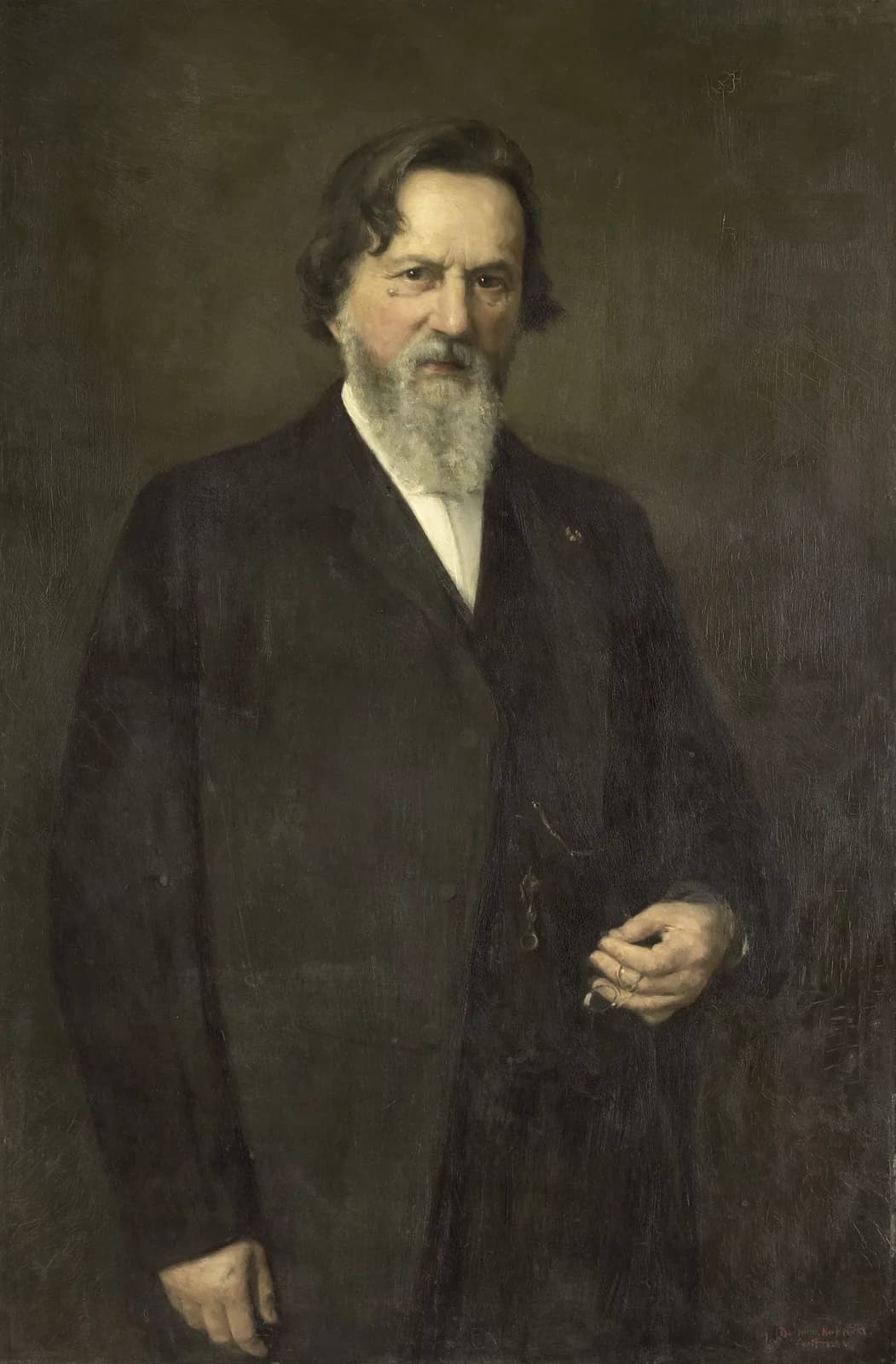
The Van Helsing most people can picture wears a long coat, carries a crossbow and kicks a door in. Bram Stoker’s Van Helsing is an elderly Dutch academic who arrives by train from Amsterdam because a former student wrote to him about a patient he could not diagnose, and whose first day in the book is one careful examination of one patient, a refusal to say what he thinks, and the evening train home.
- He is introduced in a letter. Praised for his mind before anyone has seen him do anything.
- He is a doctor and a lawyer. He says so himself, in chapter XIII.
- He talks strangely on purpose.Stoker writes his English as a Dutchman’s second language.
- The crossbow arrived in 2004.Universal’s film invented the monster hunter wholesale.
The one rule of his that everybody does know, that the Count cannot enter a house uninvited, has its own essay on this hub and is not re-argued here. If you would rather sit the night watch with him than read about him, the playable Dracula opens the sickroom at Hillingham as one of its doorways.
🎓 The short answer: he arrives as a reference
Seward has a patient he cannot explain. He has taken blood, run a qualitative analysis, found nothing, and concluded the cause must be mental. So he writes to Amsterdam, to a man he describes as his old friend and master, who knows as much about obscure diseases as anyone in the world. Then, in a letter to Arthur Holmwood explaining who this stranger is, he gives the character description the rest of the novel has to live up to.
“He is a philosopher and a metaphysician, and one of the most advanced scientists of his day; and he has, I believe, an absolutely open mind.”
The list goes on for another four lines, and the order it comes in is the point. Philosopher, metaphysician, scientist, open mind. An iron nerve appears fifth, in the middle of a run of temperament words, and the sentence ends on the kindliest and truest heart that beats. Nothing in the introduction suggests a fighter. It reads like a reference letter, because it is one.
📜 Professor, doctor, and lawyer as well
The letters give him more qualifications than anyone else in the book. Seward’s letter to Amsterdam gets a reply in chapter IX headed “Letter, Abraham Van Helsing, M. D., D. Ph., D. Lit., etc., etc., to Dr. Seward”. Seward, who runs an asylum, is headed “John Seward, M.D.” and nothing else.
Stoker keeps adding to that list in passing, usually when the plot needs one. After Lucy dies, Seward worries that his Dutch colleague will mishandle English legal formalities. Van Helsing takes no offence, and does not explain at length.
“I know; I know. You forget that I am a lawyer as well as a doctor.”
He then seals the dead woman’s papers, avoids the coroner deliberately, and takes on the night watch himself. That combination, the man who knows both what the law requires and how to work around the parts of it that would slow him down, is the actual shape of his competence. Nobody in the novel would pick him for a fight. He is the one who has read the most and is willing to act on what he has read.
His practical equipment matches. The garlic he hangs at Lucy’s window comes all the way from Haarlem, because he ordered it in advance, from home, before he knew for certain he would need it. That is a man who packs for a hypothesis.
🗣️ Why he talks like that
Modern readers frequently find Van Helsing’s dialogue hard going, and it is worth knowing that this is deliberate. Stoker writes him in broken, over-formal English, with the word order of a man thinking in Dutch and translating as he speaks. He says that Arthur’s nerves are not so calm and his blood not so bright as a young man’s. He confesses cheerfully that he cannot read shorthand. He calls Mina Madam Mina for the whole novel.
The effect is that he is never quite in control of the register, and that turns out to matter. The most unsettling scene he gets is not a confrontation with a vampire. It is the carriage ride back from Lucy’s funeral in chapter XIII, where he laughs until he cries at the thought that four men gave her blood and Arthur believes it made them married, which would make her a polyandrist and the professor himself a bigamist. Seward calls it a fit of hysterics. Van Helsing denies that and calls it his sense of humour asserting itself under very terrible conditions, then apologises for showing it, and explains that he only shows it to the one friend he trusts.
Nobody in the 2004 film does anything like that.
🏹 The 2004 film that gave him a crossbow
Universal’s Van Helsing, directed by Stephen Sommers and released on 7 May 2004, stars Hugh Jackman as an agent of the Knights of the Holy Order, a secret Vatican organisation that dispatches him across Europe to kill monsters. He is armed, among other things, with an automatic crossbow. The film is enjoyable and it is not an adaptation of anything Stoker wrote. It borrows a name and a job description that the novel never gives him, and it changes his age, his nationality, his employer and his method.
The reason the change stuck is that it solved a problem. A story about a professor who is right early is difficult to film, because being right early looks like sitting in a chair. A story about a man with a crossbow is easy to film. Universal’s 2004 film is the far end of that logic, and the pull towards it is why readers who arrive at the novel from the screen spend the middle third waiting for the professor to do something.
🕯️ What he is actually good at
His real skill is saying an unbelievable thing out loud, in front of professional colleagues, before he can prove it. He is a scientist in a room full of scientists and he is about to tell them that a corpse is walking. Everything he does before that moment is preparation for being disbelieved: he gathers the evidence, he brings witnesses, he makes them look. His long refusal to name the diagnosis while Lucy is still alive, which a companion post takes up in full, is the cost of that method rather than a lapse in it.
He is also, in one speech in chapter XVIII, the character who pays Mina Harker the highest compliment in the novel and uses the same breath to send her away from the danger. Whether that speech is admiration or containment is the subject of another essay here.
Read him as a doctor rather than a warrior and the character stops being slow. The whole text is free at Project Gutenberg and he does not appear until chapter IX, which is worth knowing before you start looking for him.
Sources
- Dracula (1897 text) — Project Gutenberg
- Van Helsing (2004 film) — Wikipedia
- Van Helsing — review — Plugged In
Frequently asked questions
- Is Van Helsing an action hero in the original Dracula book?
- No. Seward's letter in chapter IX introduces him as a philosopher and a metaphysician with an absolutely open mind, and an iron nerve appears fifth in that list. The one violent thing he does in the whole novel he calls butcher work in his own memorandum, and he adds that he trembles at the memory of it.
- What is Van Helsing's real job in Dracula?
- A professor and medical doctor from Amsterdam who specialises in obscure diseases, called in as a consultant on a case a former student cannot diagnose. He is also under an obligation. His reply in chapter IX reminds Seward that he once sucked the poison of gangrene out of Van Helsing's wound, and that is why he drops everything: it is to you that I come.
- Why does Van Helsing talk so strangely in Dracula?
- Stoker writes his English as a Dutchman's second language, with inverted word order and unusual tenses, and sustains it for the whole novel. It is characterisation, not error, and he never lets it slip. The single address Madam Mina occurs seventy-nine times across the twenty-seven chapters, and twenty-five of those are in the last chapter alone.
- Is the 2004 Van Helsing movie based on the book?
- Only the name and the vampire-hunting role. Sommers's film makes him a young agent of a secret Vatican order, sent across Europe with an automatic crossbow. Stoker's arrives by train and asks Seward to book him rooms at the Great Eastern Hotel, so that I may be near to hand. The campaign against the Count is run from a London railway hotel.
- Does Van Helsing kill Dracula?
- No. He destroys the three women in the castle and directs the hunt, but the blow is not his. In chapter XXVII Jonathan's kukri shears through the throat while Quincey Morris drives a bowie knife into the heart, and Morris dies of a knife wound minutes later. The closing note records that the Harkers' son was born on that anniversary, and they call him Quincey.
Enjoyed this one?