Who's Who in Pride and Prejudice: a Character Guide to the Bennets, the Bingleys and Everyone Else
Two rich single men arrive in the same neighbourhood in the same season, and only one of them owns land. The cast of Pride and Prejudice, with the numbers Austen actually gives.


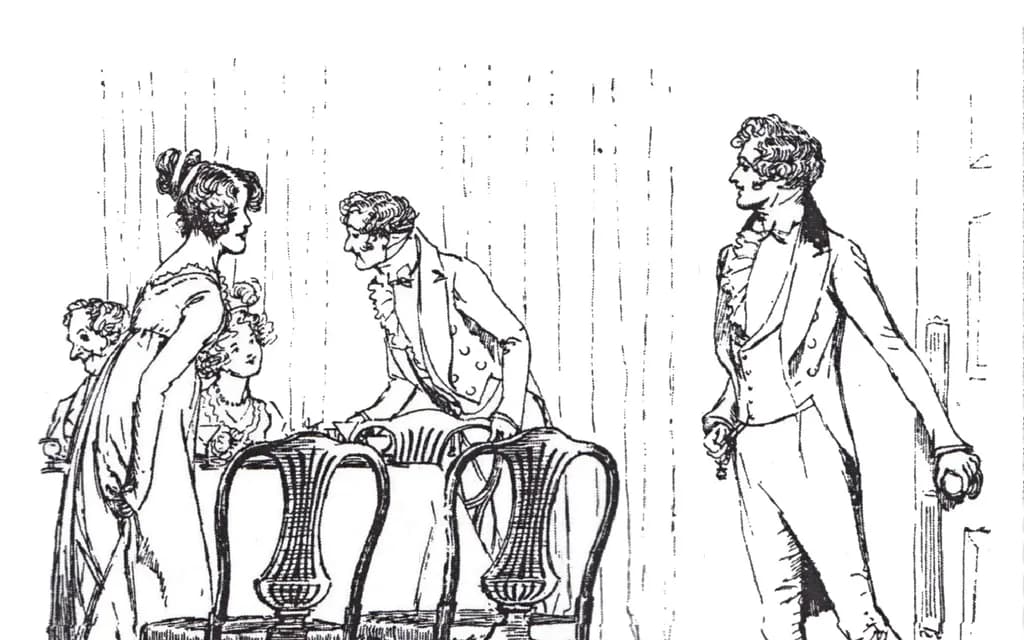
Two rich single men arrive in the same neighbourhood in the same season, and Pride and Prejudice never once lets you forget that only one of them owns land. Almost every relationship in the book runs along a line drawn by money and rank, and most of those lines are stated outright in the first four chapters. This is the cast, with the numbers attached.
- Darcy: ten thousand a year.Land, a great house, and an income roughly twice Bingley's.
- Bingley: four or five thousand a year. A hundred thousand pounds inherited, and no estate at all.
- Mr. Bennet: two thousand a year, entailed away. Five thousand pounds was settled on his wife and children: one thousand each, once both parents are dead.
- The Bingley sisters: twenty thousand pounds. From trade, which they would rather not discuss.
Below is the whole cast in order of how much they matter to the plot, with the chapter each fact comes from. If you would rather meet them, the playable Pride and Prejudice drops you into Longbourn with all of them already in the room.
💷 The short answer: the money is the plot
Chapter one gives Bingley four or five thousand a year, and Mrs. Bennet knows the figure before she knows his first name. Chapter three gives Darcy ten thousand, reported around the assembly room within half an evening. Chapter seven gives Mr. Bennet two thousand from an estate entailed away from his own children in default of a male heir, and chapter fifty supplies the other half of that sum: five thousand pounds settled by marriage articles on Mrs. Bennet and the children, an equal share each once both parents are gone.
Those three numbers are the novel's engine. They decide who may marry whom without comment, who is marrying up, and which family is one funeral away from losing its house. Elizabeth's entire expectation is one thousand pounds in the four per cents, payable only after her mother dies, and we know that because Mr. Collins tells her so during his proposal, in the tone of a man being generous about it.
Rank is not the same as money, which is the distinction modern readers most often miss. When Lady Catherine tries to place Elizabeth beneath her nephew, Elizabeth's answer is not about income: he is a gentleman and she is a gentleman's daughter, and so far they are equal. She is right, and Lady Catherine has no reply to it.
🏠 The Bennets
Five daughters, no son, and an estate that will pass to a cousin. Jane, the eldest, is the beauty and the one who thinks well of everyone, which is a real limitation as well as a virtue. Elizabeth, the second, is twenty and tells Lady Catherine so; she is the novel's intelligence and also its most confident wrong opinion.
Mary is the middle daughter who has decided that accomplishment is a substitute for beauty and practises it grimly. Kitty is two years older than Lydia and follows her everywhere, which the novel treats as the whole of her character until the last chapter quietly rescues her. Lydia is fifteen when we meet her, and her story is the subject of its own essay.
Having five daughters out in society at once is itself a social statement, and the novel makes someone say so. At Rosings, Lady Catherine is startled to learn that all five Bennet sisters are out while the eldest is still unmarried, and calls it very odd for a youngest to be in company before the elder ones are settled. It is one of the few moments where her rudeness is also a description of the family's actual problem.
Mr. Bennetis clever, detached and funny at his family's expense, and the novel gradually stops finding him funny. Mrs. Bennet is loud, embarrassing and correct about the emergency; the case for her is made in full elsewhere. Her own four thousand pounds came from a Meryton attorney, her sister married the clerk who took over that practice, and her brother is in trade in London, which is exactly the kind of family connection Darcy holds against her daughters.
🧾 The Bingleys are not quite what they look like
Chapter four is the most useful page in the book for understanding the social geometry, and almost nobody remembers it. Bingley inherited nearly a hundred thousand pounds from a father who meant to buy an estate and died before he did it. Bingley means to buy one too, and keeps not doing it, so at Netherfield he is a tenant rather than a landowner.
His sisters have a fortune of twenty thousand pounds, were educated at one of the first private seminaries in town, spend more than they should and associate with people of rank. Austen then lands the sentence the whole family is organised around: they are of a respectable northern family, a fact more deeply impressed on their memories than that their brother's fortune and their own had been acquired by trade.
That one clause explains two things at once. It explains Caroline Bingley's contempt for the Bennets, which is the contempt of someone standing on a rung she has only just reached. It also explains why Bingley takes Darcy's advice about Jane instead of trusting his own judgement: Darcy is the landed friend, and the Bingleys have been borrowing his standing since school.
📖 The line everyone quotes as if Austen meant it
Caroline Bingley is the source of the most-quoted sentence about reading in English literature, and it is a joke at her expense. In chapter eleven she picks up a book, having chosen it only because it is the second volume of the one Darcy is reading, spends the evening watching his page instead of her own, and finally gives up.
“How pleasant it is to spend an evening in this way! I declare, after all, there is no enjoyment like reading! How much sooner one tires of anything than of a book! When I have a house of my own, I shall be miserable if I have not an excellent library.”
Austen's next two sentences are the punchline. Nobody answers her. She yawns again, throws the book aside, and looks round the room for something else to do. The speech is a performance of literacy by a woman who has just failed to read for twenty minutes.
In 2017 the Bank of England put the middle of it on the Jane Austen ten pound note, which entered circulation on 14 September that year. The Guardian pointed out the problem the same summer under the headline “strange choice of quotation.” It is a small, permanent monument to reading half a chapter.
👥 Everyone else, briefly
Mr. Collins is the cousin who will inherit Longbourn, a clergyman with a patroness he cannot stop mentioning. Charlotte Lucasis Elizabeth's closest friend and marries him, for reasons the novel makes unanswerable. Lady Catherine de Bourghis Darcy's aunt, Collins's patroness, and the book's one straightforwardly rude aristocrat.
George Wickham is the officer with a grievance and a story about Darcy, and the record of what he actually does is worth reading before you believe him. Colonel Fitzwilliamis Darcy's cousin, charming and candid, and useful to the plot because he tells Elizabeth something Darcy would not.
Mr. and Mrs. Gardiner are the London relations in trade whom Darcy is supposed to look down on and instead finds he likes; they are also the two competent adults in the book. Georgiana Darcy is his younger sister, more than ten years his junior, shy rather than proud. Mrs. Reynolds, the housekeeper at Pemberley, gets about a page and changes Elizabeth's mind more than anyone except Darcy himself.
Every figure above was checked against the free text at Project Gutenberg, in the 1894 edition illustrated by Hugh Thomson. For the two scenes where all of this money turns into an actual conversation, the two failed proposals are compared here, and for the versions of this cast you have probably seen on screen, the adaptations are ranked here.
Sources
- Pride and Prejudice (1894 George Allen edition) — Project Gutenberg
- Bank of England £10 note — Wikipedia
- Entail, Elopement, and Marriage Law in Pride and Prejudice — Persuasions On-Line, Jane Austen Society of North America
Frequently asked questions
- How rich is Mr Darcy compared to Mr Bingley?
- About twice as rich, and differently rich: ten thousand a year from land against four or five thousand drawn from capital. Chapter IV adds the man nobody counts. Bingley's elder sister Louisa married Mr Hurst, described there as a man of more fashion than fortune, which is the household's third position and the least secure of the three.
- Are the Bingleys landed gentry?
- Not yet. Chapter IV says their fortune was acquired by trade, and Bingley's father died before buying the estate he meant to buy. At Netherfield the son is a tenant, and he says himself that if he resolved to quit it he should probably be off in five minutes. A landowner cannot leave in five minutes.
- Who is Caroline Bingley in Pride and Prejudice?
- Bingley's unmarried sister, twenty thousand pounds, and the novel's sharpest social climber. The last chapter settles her: too deeply mortified by Darcy's marriage to keep up the quarrel, she dropped the resentment and paid off every arrear of civility to Elizabeth. Austen lets her stay in the family and makes her pay the bill.
- Whose line is on the Jane Austen £10 note?
- Caroline Bingley's. The Bank of England's Austen note entered circulation on 14 September 2017 carrying I declare after all there is no enjoyment like reading. The novel's own serious line about reading belongs to Darcy, three chapters earlier: an accomplished woman must add the improvement of her mind by extensive reading.
- How many Bennet sisters are there?
- Five: Jane, Elizabeth, Mary, Kitty and Lydia. Mary is the one the book is hardest on. At the Netherfield ball in chapter XVIII she is still singing when her father stops her in front of the whole room: that will do extremely well, child, you have delighted us long enough. Nobody defends her.
- Who are the Gardiners in Pride and Prejudice?
- Mrs Bennet's brother and his wife, London relations in trade. Austen puts the address in chapter XXV: Mr Gardiner lived by trade and within view of his own warehouses, which is exactly the fact the Netherfield ladies would have had difficulty in believing, given how well-bred and agreeable he turns out to be.
Enjoyed this one?