Romeo and Juliet Ending Explained: What Happens in the Tomb
The play's last scene is one location and a few minutes. The confusing part is the order of who knows what, and when.


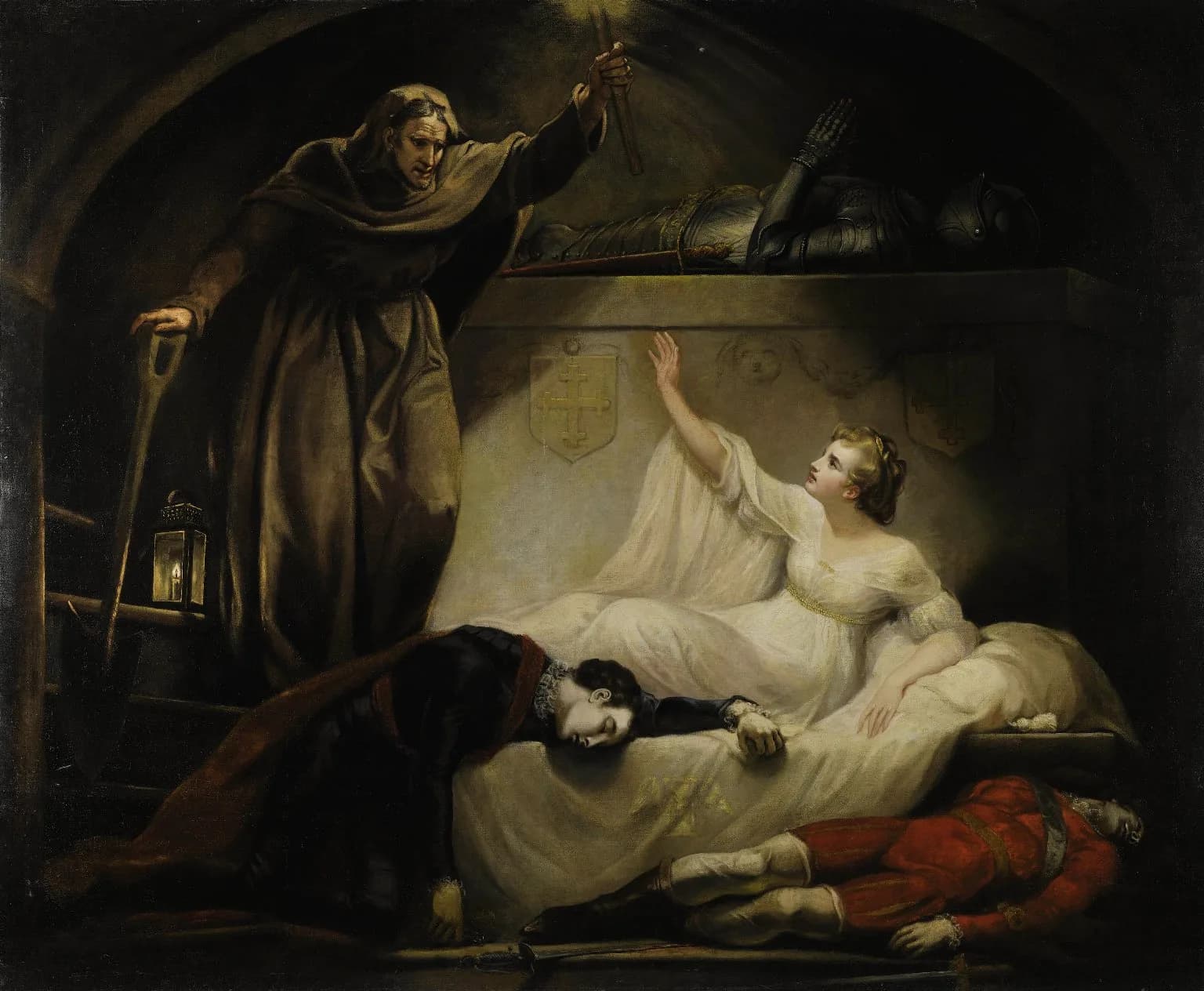
Spoilers for the whole of Romeo and Juliet, scene by scene through the tomb.
The Prologue tells you both lovers die, so the confusion readers bring to this scene is about order: who knew what, and when. The last minutes in the vault are a doorway in the playable Romeo and Juliet, and playing them makes the timing obvious in a way a summary cannot.
⚰️ What happens in the tomb at the end of Romeo and Juliet?
Three people die in Act 5, Scene 3, in this order. Paris, who came to strew flowers at Juliet’s grave, fights Romeo at the door of the monument and is killed, asking with his last breath to be laid beside her. Romeo carries him inside, speaks to Juliet’s body, drinks the poison and dies. Then Juliet wakes, finds him, and kills herself with his dagger.
The stage direction that matters most comes right after Romeo’s death: Friar Laurence enters at the other end of the churchyard with a lantern, a crowbar and a spade. He is minutes late, and the scene is built so the audience watches him arrive just after there is nothing left to save.
📨 What Romeo hears in Mantua, and what he does not
Act 5 opens with two pieces of news travelling in opposite directions. Romeo’s servant Balthasar rides to Mantua and tells him what the whole city believes, that Juliet’s body sleeps in the Capulet monument. Romeo answers by defying the stars, sends for horses, and goes to buy poison from a poor apothecary he remembers.
The other message never leaves Verona. Friar John, carrying Laurence’s letter that explains the sleeping draught, was shut up by the town’s searchers in a house suspected of the pestilence, and he brings the letter back undelivered. Whether the Friar should have trusted one messenger is the subject of the case against Friar Laurence; this page is only following the clock.
🕯️ Juliet wakes too late
The Friar has been told by Balthasar that Romeo has been inside the tomb for a full half hour. He goes in, finds Romeo pale and Paris in his blood, and in the same speech notices the lady stirring. Juliet wakes calmly, remembers exactly where she is supposed to be, and asks the first question anyone would ask.
“O comfortable Friar, where is my lord? I do remember well where I should be, And there I am. Where is my Romeo?”
He tells her that her husband lies dead, offers to place her in a sisterhood of nuns, hears the watch coming and runs, and she refuses to go with him. Alone, she finds the cup in Romeo’s hand and kisses him hoping for poison on his lips, and notices that his lips are still warm. That one line is the cruelty of the timing in four words. When the watch is heard outside she takes his dagger, calls it happy, and falls on his body.
🏛️ The fathers and the golden statues
The watch fetches the Prince, the Capulets and Montague, who reports that his wife has died that same night of grief over their son’s exile. Friar Laurence, promising to be brief, tells the whole story, and the Prince turns it on the two families: see what a scourge is laid upon your hate. The question of who carries the most guilt is argued in the essay on the parents, and the play itself stops short of a verdict.
Capulet offers his hand to Montague and calls it his daughter’s jointure. Montague answers that he will raise a statue of Juliet in pure gold, and Capulet promises Romeo one as rich to lie beside it, the two children turned into matching monuments. The Folger Shakespeare Library’s edition and the Project Gutenberg text both close on the Prince’s six lines about a glooming peace and a story of more woe.
- The order is Paris, Romeo, Juliet. All three die in the same scene, at the same monument, within a few minutes.
- The Friar arrives in between.He enters the churchyard right after Romeo’s death and is inside when Juliet wakes.
- The feud ends over the bodies. A handshake and two promised statues, after Lady Montague has also died offstage.
Sources
- Romeo and Juliet (Project Gutenberg eBook #1513) — Project Gutenberg
- Romeo and Juliet — Folger Shakespeare Library
- Romeo and Juliet — Wikipedia
- Friar Laurence — Wikipedia
Frequently asked questions
- What makes the ending of Shakespeare's 'Romeo and Juliet' confusing?
- The signs that Juliet is alive are spoken aloud and ignored. Standing over her, Romeo says "Beauty's ensign yet / Is crimson in thy lips and in thy cheeks" and that death's pale flag has not advanced there. He reads the colour as a miracle of beauty, not as breathing, and drinks the poison anyway.
- What were Juliet's last words before she died?
- "This is thy sheath. There rest, and let me die." She says it as she stabs herself with Romeo's dagger, speaking to the blade and treating her own body as its sheath. The stage direction that follows has her fall on Romeo's body and die, moments before the watch enters the tomb.
- Did Juliet kiss Romeo when he died?
- Yes, and she means it as a way to follow him. Finding the empty cup, she says "I will kiss thy lips. Haply some poison yet doth hang on them, To make me die with a restorative." There is not enough left to kill her, so she reaches for his dagger instead.
- What does Romeo say before he kills himself?
- He says goodbye to her body piece by piece, then toasts her. "Eyes, look your last. Arms, take your last embrace!" comes first, and as he drinks he says "Here's to my love! O true apothecary! Thy drugs are quick. Thus with a kiss I die." He dies kissing a wife who is minutes from waking.
- Who ends the feud at the end of Romeo and Juliet?
- The two fathers do, under the Prince's rebuke. The Prince admits his own share, having "lost a brace of kinsmen" by winking at their discords, and tells them "All are punish'd." His last order promises a judgement still to come: "Some shall be pardon'd, and some punished."
Enjoyed this one?